


















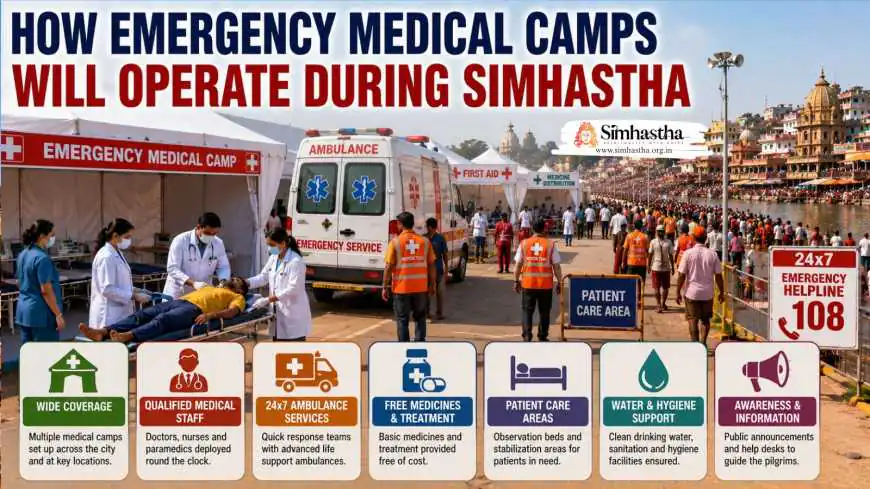
How Emergency Medical Camps Will Operate During Simhastha
Learn how emergency medical camps will operate during Simhastha 2028 with a 550-bed Medicity, water ambulances, rapid response teams, and AI-powered command centers for pilgrim safety.

When Faith Meets Healthcare: The Medical Masterplan for 40 Crore Pilgrims
Let me be completely honest with you. 🙏
A gathering of 40 crore devotees—that's more than the population of the United States—presents a medical challenge that sounds almost impossible to tackle. 🏥
You're walking through the crowded streets of Ujjain. The air is thick with the sound of conch shells and the scent of incense. Suddenly, a family member feels faint. Or a child gets separated and injured. Or an elderly devotee suffers a heatstroke. In the chaos of millions, what happens next? Who do you call? Where do you go? 😰
This is the nightmare scenario that keeps every pilgrim awake at night. And it's precisely why the Madhya Pradesh government, in collaboration with the Central Government and multiple agencies, has built one of the most sophisticated emergency medical response systems ever deployed at a religious gathering. 🚑
Trending Guides Now

How Ujjain’s New Bridges & Bypasses Will Reduce Simhastha Traffic in 2028

How Smart City Projects Are Reshaping Ujjain

New Railway Upgrades Planned Before Simhastha 2028

How Ujjain's Bus Network May Expand Before 2028

Ujjain Railway Station to Mahakaleshwar Temple Distance (2026 Guide)

Ujjain Simhastha 2028 Dates Announced: Full Shahi Snan & Event Timeline
Ujjain Railway Station to Gadkalika Temple: Distance, Auto Fare and Route
Ujjain Railway Station to Mangalnath Temple: Distance, Auto Fare and Best Route
In this article, we'll pull back the curtain on how emergency medical camps will operate during Simhastha 2028. From the massive 550-bed Medicity to the unprecedented water ambulances on the Shipra River, from rapid response teams trained in CPR to AI-powered command centers that can predict medical emergencies before they happen—this is the blueprint for saving lives during one of the world's largest spiritual events. 🌟
The Crown Jewel: Ujjain's 550-Bed Medicity
₹592 Crore Investment in Healthcare Infrastructure
Let's start with the big one. In November 2024, Chief Minister Mohan Yadav performed the bhoomi pujan (ground-breaking ceremony) for Madhya Pradesh's first Medicity and Medical College in Ujjain, a monumental project worth ₹592.30 crores .
The vision is clear: This 550-bed Medcity is being constructed specifically to serve the massive influx of devotees during Simhastha 2028 . But this isn't just a temporary facility—it's a permanent addition to Ujjain's healthcare landscape.
What's inside:
-
A full-fledged Medical College with residential arrangements for doctors, paramedical staff, and other personnel .
-
Advanced medical facilities comparable to the best in India.
-
A Medical Device Park to support cutting-edge healthcare delivery .
-
High-rise design maximizing space utilization on 14.97 acres of land .
The "Medicity" concept is a first for Madhya Pradesh, designed to establish Ujjain "globally in the health sector" under the divine guidance of Lord Mahakal .
The "Clean and Healthy Simhastha" Vision
Chief Minister Yadav has defined the primary baseline of the Simhastha as a "clean and healthy Simhastha" . This isn't just rhetoric—it's a commitment backed by concrete action:
-
The Health Department will implement disaster management plans with a specific emphasis on cholera prevention, trauma care, and emergency services .
-
Temporary hospitals and health camps will work in tandem with the Medicity to ensure comprehensive coverage across the entire mela area .
The goal? To create a healthcare network so robust that no devotee—regardless of location—is more than a few minutes away from emergency care.
The Four-Layer Approach: How Medical Care Will Reach Everyone
Layer 1: The Medicity and Permanent Hospitals
The Medicity and existing Ujjain hospitals form the "hub" of the emergency response system. These facilities will handle:
-
Complex trauma cases and surgeries

-
Intensive care for critically ill patients
-
Referral services from smaller health camps
-
Specialized treatments requiring advanced equipment

Layer 2: Temporary Hospitals and Health Camps
Scattered across the Simhastha area, temporary hospitals will serve as the second layer of care, handling moderate cases and performing triage . These camps will be positioned at strategic locations:
-
Near major ghats and bathing areas
-
Around the Akhara camps where thousands of sadhus congregate
-
At the edge of the tent cities housing millions of families
Layer 3: Rapid Medical Response Teams (RMRT)
This is where the response becomes truly dynamic. Taking inspiration from the Nashik Simhastha Kumbh, where rapid medical response teams were deployed for immediate healthcare services to devotees , Ujjain is building a similar system.
Key positions for Rapid Response Teams:
-
Sadhugram (the spiritual hub)
-
Ghats and bathing areas
-
Parking areas and transport hubs
-
Railway stations and bus stands
-
Akhara sites and their camps
-
Major tourist spots and religious sites

Triage Protocols: Hospital staff will be trained in triage—the process to assess patients, casualties, and decide priority of treatment based on the severity of the incident . This ensures that the sickest patients receive immediate attention even when resources are stretched.
Layer 4: Integrated Emergency Response Coordination
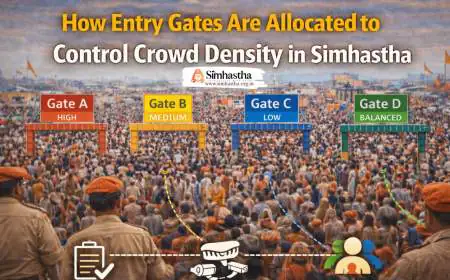
The lynchpin holding these layers together is the AI-powered Digital Command Centre .
Built at a cost of ₹139 crore, this "security and emergency response facility" will run on artificial intelligence platforms, integrated with CCTV feeds across the municipal boundaries and predictive crowd-mapping software to prevent stampedes .
How this matters for medical emergencies:
-
When someone collapses, the command center knows about it instantly.
-
The AI predicts where crowds are densest and positions medical teams pre-emptively.
-
Emergency responders—security, fire safety, and medical first responders—receive integrated disaster management training to coordinate rescues through this central operations room .
It's like having a guardian angel watching over every pilgrim, 24/7.
Water Ambulances: A First on the Shipra River
Learning from Prayagraj's Mahakumbh
Here's something truly innovative. For the first time in Ujjain's history, water ambulances will be deployed on the Shipra River at 3–4 locations .
The Inspiration: Ujjain officials, including Collector Neerajkumar Singh and SP Pradeep Sharma, visited Prayagraj to study the Mahakumbh's arrangements and returned with a treasure trove of best practices .
How water ambulances work:
-
They will be stationed at 3-4 strategic points along the Shipra River .
-
These ambulances quickly transport patients to emergency routes, bypassing crowded areas .
-
They're ideal for rescuing elderly or ill devotees who may suffer heatstroke or fainting during the holy dip.
Why this matters: During Simhastha, the ghats will be packed with millions of devotees taking the sacred dip. If someone collapses in the water, getting a stretcher through the crowd to a road ambulance could take minutes—minutes that could cost a life. Water ambulances bypass the crowd entirely.
A Multimodal Emergency System
The water ambulances are part of a multimodal emergency response system that includes:
-
Road ambulances stationed across the mela area
-
Air ambulances for rapid evacuation of critical patients
-
Helipads being developed for airlift operations
Chief Minister Yadav has already directed the construction of a helipad at Omkareshwar to support emergency services and air ambulance operations . This multi-modal approach ensures that no patient is ever stranded.
Training the First Responders
Six-Day Police Training: CPR and First Aid
Here's a statistic that should give you confidence: The Madhya Pradesh Police Headquarters launched a six-day special training programme to train 100% of the personnel earmarked for Simhastha duty .
The medical component:
-
Training in CPR (cardiopulmonary resuscitation) and first aid will be provided in collaboration with the Chief Medical and Health Officers .
-
Expert officers from the Bomb Disposal Squad (BDDS), Quick Response Force (QRF), Special Task Force (STF), and Home Guard have been integrated into the training process .
The full training curriculum covers:
-
Traffic planning and Green Corridors (dedicated routes for emergency vehicles)
-
Disaster management protocols
-
CCTV surveillance systems and radio communication networks
-
Quick Response mechanisms
Every single officer who will be on duty during Simhastha will be trained to handle medical emergencies. The police aren't just there for crowd control—they're your first line of medical response.
Disaster Management Training for Hospital Staff
Beyond police, hospital employees will receive specialized training to handle the unique challenges of a mega-gathering .
Key training focus areas:
-
Triage protocols to assess patients and decide priority of treatment .
-
Hospital safety—including fire safety, oxygen supply management, and patient relocation procedures .
-
Disaster preparedness for potential scenarios: epidemics, floods, road accidents, and even possible stampedes .
The training is being conducted in collaboration with the National Institute of Disaster Management and the Yashwantrao Chavan Academy of Development Administration .
Crowd-Specific Medical Preparedness
The Ghat Challenge: Managing Millions at the Water's Edge
The ghats—where millions will take the sacred dip—present the highest medical risk. Rapid response teams will be positioned at these locations .
Specific measures:
-
Life-saving equipment at every major bathing ghat
-
Personnel with specialized training in drowning rescue
-
Water ambulances stationed offshore
-
Shaded rest zones with drinking water to prevent heatstroke
The administration has been instructed to create a comprehensive action plan ensuring that "people have to walk a minimum distance" from parking to the ghats to prevent exhaustion .
Akhara Camps: Care for the Seers
The 13 Akharas, housing thousands of Naga Sadhus and seers, will have dedicated medical units . This is critical because these camps are often located on the outskirts of the main mela area, far from central facilities.
Rapid response teams will visit these camps daily to:
-
Check for health issues among the elderly sadhus
-
Provide immediate care for injuries from martial arts displays
-
Prevent the spread of communicable diseases in densely populated camps
Children and Elderly: High-Risk Groups
With families attending Simhastha, children and the elderly are high-risk groups. The medical camps are being designed to cater specifically to:
-
Pediatric emergencies: Children separated from families, dehydration, and injuries
-
Geriatric care: Elderly devotees with pre-existing conditions like diabetes, hypertension, and heart disease
Senior citizens are being recommended to avail of the air ambulance services for critical evacuation . The integrated ambulance network ensures that no vulnerable pilgrim is left behind.
Preventive Health: Cholera and Epidemic Control
Lessons from Past Kumbhs
One of the biggest health risks at any mass gathering is the spread of waterborne diseases. The Health Department is implementing disaster management plans with an emphasis on cholera prevention .
Measures include:
-
Ensuring that drinking water at holding hubs and tent cities meets safety standards
-
Sanitation infrastructure (bio-toilets, mobile toilets) to prevent open defecation
-
Health camps conducting daily screenings
The Shipra River itself is being cleaned, and for the first time in nearly six decades, devotees will be able to bathe in the river's actual waters rather than relying on diverted water or other sources .
CSR Support for Healthcare Infrastructure
The government is also seeking Corporate Social Responsibility (CSR) support for key health facilities, with the overall requirement for identified healthcare and sanitation services estimated at over ₹200 crore .
CSR-backed initiatives include:
-
500 water ATMs (₹10 crore) to provide safe drinking water
-
1.5 lakh mobile toilets (₹50 crore) to maintain hygiene
-
2,000 changing rooms for women at ghats (₹6 crore)
-
Temporary medical facilities and river cleaning projects
The Bottom Line: A System Designed for Every Pilgrim
So, how will emergency medical camps operate during Simhastha? Through a meticulously designed, four-layer system that ensures every devotee—regardless of location, age, or condition—receives timely medical care.
Here's what it looks like in action:
-
If a child gets injured near the ghat, the rapid response team at that ghat provides immediate first aid and, if needed, arranges transport via water ambulance to bypass crowds. 🚑
-
If an elderly devotee suffers a heart attack at the Mahakal Lok Corridor, the AI-powered command center identifies the emergency, dispatches the nearest ambulance, and coordinates with the Medicity for rapid admission. 🏥
-
If a heatwave hits the tent city, preventive health teams distribute water, set up cooling stations, and monitor for early signs of heatstroke. 🌡️
The numbers speak for themselves:
-
₹592 crore Medicity with 550 beds
-
₹139 crore AI-powered command center
-
42,000 police personnel trained in emergency response
-
Water ambulances deployed for the first time in Ujjain's history
-
148 ongoing development projects worth ₹16,910 crore
The message is clear: The authorities are not leaving your health to chance. They're building a medical fortress designed to handle the unprecedented demands of 40 crore devotees. Your responsibility is to stay aware, follow safety guidelines, and trust that a dedicated team of doctors, police, and emergency responders are working 24/7 to keep you and your family safe. 🕉️
Frequently Asked Questions