































Indian Railways Unveils Mega Crowd Control Plan for Simhastha 2028
Indian Railways prepares massive crowd control plan for Simhastha 2028 in Ujjain. 5 satellite stations, ₹600 crore bypass lines, 100 special trains, AI-powered surveillance to handle 1 crore passengers daily. Full details inside.



The Countdown Begins: Simhastha 2028 Gets Its Biggest-Ever Makeover
In less than two years, the historic city of Ujjain will transform into the world's largest temporary city. Come 2028, an estimated 14 crore devotees will descend upon the banks of the Kshipra River for the Simhastha Mahakumbh—a spiritual spectacle that occurs once every 12 years.
And this time, nothing is being left to chance.
The Indian Railways, learning from past experiences and particularly from the massive success of the Prayagraj Kumbh, has unveiled a staggering crowd control blueprint. This is not just about laying extra tracks. This is a full-scale war room strategy, designed to handle a daily influx of up to one crore passengers while ensuring that not a single pilgrim feels lost or unsafe.
From building five dedicated satellite railway stations to deploying AI-powered drones for real-time monitoring, the plan for Simhastha 2028 is being hailed as the most technologically advanced and logistically ambitious crowd management exercise in the country's recent history.
Trending Guides Now
Ujjain Simhastha 2028: ₹700 Crore Bypass Road Plan to Manage 30 Crore Pilgrims
Indore–Ujjain Six-Lane Highway nearing completion — big step for regional growth!

Ujjain’s New Smart City Plan for Simhastha 2028 Revealed: How 15 Crore Pilgrims Will Be Managed ?

Simhastha 2028 Preparation Status Report: What Has Been Completed in Ujjain by May 2026?

Ujjain Railway Station to Mahakaleshwar Temple Distance (2026 Guide)

Ujjain Simhastha 2028 Dates Announced: Full Shahi Snan & Event Timeline

Benefits of Becoming a Simhastha Volunteer

Ujjain Travel During Shravan Month: What Changes for Visitors
For Every pilgrims, understanding Simhastha 2028 dates and the official Shahi Snan timeline is essential before booking flights or accommodation, as these sacred dates are completely non-negotiable
Why Simhastha 2028 Is A Different Beast Altogether
Before we dive into the specifics of the railway plan, it is important to understand the scale of the challenge. The Simhastha Kumbh at Ujjain is unique.
Unlike the Kumbh at Prayagraj or Haridwar, which happen on riverbanks in wide, open plains, Ujjain is a dense urban city. The Kshipra River flows right through the middle of it. This means the pressure points are far sharper and the margins for error are much smaller.
To put it in perspective, the Madhya Pradesh government has already earmarked over ₹3,060 crore in the 2026–27 budget exclusively for infrastructure upgrades. But that figure balloons to over ₹20,000 crore when you include all the road, metro, and utility projects currently underway. The goal is simple: to turn Ujjain into a global spiritual hub while keeping the pilgrims safe, hydrated, and connected.
The Masterstroke: Railways' ₹600 Crore Bypass Lines
The jewel in the crown of the crowd control strategy is the plan to divert heavy traffic away from the main Ujjain Junction. During the Shahi Snan (holy bathing) days, the city will be bursting at its seams. If regular trains passed through Ujjain Junction, the entire system would grind to a halt.
To solve this, the Indian Railways has approved a massive ₹600 crore project to build dedicated railway bypass lines at two critical junctions—Nagda and Ujjain.

Here is how it will work. During peak days, all long-distance trains and freight trains will bypass the city entirely. Instead of crawling through the crowded station, they will be rerouted through these newly constructed bypass corridors. This frees up precious platform capacity at Ujjain station exclusively for special Simhastha trains.
Railway officials have confirmed that this bypass system will be operational well before the first Shahi Snan in 2028. Regular train passengers who are not heading to the fair will not even have to slow down. They will simply glide past Ujjain on the new lines, while pilgrims get off smoothly at designated points.
5 Satellite Stations: Your Gateway To The Kumbh
This is perhaps the most practical and people-friendly part of the entire plan. The Indian Railways has identified and begun upgrading five satellite railway stations around Ujjain to act as secondary entry and exit points.
Think of them as pressure release valves. Instead of forcing every single devotee to squeeze through the main Ujjain Junction, special trains will be diverted to these outer stations. From there, dedicated shuttle buses and e-rickshaws will ferry pilgrims directly to the Kshipra ghats.
Here are the five satellite stations being built or upgraded for Simhastha 2028:
-
Pingleshwar – Located on the outskirts, this station is being expanded to handle multiple special trains simultaneously.
-
Panwasa – This will serve devotees coming from the western side of the state.
-
Mohanpura – A key node for those arriving from Ratlam and Mandsaur routes.
-
Naikheda (Nayi Khedi) – Perhaps the most important of the five, this station is getting a complete makeover with wider platforms, holding areas, and direct road connectivity.
-
Shri Chintaman Ganesh – Located close to the famous Chintaman Ganesh Temple, this station will cater to devotees coming from the southern districts.
In addition to these five, the Vikram Nagar station has also received approval for an upgrade. While it is not being called a full satellite station, it will play a supporting role in managing the overflow.
Each of these stations will have holding areas where devotees can wait comfortably for their return trains. No more sitting on open tracks under the blazing sun. These holding zones will be shaded, will have water coolers, mobile charging points, and medical kiosks.
To deepen your understanding of the spiritual customs and sacred rituals practiced during Ujjain Simhastha, read our complete Simhastha rituals and sacred practices guide that explains their meaning, timing, and significance.
Foot Overbridges: The Simple Solution That Saves Lives
One of the biggest dangers during any large gathering is pedestrians walking across live railway tracks. At the Ujjain Junction, this has been a recurring problem. Thousands of devotees, unaware of train schedules or impatient to cross, often risk their lives by hopping across rails.
For Simhastha 2028, the Indian Railways is constructing multiple wide foot overbridges (FOBs) at the main station and at each satellite station. These are not the narrow, slippery bridges you sometimes see at smaller stations.
These FOBs are being designed with ramps for elderly and disabled pilgrims, and they will be wide enough to handle two-way crowds without bottlenecks. Some of them will even have travelators—moving walkways—to speed up the flow of people.
Railway sources say that the Foot Overbridge at Ujjain Junction will directly connect the platform to the main exit gate leading toward the city. This means devotees arriving at the station will not have to mix with departing crowds. The flow will be unidirectional—arrivals on one side, departures on the other.
AI, Drones & CCTV: The Tech Backbone Of Simhastha 2028
You cannot manage a gathering of 14 crore people with just whistles and barricades. You need intelligence. Real-time, actionable, predictive intelligence.
That is where Artificial Intelligence comes in.
The Madhya Pradesh government, in collaboration with the Railway Protection Force (RPF) and local police, is setting up a centralized Integrated Command and Control Center. This center will receive live feeds from over 1,200 high-resolution CCTV cameras installed across Ujjain station, all satellite stations, and the Kshipra riverfront.
But here is the difference. These cameras will not just record. They will think.
AI algorithms will track crowd density in real time. If a platform exceeds safe capacity, the system will automatically flag it. If a crowd starts moving in the wrong direction—for example, toward an exit that is closed—the AI will detect the anomaly and alert the control room instantly.
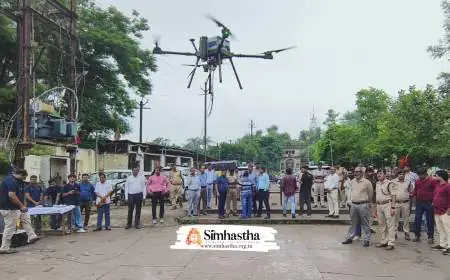
Drone surveillance will add another layer. During the Shahi Snan days, a fleet of drones will hover over the Kshipra ghats and the railway stations, providing a bird's eye view to the command center. These drones will also be used for announcements—warning crowds to disperse or guiding lost pilgrims toward help booths.
The AI system will also predict crowd buildup. By analyzing arrival patterns of trains and historical data, it will forecast exactly when and where a rush is about to happen. Security forces can then be deployed proactively, not reactively.
Also Read | Step-by-Step Guide to Shipra Snan at Ujjain Kumbh Mela
100 Special Trains & The 1 Crore Passenger Math
Numbers matter. And the numbers being thrown around for Simhastha 2028 are staggering.
Indian Railways estimates that on the peak bathing days, the system will need to handle up to one crore passengers in a single day. That is more than the population of many countries. To put it in perspective, that is roughly the entire population of Mumbai moving through Ujjain on the same day.
How do you move that many people?
You run special trains. Lots of them.
Indian Railways has announced that it will run 100 special trains daily during the Simhastha 2028 period. These will be in addition to the regular trains that are already plying on the Mumbai-Delhi and Bhopal-Indore routes.
These special trains will operate on a shuttle model—bringing devotees from major cities like Indore, Bhopal, Ratlam, Nagda, Dewas, and Shajapur directly to the satellite stations. Once the bathing rituals are over, the same shuttle trains will carry people back.
To ensure no one gets left behind, the Railways will also set up temporary booking counters at key locations. These counters will issue same-day return tickets so that pilgrims do not have to plan weeks in advance. The idea is to make the entire process as flexible as possible.
Also Read | Best Time to Visit Ujjain Simhastha 2028
Holding Areas: No More Sleeping On Staircases
Anyone who has attended a large Kumbh Mela knows the pain of arriving at a station and finding absolutely nowhere to sit. You end up sprawling on the staircase, or worse, on the platform edge.
For Simhastha 2028, Indian Railways is building dedicated holding areas at Ujjain Junction and all five satellite stations. These are not temporary tents. They are permanent structures with concrete flooring, shaded roofs, fans, water dispensers, toilets, and first-aid rooms.
The largest holding area will be at Naikheda station, capable of accommodating 50,000 devotees at once. That is roughly the capacity of a small stadium. These holding areas will also have LED screens displaying train schedules, platform numbers, and real-time crowd updates.
For women travelers, separate segregated holding zones will be available. The Railways has learned from past incidents and is taking no chances with the safety of female pilgrims. These zones will have women RPF personnel and CCTV coverage monitored by female staff.
The GMPVs & Disaster Response Teams
You cannot just move people. You have to move them safely.
The Railways is deploying GMPVs—Government Railway Police special mobile patrol vans—throughout the Simhastha 2028 zone. These vans will be stationed at strategic points near the Kshipra ghats, the main station, and the satellite stations.
Each GMPV will be equipped with medical supplies, public address systems, and a direct hotline to the Integrated Command Center. In case of any medical emergency, a GMPV can reach the spot within minutes.
Additionally, Disaster Response Teams from the National Disaster Response Force (NDRF) will be on standby. These teams are trained for crowd crushes, heat strokes, fire accidents, and even chemical spills. While no one wants to think about disasters, the planners of Simhastha 2028 are preparing for every possible scenario.
Water, Power, And Sanitation: The Unsexy Heroes
A crowd control plan is not just about trains and platforms. It is about making sure that when a devotee alights from a train, they don't faint from thirst or fall sick from unclean toilets.
That is why the Railways is working hand in hand with the Madhya Pradesh Jal Nigam and the Ujjain Municipal Corporation.
At each satellite station, RO water plants are being installed. These plants will produce 20,000 liters of potable water per hour—enough to keep tens of thousands of pilgrims hydrated through the hot summer days of Simhastha 2028 (the event falls between April and May).
Mobile toilets are being contracted from private vendors. Over 5,000 toilet units will be deployed across all railway locations. They will be cleaned every two hours by dedicated sanitation staff. The days of overflowing, stinking toilets at Kumbh Melas are ending.
Power backup is another critical component. Ujjain Junction and all satellite stations are getting generators and solar panels to ensure that even if the grid fails, lights, fans, and water pumps continue running. In a gathering of this size, a power cut can cause panic. The planners are making sure that does not happen.
How Regular Traffic & City Roads Are Being Synchronized
The railway plan does not exist in isolation. It has to blend with the city's road network.
Imagine fifty thousand people pouring out of Pingleshwar station at the same time. If the connecting roads are choked, chaos follows. That is why the Madhya Pradesh Road Development Corporation is widening all approach roads to these satellite stations.
A new ₹700 crore bypass road is being constructed specifically for Simhastha 2028. This road will connect the satellite stations directly to the Kshipra riverfront without going through the congested old city. It will be a four-lane, well-lit corridor with dedicated pedestrian walkways.
Traffic signals on this corridor will be AI-controlled. They will adjust their timings based on real-time crowd density. No more waiting for three minutes at a red light when there are no cars coming. The system will prioritize buses carrying pilgrims over private vehicles.
What This Means For The Common Devotee
Let us break this down in simple terms for the average pilgrim who is planning to attend Simhastha 2028.
If you are coming from Mumbai, Delhi, Chennai, or Kolkata, your long-distance train will likely drop you at Naikheda or Pingleshwar satellite station, not at the main Ujjain Junction. Do not panic. That is part of the plan.
From the satellite station, you will board a free shuttle bus or a paid e-rickshaw that will take you to your designated bathing ghat. These shuttles will run every five minutes during peak hours.
After your Shahi Snan, you will return to the same satellite station. The station will have holding areas, food stalls, medical help, and train information available at all times.
Your return train will be announced on LED screens and through loudspeakers. You will board from the same satellite station and head back home.
The entire process is designed to be stress-free. No running. No pushing. No sleeping on platforms. No risking your life crossing tracks.
Lessons From Prayagraj Kumbh 2025 & 2019
The Indian Railways has openly admitted that the Simhastha 2028 plan is heavily inspired by the successes of Prayagraj Kumbh 2019 and Prayagraj Kumbh 2025.
In 2019, Prayagraj managed to move 15 crore devotees over 50 days with relatively fewer accidents than previous Kumbhs. The use of holding areas, special trains, and satellite stations proved to be a game changer.
In 2025, the Prayagraj Kumbh refined the model further with AI cameras and drone surveillance. The results were even better. The average waiting time at stations dropped by over 40% compared to 2013.
Simhastha 2028 will take all these lessons and apply them to the unique geography of Ujjain. If anything, Ujjain now has an advantage—it is implementing these systems from the ground up, rather than retrofitting them into an existing city.
Closing Thoughts: A Blueprint For The Future Of Faith-Based Travel
Simhastha 2028 is not just a religious event. It is a logistical laboratory. What the Indian Railways and the Madhya Pradesh government are building in Ujjain will become the template for every future Kumbh Mela—in Haridwar, Nashik, Prayagraj, and Ujjain itself.
The numbers are intimidating. 14 crore devotees. One crore passengers on peak days. 100 special trains. 5 satellite stations. ₹600 crore bypass lines. AI surveillance. Drone fleets. Foot overbridges for the elderly. Holding areas with air coolers.
But behind each number is a human being. A grandmother coming to take a dip in the Kshipra River for one last time. A young father carrying his toddler on his shoulders. A sadhu who has walked hundreds of kilometers.
The planners of Simhastha 2028 seem to finally understand that. They are not just moving trains. They are moving hopes. And for that, they deserve a respectful nod of appreciation.
As the first Shahi Snan approaches in April 2028, the world will watch how Ujjain performs. If all goes well, this tiny city on the banks of the Kshipra will teach the world a lesson in how to manage faith at an impossible scale without losing humanity.
Related Ujjain Kumbh Mela 2028 Updates :
Frequently Asked Questions