
































How Hotel Prices Dynamically Increase in Ujjain Simhastha 2028
Discover the dynamic pricing mechanism driving hotel costs during Simhastha 2028 in Ujjain. Real-time algorithms, demand surges, and insider tips to save money revealed.


Your Room Rate Is Changing as You Read This
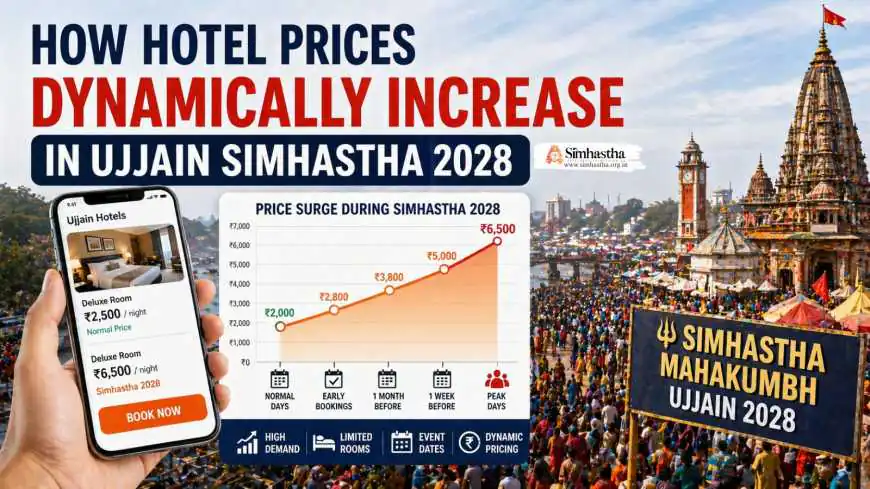
Here is a truth that most hotels in Ujjain will never tell you. The price you see for a room right now is probably not the price you will see tomorrow morning. And the price you see tomorrow morning will definitely not be the price you will see a week before Simhastha 2028. Your hotel room rate is being decided not by a human being sitting behind a reception desk, but by a cold, calculating, profit-maximizing algorithm that is watching your every click, tracking how many other pilgrims are searching for the same dates, and adjusting prices in real-time. This is not a conspiracy. This is dynamic pricing – the same technology that makes your Uber ride cost three times more when it is raining, the same technology that tripled flight fares during the Maha Kumbh 2025, and the same technology that is now coming for your Ujjain Simhastha 2028 hotel budget.
The scale is unlike anything Ujjain has ever seen. The Simhastha Mela Officer has confirmed that the holy city will host this mega event for a full 60 days, from March 27 to May 27, 2028 – double the duration of the 2016 Simhastha. During this window, three Amrit Snan and seven major bathing festivals are scheduled between April 9 and May 8, 2028. The expected footfall? A staggering 15 to 30 crore pilgrims will descend upon the banks of the Shipra River. Approximately one crore devotees are expected to travel by train alone – a fivefold increase from the 2016 Simhastha.
Now overlay this demand on a city with a finite number of hotel rooms, guesthouses, and dharamshalas. What do you get? A pricing environment where dynamic algorithms will rule supreme, where early birds will pay normal rates, and where last-minute pilgrims will face price shocks that could easily exceed 300% of normal tariffs. This article exposes exactly how this system works, what triggers each price jump, and – most crucially – how you can use this knowledge to outsmart the algorithm.
What Is Dynamic Pricing? The Invisible Hand Behind Your Hotel Bill
Let us demystify this term. Dynamic pricing is not the same as hiking prices arbitrarily. It is a sophisticated revenue management strategy where hotel room rates are adjusted in real-time based on a complex cocktail of factors – demand patterns, competitor pricing, booking lead time, length of stay, special events, and even the time of day you are searching for a room.
Trending Guides Now

Ujjain Temple Photography Rules Every Visitor Should Know

Ujjain Simhastha 5 Day Itinerary for Couples

2 Days Ujjain Itinerary: Complete Temple Darshan Plan

Surat to Ujjain Travel Guide: Routes, Distance and Time

Ujjain Railway Station to Mahakaleshwar Temple Distance (2026 Guide)

Ujjain Simhastha 2028 Dates Announced: Full Shahi Snan & Event Timeline

Benefits of Becoming a Simhastha Volunteer

Ujjain Travel During Shravan Month: What Changes for Visitors
Think of it as a stock market for hotel rooms. Just as share prices fluctuate every second based on buying and selling pressure, hotel room prices fluctuate based on how many pilgrims are booking and how many rooms remain available. A hotel revenue management system receives live data from booking platforms, competitor websites, and its own reservation engine. It then runs this data through a predictive algorithm that forecasts demand for each specific date during the Simhastha period. Based on this forecast, it sets a price designed to maximize revenue.
Here is the key insight that most pilgrims miss. Dynamic pricing is not designed to cheat you. It is designed to solve a fundamental economic problem – how to allocate a limited number of rooms among an almost unlimited number of potential guests. The algorithm does not care about fairness or devotion. It cares about capacity and revenue. It charges higher prices to those who signal the most urgent need (last-minute bookers) and offers lower prices to those who book early or choose off-peak dates. If you understand this logic, you can use it to your advantage.
The Algorithm That Never Sleeps: How It Decides Your Room Rate
Let me walk you through the actual decision-making process of a dynamic pricing algorithm. Imagine it is January 2028. You open your laptop at 11 PM on a Tuesday and search for a hotel near Mahakaleshwar Temple for a night during the April 15 Amrit Snan. The algorithm processes the following inputs in milliseconds.
First, it checks current occupancy. How many rooms are already booked for that date? If more than 70% are gone, the algorithm raises the price. Second, it scans competitor prices. What are five similar hotels charging for the same date? The algorithm positions your chosen hotel slightly above or below based on its amenities and ratings. Third, it analyzes demand forecasts for that specific date based on historical booking patterns and the official Shahi Snan schedule. Fourth, it considers lead time – how far away the travel date is. A booking made 45 days in advance gets a lower price than a booking made 3 days in advance. Fifth, it looks at search volume in real-time. If 500 people are viewing the same hotel page simultaneously, the algorithm increases the price instantly – sometimes within seconds.
The Supreme Court of India has taken serious note of this practice, particularly in the airline industry, calling such unpredictable fluctuations "exploitative" and stating that the court will "definitely interfere" to address the issue. A public interest petition has challenged the current pricing model that depends heavily on algorithms and sudden fare hikes close to the date of travel. However, until concrete regulations are enforced, dynamic pricing remains the dominant model across the hospitality sector.
The Shahi Snan Effect: When Prices Explode Exponentially
Here is the most important concept you need to understand about Simhastha 2028 pricing. The price hike is not uniform across the entire 60-day event. It spikes dramatically on specific, astronomically determined dates – the Shahi Snan days. These are the most auspicious dates to take a holy dip in the Shipra River, and on these dates, both the crowds and the prices hit absolute maximum levels.

The 2028 edition will feature three Amrit Snan between April 9 and May 8, along with a total of seven major bathing festivals. On these peak days, hotel rates do not just rise. They explode. The Maha Kumbh 2025 in Prayagraj offered a terrifying preview. Standard hotel rooms that typically cost ₹2,500-₹3,000 per night rose to ₹6,000-₹7,000 before spiking to over ₹22,000 per night on peak days like Mauni Amavasya. Three-star hotels that normally charged ₹3,000-₹4,000 demanded ₹35,000 to ₹38,000. Private tent rentals jumped from ₹15,000 to ₹45,000 per night.
A luxury cottage stay for three nights cost a staggering ₹2.4 lakh, while Dome City accommodations reached ₹91,000. Even basic budget accommodations that started at ₹800-₹1,500 surged to ₹5,000 per hour. These numbers are not exaggerations. They are real data from a real mega-event that happened just last year. And what happened in Prayagraj will almost certainly be replicated – and arguably intensified – in Ujjain in 2028.
Peak vs. Normal Days: A Tale of Two Price Worlds
To truly grasp the dynamic pricing mechanism, you must understand the drastic difference between peak bathing days and normal days during Simhastha 2028. The event spans 60 days, but the extreme price spikes are concentrated in a relatively short window.
Peak Days (Amrit Snan Dates): These are the three holiest days between April 9 and May 8, 2028. On these dates, every hotel room within a 20-kilometer radius of Ujjain will be booked solid. Dynamic pricing algorithms will push rates to their absolute ceilings. Based on Maha Kumbh data, expect budget hotels that normally charge ₹1,000-₹2,000 to demand ₹8,000-₹12,000. Mid-range hotels that normally charge ₹3,000-₹5,000 will command ₹20,000-₹30,000. Luxury properties that normally charge ₹6,000-₹8,000 will ask for ₹40,000-₹60,000 or more per night. And even at these rates, rooms will sell out within minutes or hours of becoming available.
Normal Days (Remaining 50+ Days): Here is the opportunity. The 60-day window includes over 50 days that are not peak bathing dates. On these days, demand is still high – after all, 15 crore pilgrims are visiting – but it is not the frantic, desperate peak of the Shahi Snan. On normal days, dynamic pricing algorithms will set lower rates. Hotels will still charge a premium compared to regular times, but the premium will be more manageable. For example, a budget hotel that normally charges ₹1,500 might charge ₹4,000-₹5,000 on a normal day – expensive, but not ruinous. Early booking discounts may still be available for these dates.
The key strategic insight is this. If you must visit during a Shahi Snan date, book as early as humanly possible – ideally 6-12 months in advance. If your pilgrimage dates are flexible, choose normal days and save 50-70% on your accommodation costs.
The Live Case Study: What Ujjain Hotels Learned From Maha Kumbh 2025
The hotel industry in Ujjain is watching the Maha Kumbh 2025 data very closely. And they have learned valuable lessons. After the 2019 Kumbh in Prayagraj, where unchecked tariff hikes caused significant business losses as many pilgrims opted for Varanasi instead, some hoteliers adopted a more structured pricing policy. Maximum room rates were capped at ₹20,000, while budget accommodations started at ₹3,000.
However, not all hoteliers are convinced by strict price capping, with some arguing that price control is dictated by demand and supply, and if the government follows dynamic pricing systems in sectors like aviation, hotels should apply the same logic. Ujjain's hotel owners are now preparing their own dynamic pricing strategies for Simhastha 2028, balancing the lessons from Prayagraj with their own profit motives.
The results of the Maha Kumbh 2025 survey are stark. 87% of air travellers paid 50-300% more than regular fares. 67% of accommodation seekers paid 50-300% more than standard rates for rooms, tents, and lodges. 66% paid 50-300% more for local transportation and boat rides. A Chennai-Prayagraj one-way ticket touched ₹53,000. A Kolkata-Prayagraj round trip cost ₹35,000. These numbers are now being fed into the models that will set your Ujjain Simhastha 2028 hotel prices.
The Supply-Demand Chasm That Powers the Algorithm
No discussion of dynamic pricing is complete without understanding the brutal supply-demand gap that enables it. The Madhya Pradesh government has projected a footfall of approximately 15 crore pilgrims for Simhastha 2028. Some estimates go as high as 30 crore. Now consider the accommodation inventory. The MP Tourism Development Corporation has an estimated 320 existing rooms in its hotels and resorts across the Indore-Ujjain region. They are expanding, adding rooms at Maheshwar and Choral resorts. Private hotels are increasing capacity. Temporary tent cities are being planned.
But let us be honest. No amount of expansion can create enough beds for 15 crore people in a city of Ujjain's size. The ratio of pilgrims to available rooms will be astronomically high. This is the fundamental driver of dynamic pricing. When demand outstrips supply by a factor of thousands, prices do not just rise. They soar. The algorithm is merely the messenger. The real villain is the physical reality that there are only so many buildings in Ujjain. Understanding this helps pilgrims accept the reality – and take action accordingly.
Outsmart the Algorithm: Your Action Plan
Here is the good news. Dynamic pricing works both ways. While it hurts last-minute bookers, it rewards early planners. Here is how you can use the algorithm's own logic to get the best rates.
Book as soon as booking windows open. For Simhastha 2028, many hotels will start accepting advance bookings 6-12 months before the event. Book immediately. Do not wait for "deals".
Book weekdays, not weekends. If your schedule allows, arrive on a Tuesday or Wednesday rather than a Friday or Saturday. Algorithms charge less on low-demand days.
Book longer stays. Many hotels offer discounts for stays of 3 nights or more. The algorithm is programmed to encourage longer bookings because they guarantee occupancy.
Clear your cookies or use incognito mode. Some dynamic pricing systems track your search history. If you search for the same hotel multiple times, the algorithm might increase the price, assuming you are desperate. Avoid this by searching in incognito mode.
Use multiple booking platforms. Compare prices across MakeMyTrip, Goibibo, Agoda, Booking.com, and the hotel's own website. The algorithm shows different prices on different platforms based on commission structures.
Book with free cancellation. If you find a good rate, book it immediately, even if you are not 100% sure of your plans. Then continue searching. If you find a better rate later, cancel the first booking – as long as free cancellation is available.
Consider staying in Indore. The nearest major city is just 55 km away, connected by a new expressway and Vande Metro trains. Hotel prices in Indore will be significantly lower than in Ujjain during the Simhastha, even with transportation costs factored in.
Avoid searching during peak hours. Algorithms detect high search volumes. Search for hotels late at night or early in the morning when fewer people are online. You might see lower prices.
The Sanctuary of Savings
The Shipra River will welcome you with open arms regardless of whether you paid ₹2,000 or ₹20,000 for your room. The divine energy of Mahakaleshwar Jyotirlinga does not demand a luxury suite as a prerequisite for blessings. But the hotel algorithms of Ujjain absolutely will demand a premium if you arrive unprepared.
You now understand the invisible machinery working behind every price tag. You know that dynamic pricing is not random chaos but predictable logic. You know that Shahi Snan dates will empty your wallet, while normal days offer sanctuary. You know that early booking is not a suggestion but a survival strategy. The choice is yours to make. Will you be the pilgrim who clicks "book now" with confidence, or the one who arrives in Ujjain only to find every room priced beyond reach? May Lord Mahakal give you the wisdom to book early – and the discipline to stick to your budget.
Frequently Asked Questions