


























Accommodation Supply vs Hotel Price Surge in Ujjain Simhastha 2028
Simhastha 2028 Ujjain accommodation crisis explained. Why hotel prices will surge 500-1000% and how limited supply vs massive demand impacts pilgrims.



What Exactly Is Simhastha and Why Does It Break Ujjain?
Let me back up for a second for anyone who does not know. Simhastha is the Kumbh Mela of Ujjain. It happens every 12 years when Jupiter moves into Leo (Simha rashi) . The Kshipra River becomes the center of the spiritual universe. Sadhus from every akhara come with their processions. Pilgrims from every corner of India – and the world – come to take a holy dip on auspicious bathing dates called Shahi Snan.
Here is the scale we are talking about:
| Year | Estimated Pilgrims | Duration |
|---|---|---|
| Simhastha 2016 | 75 million (approx) | 30-45 days |
| Simhastha 2028 | 90-100 million (projected) | 30-45 days |
Seventy five million people. That is more than the population of France. Almost all of them need somewhere to sleep, eat, and use a bathroom. Ujjain – the host city – has a permanent population of about 600,000 people. You see the problem now, right?
The Brutal Numbers: Accommodation Supply in Ujjain
Let me break down the accommodation supply in Ujjain right now. These are rough estimates based on industry data and ground reports, but they give you the real picture.
Trending Guides Now

Ujjain Simhastha 7 Day Itinerary for Families

Best Time to Visit Ujjain Simhastha 2028 Crowd Levels & Pilgrim Guide

Is Phone Allowed in Mahakaleshwar Temple Ujjain?

How Many Days Are Enough for Ujjain? Complete Trip Planner

Ujjain Railway Station to Mahakaleshwar Temple Distance (2026 Guide)

Ujjain Simhastha 2028 Dates Announced: Full Shahi Snan & Event Timeline

Benefits of Becoming a Simhastha Volunteer

Ujjain Travel During Shravan Month: What Changes for Visitors
Permanent Hotels and Guesthouses:
-
Budget hotels (₹500-₹1500 per night normally): Approximately 200 properties, maybe 5,000 rooms
-
Mid-range hotels (₹1500-₹4000 normally): Approximately 100 properties, maybe 4,000 rooms
-
Premium hotels (₹4000-₹10,000 normally): Approximately 20 properties, maybe 1,500 rooms
-
Luxury/heritage hotels (₹10,000+ normally): Approximately 5 properties, maybe 300 rooms
-
Dharamshalas and trust-run guesthouses: Approximately 200 properties, maybe 3,000 rooms

-
Homestays and small guesthouses: Approximately 300 properties, maybe 2,000 rooms

Total permanent rooms in Ujjain: Roughly 15,000 to 20,000 rooms
Total permanent bed capacity: Roughly 50,000 to 80,000 beds (assuming 3-4 people per room)
Now let us talk about temporary accommodation that gets set up specifically for Simhastha:
-
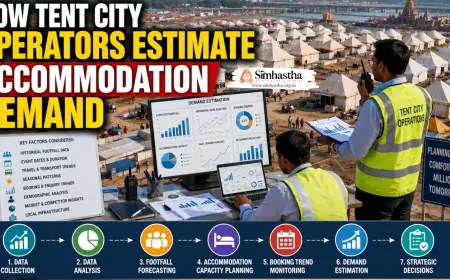
Tent cities by MP Tourism and private operators: Maybe 5,000 to 10,000 tents
-
Dormitory-style temporary shelters by government: Maybe 10,000 to 15,000 beds
-
School and college buildings converted to shelters: Maybe 5,000 to 10,000 beds
Total temporary capacity: Roughly 20,000 to 35,000 beds
Total overall capacity (permanent + temporary): Roughly 70,000 to 115,000 beds
Now compare that to the demand. On a peak bathing day like Shahi Snan, 10 to 15 million pilgrims are in Ujjain at the same time. Even if you put 10 people in one room (which nobody wants), you are still short by millions of beds.
This is not a small gap. This is a chasm.
The Hotel Price Surge: What Actually Happens
Let me tell you what happened in Simhastha 2016 because it will happen again in 2028 – just worse.
Normal prices in Ujjain (non-Simhastha year like 2027):
| Hotel Type | Normal Room Rate |
|---|---|
| Budget guesthouse | ₹500 – ₹1,000 |
| Mid-range hotel | ₹1,500 – ₹2,500 |
| Premium hotel | ₹3,000 – ₹5,000 |
| Luxury property | ₹6,000 – ₹10,000 |
Simhastha 2016 prices (as reported by pilgrims):
| Hotel Type | Simhastha Rate | Price Increase |
|---|---|---|
| Budget guesthouse | ₹5,000 – ₹8,000 | 500% to 800% |
| Mid-range hotel | ₹10,000 – ₹15,000 | 500% to 700% |
| Premium hotel | ₹20,000 – ₹35,000 | 500% to 600% |
| Luxury property | ₹40,000 – ₹80,000 | 400% to 700% |
Yes, you read that right. A ₹1,000 room became a ₹6,000 room. A ₹2,500 room became ₹12,000. And people paid it because they had no choice. Either pay the surge price or sleep on the street.
Simhastha 2028 projections (conservative estimates):
| Hotel Type | Projected Simhastha Rate | Estimated Price Increase |
|---|---|---|
| Budget guesthouse | ₹8,000 – ₹12,000 | 800% to 1,200% |
| Mid-range hotel | ₹15,000 – ₹25,000 | 700% to 1,000% |
| Premium hotel | ₹30,000 – ₹50,000 | 600% to 900% |
| Luxury property | ₹60,000 – ₹1,00,000+ | 500% to 900% |
Why will 2028 be worse than 2016? Because inflation is a thing, and because Simhastha 2028 will likely see more pilgrims than 2016. More demand + same supply = higher prices. Simple math.
Why Do Hotels Jack Up Prices During Simhastha?
Look, I am not defending the price surge. But let me explain the economics so you understand what is happening.
Reason 1: Basic supply and demand
Hotels in Ujjain operate at 50-70% occupancy during normal months. Some months they barely break even. Simhastha is their chance to make six months to a year of profit in four weeks. They know you have nowhere else to go. They know you will pay.
Reason 2: They can charge whatever they want
There is no government fixing maximum room rates during Simhastha. The Ujjain district administration has tried in the past, but hotels find loopholes. They call it a "festival special package" or "mandatory meal plan." They add "service charges" and "convenience fees." The bottom line – you pay.
Reason 3: Advance bookings create artificial scarcity
Hotels release only 20-30% of rooms for advance booking. They hold back the rest to sell at walk-in rates which are even higher. They know desperate pilgrims who show up without a booking will pay anything.
Reason 4: Cancellation policies are brutal
During Simhastha, most hotels have zero refund or 90% cancellation charges. You book a room for ₹12,000, and if your plans change, you lose the money. They keep your deposit and resell the room to someone else at an even higher rate.
The Real Problem: Not Enough Rooms, Period
Let me give you some perspective. Haridwar Kumbh Mela 2021 (which was actually in 2022 due to COVID) saw similar chaos. Pilgrims were paying ₹15,000 to ₹20,000 for rooms that normally cost ₹1,500. Some people slept at railway stations or in fields. Others stayed in Rishikesh (20 km away) and commuted.
Ujjain has it worse. The nearest big city is Indore, which is 55 kilometers away. On a normal day, that is a 1.5 hour drive. During Simhastha, because of road closures and traffic, it can take 3 to 5 hours one way. So staying in Indore and commuting to Ujjain for the Shahi Snan is not really practical.
Smaller towns near Ujjain:
-
Dewas – 35 km, about 1 hour
-
Maksi – 45 km, about 1.5 hours
-
Shajapur – 55 km, about 1.5 hours
-
Ratlam – 100 km, about 2.5 hours
-
Agar – 65 km, about 1.5 hours
These towns have very limited accommodation – maybe a few hundred rooms total. They will also see price surges, just not as extreme as Ujjain itself.
Government and Temporary Accommodation: Will It Help?
The Madhya Pradesh government and MP Tourism know about the accommodation crisis. They always set up tent cities during Simhastha. But here is the honest truth – it is never enough.
MP Tourism tent city (2016):
-
Location: Near Kshipra riverbank
-
Capacity: Approximately 2,000 to 3,000 tents
-
Cost in 2016: ₹3,000 to ₹10,000 per night
-
Amenities: Cots, blankets, shared bathrooms, food courts
-
Booking: Through MP Tourism website or at the venue
Private tent cities (2016):
-
Several private operators set up larger tent cities
-
Capacity: Maybe 5,000 to 8,000 tents total
-
Cost: ₹5,000 to ₹20,000 per night
-
Quality varied wildly – from luxury AC tents to basic canvas shelters
Government free shelters (2016):
-
Schools, colleges, and community halls converted to dormitories
-
Capacity: Approximately 10,000 to 15,000 beds
-
Cost: Free or nominal (₹50-₹100)
-
Amenities: Basic – just a floor to sleep on. Bring your own bedding.
For Simhastha 2028: Expect similar setups, maybe slightly larger. But with 100 million pilgrims expected, even 50,000 temporary beds is a drop in the ocean. Do not rely on government shelters unless you have absolutely no other option.
How to Beat the Price Surge: Practical Tips
I have spoken to pilgrims who survived Simhastha 2016 and Haridwar Kumbh 2021. Here is their advice – take it seriously.
Tip 1: Book at least 6 to 8 months in advance
Do not wait. Hotels start accepting advance bookings 6 to 12 months before Simhastha. The early prices are still high, but they are lower than what you will pay closer to the dates. Book directly with the hotel if possible – online travel agents add their own commissions.
Tip 2: Stay in Indore and commute on non-bathing days
If you cannot find or afford a room in Ujjain, stay in Indore. The distance is 55 km, but on non-bathing days, the drive is manageable. Take a hotel in Indore near the Bypass Road or Vijay Nagar area for quicker access to Ujjain. You will still face traffic, but at least you will have a bed.
Tip 3: Look at homestays and家庭的住宿
Regular hotels get booked first. But homestays – local families renting out a room – are often overlooked. They are harder to find online. But once you are in Ujjain, you will see "Room Available" signs on houses. Negotiate directly. Prices will be high, but lower than hotels.
Tip 4: Join a group and share accommodation
Instead of booking one room for two people, find four or six pilgrims and book a bigger room or dormitory. Splitting costs makes the surge price hurt less. Many hotels have family rooms that sleep 5-6 people. Use them.
Tip 5: Avoid peak bathing days for overnight stays
The highest price surge happens on the Shahi Snan dates – typically 4 to 6 specific days during the 45-day Simhastha period. If you can, book your stay before or after these peak dates. Take your holy dip on a secondary bathing day. The spiritual benefit is still there, and the prices are slightly lower.
Tip 6: Bring your own bedding and be ready for anything
If you end up in a government shelter or a very basic tent, you will need your own bed sheet, pillow, blanket, and mosquito repellent. The ground is hard. The nights can be cold (January-February). Prepare for basic conditions.
Tip 7: Keep cash for walk-in bookings
Online booking portals crash during Simhastha because everyone is trying to book at once. Hotels also release last-minute rooms that are not listed online. Carry enough cash (₹10,000-₹20,000) to pay for a room if you find one by walking in.
Will the Government Regulate Prices in 2028?
The short answer is no, not effectively. The Ujjain district administration has tried in past Kumbh Melas to set maximum room tariffs. Hotels simply ignore the rules or find creative ways around them.
The "mandatory meal plan" trick: The hotel says the room is ₹3,000 per night (which is the government cap), but you must buy their "meal plan" for ₹2,000 per person per day. So a family of four ends up paying ₹3,000 + ₹8,000 = ₹11,000.
The "minimum stay" trick: The hotel requires a 7-day minimum stay during Simhastha. You only need 2 nights, but you pay for 7.
The "advance deposit" trick: The hotel asks for 100% advance at the time of booking. If you cancel, you lose everything.
The "walk-in only" trick: The hotel does not accept advance bookings at all. They only rent rooms to people who walk in on the day – at whatever price they feel like charging.
Do not expect the government to save you. They never have, and they probably never will. Your best defense is planning early and managing expectations.
A Word About Simhastha 2028 Dates and Booking Window
The exact auspicious bathing dates for Simhastha 2028 will be announced by the Ujjain Kumbh Mela authorities closer to the event – usually about 6 to 12 months in advance. However, based on astrological calculations, the Simhastha period will likely fall between April and May 2028 or January to February 2028 (consult official sources for confirmation).
Once the dates are announced, hotel booking madness will begin. My advice:
-
Start researching hotels now – save phone numbers and email addresses
-
Call hotels directly in early 2027 and ask about Simhastha booking policies
-
Be prepared to pay 50-100% advance to confirm your booking
-
Get written confirmation – email or WhatsApp message – of your booking and price
Do not rely on OTA websites like MakeMyTrip, Goibibo, or Agoda during Simhastha. They will show "sold out" for most properties because hotels prioritize direct bookings. Call the hotel directly.
Frequently Asked Questions