

















What Makes Bhartrihari Caves Different From Other Cave Shrines
Discover what makes Bhartrihari Caves different from other cave shrines—the Nath tradition, royal renunciation, literary legacy, and 11th-century architecture.

A Cave Shrine Unlike Any Other in India 🏛️
Let me ask you something straight up. When you hear "cave shrine" in India, what pops into your head? The jaw-dropping Ajanta and Ellora caves? The icy pilgrimage of Amarnath? The peaceful Buddhist vibes of Karla? All incredible in their own right. But tucked away on the banks of the Shipra River in Ujjain lies something completely different. 🕉️
The Bhartrihari Caves aren't about massive sculptures or sprawling complexes. They aren't even fully natural. But what they lack in size, they make up for in raw emotion, deep spirituality, and a story that still echoes through the ages. 🌊
So, what makes Bhartrihari Caves different from other cave shrines? The answer hits you the moment you step inside. This isn't just a temple. It's the meditation spot of a heartbroken king who gave up his throne. It's where one of India's greatest Sanskrit poets wrote verses that still move people today. It's a sanctuary for the Nath tradition, the Kapalika ascetics, and the Aghori sadhus—esoteric sects that most people never encounter. 🔱
In this article, we'll explore everything that sets these caves apart. No fluff. No filler. Just the real reasons why the Bhartrihari Caves deserve a spot on every spiritual traveler's bucket list. Let's get into it. 🙏
Trending Guides Now

Kal Bhairav Temple Visitor Etiquette and Temple Customs
Why the Harsiddhi Deep Stambh Attracts Thousands
Why Mangalnath Temple Attracts Devotees From Across India

Ujjain Railway Station to Gopal Mandir: Distance, Auto Fare and Best Route

Ujjain Railway Station to Mahakaleshwar Temple Distance (2026 Guide)

Ujjain Simhastha 2028 Dates Announced: Full Shahi Snan & Event Timeline

Ujjain Railway Station to Mangalnath Temple: Distance, Auto Fare and Best Route

Ujjain Simhastha 2028 Road Widening Brings Action Against Religious Structures Houses and Shops
The Man Who Gave Up a Kingdom for Peace 👑
Who Was Bhartrihari?
Let's start with the most important thing: the man behind the caves. Unlike most cave shrines named after gods or goddesses, the Bhartrihari Caves are named after a real historical figure—Bhartrihari. 👑
According to tradition, Bhartrihari was the stepbrother of the legendary King Vikramaditya of Ujjain. While his brother conquered kingdoms, Bhartrihari was a poet and scholar at heart. But here's what makes his story so powerful—he walked away from everything. 🚶♂️
Why did he renounce his kingdom? Legend says that after a painful personal betrayal and heartbreak, Bhartrihari decided that power, wealth, and luxury meant nothing without peace of mind. So he gave it all up. The crown. The palace. The servants. Everything. 💔
He came to the banks of the Shipra River, near the Gadkalika Temple, seeking solitude. And he spent 12 long years here in deep meditation. This spot became his spiritual retreat, and eventually, the caves that now bear his name were carved into the hillside. 🧘♂️
Why does this matter? Most cave shrines are about mythology and divine beings. The Bhartrihari Caves are about a human being—a king who chose the hard path of the soul over the easy path of power. That's rare. That's real. That's what makes these caves different.
The Poet Who Wrote Immortal Verses in Solitude 📜
Bhartrihari's Literary Masterpieces
Here's another thing that sets these caves apart. Bhartrihari wasn't just a renunciate—he was a literary genius. While meditating in these very caves, he composed three works that are still considered gems of Sanskrit literature. ✍️
| Work 📖 | Subject 📚 | What It's About |
|---|---|---|
| Nitishatak | Ethics & Morality | 100 verses on how to live a righteous life |
| Shringarshatak | Love & Romance | 100 verses on the beauty and pain of love |
| Vairagyashatak | Renunciation | 100 verses on letting go of worldly attachments |
It's widely believed that he wrote all three of these 'Shatakas' (collections of 100 verses) right here in these caves. 📜
Think about that for a second. The same caves where a king meditated in silence are the birthplace of poetry that has been read, studied, and cherished for over 1,500 years. Most cave shrines are purely devotional spaces. The Bhartrihari Caves are both a shrine and a literary monument—a place where words and spirituality merge. 🌟
The Esoteric Spiritual Traditions That Thrive Here 🔱
The Nath Tradition Connection
Now let's talk about the spiritual side. One of the most remarkable things about the Bhartrihari Caves is their deep connection to the Nath tradition. 🧘
The Nath tradition is an esoteric Shaiva movement that focuses on yoga, meditation, and intense spiritual discipline. The caves are considered a holy shrine for the Nath community, and every year thousands of devotees—including Naga Sadhus—come here to pay their respects. 🚩
Many Nath followers actually pitch tents outside the caves and meditate here, continuing the tradition that Bhartrihari started centuries ago. This isn't just a tourist spot—it's a living spiritual site where ancient practices are still alive. ⛺
The Kapalika and Aghori Connection 💀
Here's something that really sets these caves apart. The Bhartrihari Caves have been a center for Kapalika and Aghori ascetics for centuries. 🔥
Who are the Aghoris? They are intense spiritual practitioners who follow unconventional rituals—meditating in cremation grounds, using skulls as begging bowls, and seeking liberation through extreme detachment. They are rarely seen in mainstream temples.
But here, in these caves, their presence is felt. Some visitors mention a strong, pungent smell inside—a mark of Aghori rituals and meditations. While this might be off-putting to some, for spiritual seekers, it's a sign that this is a place of raw, untamed energy. ⚡
The key takeaway: This is not a sanitized tourist attraction. It is a living, breathing site where esoteric traditions are still practiced. That's rare. That's powerful. That's what makes these caves different.

The Pir Matsyendranath Connection 🏔️
Adding to the spiritual significance is the nearby site of Pir Matsyendranath, a prominent figure in the Nath tradition. This proximity has made the entire area a major pilgrimage destination for followers of the Nath sect. 🙌
The Architecture: 11th Century Rock-Cut Design 🏗️
Paramara Period Structure
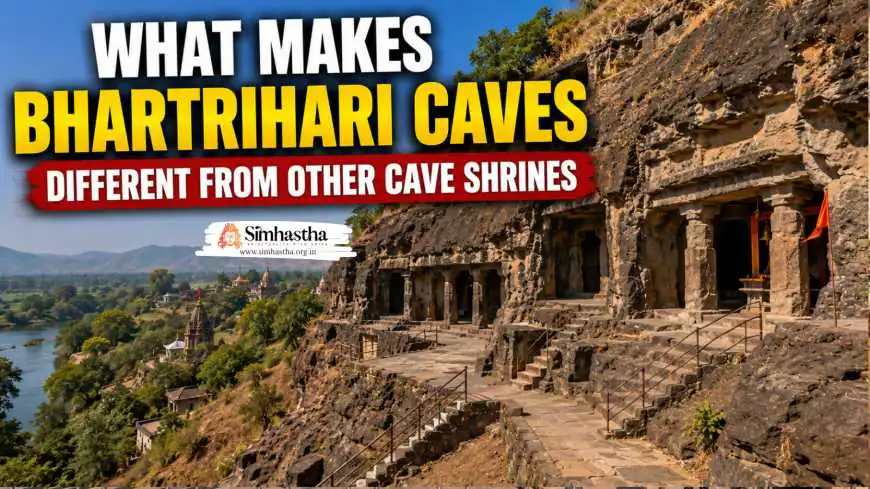
Let's talk about the physical structure. Unlike purely natural caves, the Bhartrihari Caves are a fascinating mix of natural rock and 11th-century rock-cut architecture. 🪨
According to historians, they are the remains of a double-storied monastery from the Paramara period (10th-11th Century CE). The ceilings are supported by exquisitely carved stone pillars that are not integral to the cave, suggesting they were brought from elsewhere. 🏛️
The entrance features a three-tier Rajagopuram built in South Indian architectural style—a relatively recent addition that enhances the aesthetic appeal. 🌺
Narrow Entrances and Underground Layout
Here's something you won't find in most cave shrines. The Bhartrihari Caves have extremely narrow entrances and feel more like an "underground home" with multiple rooms, halls, and a holy shrine. 🏚️
What you'll find inside: 👀
-
A stone-curved statue of Bhartrihari in a sitting meditation posture 🧘
-
A small temple dedicated to the Nath community 🙏
-
Ancient sculptures of Kali Ma, Shiva, Hanuman, Durga, Gorakhnath, and various Yogis and Munis 🗿
-
Exquisitely carved stone pillars with intricate designs
Accessibility Warning ⚠️
Due to the narrow passages and uneven steps, the caves are not recommended for elderly visitors, those with back pain, or people with claustrophobia. The entry and exit are often through the same gate, which can cause congestion during busy times. 😰

Best time to visit: Early morning (6:00 AM) for peace and cooler weather. 🌅
The Atmosphere: Peaceful Yet Intense 🕊️
A World Away from Ujjain's Bustle
One of the most cherished aspects of the Bhartrihari Caves is the atmosphere. Located on a small hill on the banks of the Shipra River, the site offers a serene, reflective environment that is hard to find in the busy city of Ujjain. 🌊
Visitors seeking solitude and spiritual connection rate it as a top destination. The interior is cool, peaceful, and deeply spiritual—perfect for meditation and self-reflection. 🧘♀️
Raw Spiritual Energy
Unlike other cave shrines that have been heavily commercialized, the Bhartrihari Caves retain a raw, intense energy. The presence of Aghori practitioners and the lingering evidence of their rituals confirm that this is still an active esoteric site. 🔥
This makes it fundamentally different from more polished and tourist-friendly cave shrines across India. 🏔️
Quick Comparison: Bhartrihari Caves vs Other Cave Shrines 📊
| Feature 🔍 | Bhartrihari Caves 🏛️ | Typical Cave Shrines 🕉️ |
|---|---|---|
| Origin Story | Based on a king's personal renunciation 👑 | Based on divine events or deities 🙏 |
| Literary Significance | Site where Bhartrihari composed 3 Sanskrit works 📜 | Typically not associated with specific literary works ❌ |
| Tradition | Nath, Kapalika, and Aghora traditions 🔱 | Mainstream Hindu, Buddhist, or Jain worship 🕉️ |
| Architecture | 11th-century rock-cut with added stone pillars 🏗️ | Often purely carved from rock or natural formations 🪨 |
| Atmosphere | Raw, intense, meditative ⚡ | Often tourist-friendly, polished 🌸 |
| Accessibility | Narrow, cramped, not for elderly or claustrophobic ⚠️ | Often designed for large crowds 🚶♂️🚶♀️ |
Practical Tips for Visiting Bhartrihari Caves 📝
Timings and Entry ⏰
-
Opening Time: 6:00 AM 🌅
-
Closing Time: 8:00 PM 🌙
-
Entry Fee: Free (donations welcome) 💰
Location 📍
-
Distance: About 5-6 kilometers from Ujjain Railway Station 🚉
-
Travel Time: 10-15 minutes by auto or taxi 🛺
-
Nearby: Close to Gadkalika Temple and Triveni Sangam 🌊
Best Time to Visit 🌤️
-
Early morning (6:00 AM) for calmness and cooler weather ☀️
-
Avoid weekends and holidays to avoid claustrophobic chaos 😰
Essential Tips ✅
-
Wear comfortable shoes: Steps are uneven 👟
-
Bring a flashlight: If you want to explore deeper areas 🔦
-
Respect the silence: Many come here for meditation 🤫
-
Be patient: If it's crowded, wait your turn 🙏
-
Understand the raw atmosphere: This is not a typical tourist spot—be prepared for intense spiritual energy ⚠️
The Bottom Line: Why These Caves Are Truly Different 🎯
So, what makes Bhartrihari Caves different from other cave shrines? Let's sum it up:
-
The story is human, not just divine. A king who gave up his throne for peace. 👑
-
The purpose is literary as well as spiritual. The birthplace of immortal Sanskrit poetry. 📜
-
The tradition is esoteric and raw. Nath, Kapalika, and Aghori practices still thrive here. 🔱
-
The atmosphere is peaceful yet intense. Centuries of meditation and poetry have seeped into the stone walls. 🕉️
-
The architecture is unique. 11th-century rock-cut design with narrow passages and carved pillars. 🏗️
The Bhartrihari Caves are not about big architecture or show. They are about deep, silent spirituality. When you step inside, you walk into centuries of meditation, wisdom, and peace. You walk into the heartbreak of a king who found liberation in renunciation, and into the verses of a poet who spoke to the ages. 🧘♂️💫
Visit them. Sit in silence. Feel the energy. You'll understand why these caves are unlike any other. 🙏🌿
Frequently Asked Questions