






















How Mahakaleshwar Temple Handles Lakhs of Devotees Daily
Discover how Mahakaleshwar Temple handles lakhs of devotees daily with online booking systems, AI monitoring, tiered darshan, and real-time crowd control.
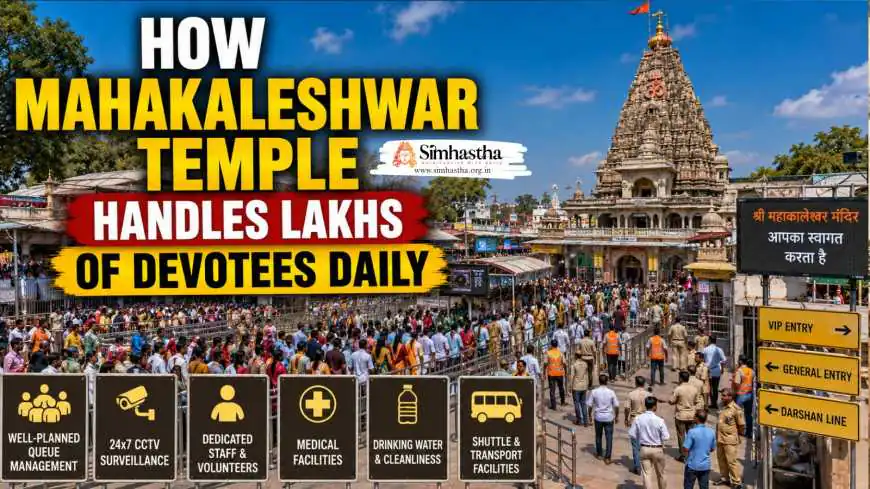

The 1.5 Lakh Daily Challenge: Inside Mahakal's Crowd Management Machine
Picture this: Over 1.5 lakh devotees, sometimes swelling to nearly 2 lakh, streaming through a single temple complex every single day. 🚶♂️🚶♀️ That's more than the population of many small cities—arriving, praying, and leaving within a few hours, day after day. And on weekends? The numbers climb even higher .
This is the daily reality at the Shri Mahakaleshwar Temple in Ujjain, one of the 12 revered Jyotirlingas. A decade ago, the temple saw around 40,000 to 50,000 devotees daily . Today, that number has more than tripled, driven largely by the development of the Mahakal Lok corridor and growing spiritual tourism .
So how does the temple administration manage this unprecedented surge? How do they ensure that every devotee—whether a VIP or a first-time pilgrim—gets a meaningful darshan experience while maintaining order, safety, and sanctity?
In this article, we'll pull back the curtain on exactly how Mahakaleshwar Temple handles lakhs of devotees daily. From sophisticated online booking systems to real-time VIP monitoring, from tiered darshan categories to Google Maps-based traffic management, this is the blueprint of one of India's most efficient temple operations. 🏛️
Trending Guides Now

Ujjain Railway Station to Mahakaleshwar Temple Distance (2026 Guide)

Mahakaleshwar Temple Entry Rules 2026: Dress Code, Mobile & Bag Policy

Bhasma Aarti at Mahakaleshwar Temple – Complete Pilgrim Guide

Ujjain Bus Stand to Mahakaleshwar Temple Distance (2026 Guide)

Ujjain Simhastha 2028 Dates Announced: Full Shahi Snan & Event Timeline

Why Ujjain Is One of the Four Kumbh Cities in India
Ujjain Railway Station to Mangalnath Temple: Distance, Auto Fare and Best Route

Ujjain Simhastha 2028 Road Widening Brings Action Against Religious Structures Houses and Shops
The Numbers Game: Understanding the Scale
Daily Footfall: The Staggering Statistics
Let's start with the numbers that define the challenge:
| Day Type | Daily Devotees |
|---|---|
| Normal Weekdays | 1.20 lakh–1.25 lakh |
| Weekends | 1.5 lakh–1.75 lakh |
| Peak Periods (New Year, Festivals) | 2 lakh+ |
The Annual Picture:
-
Between January 1 and December 15, 2025, the temple received over 5.5 crore devotees
-
This represents a massive jump from a decade ago when daily footfall was 40,000–50,000
-
The temple earned over Rs 107 crore from donation boxes and ticket sales, a record-breaking figure
What This Means:
With over 5.5 crore devotees annually, The Mahakaleshwar Temple has become one of the busiest religious sites in the world. The challenge isn't just about managing people—it's about ensuring safety, dignity, and spiritual fulfillment for every single visitor. 🕉
The Digital Backbone: Online Booking Systems
Bhasma Aarti: The Most Sought-After Ritual
The Bhasma Aarti is the temple's crown jewel—a pre-dawn ritual where the Shivalinga is bathed in sacred ash. It's an experience so profound that devotees plan their entire Ujjain trip around it .
How the Booking System Works:
Online Booking (Recommended):
-
Opens on the 1st of the previous month at 8:00 AM
-
Fee: ₹200 per person
-
Limited to approximately 1,200 devotees daily
-
Slots often fill within minutes—devotees must book as early as possible
-
Requires a valid government ID (Aadhaar, passport, etc.)—the same ID must be carried during the visit


Tatkal Booking:
-
Opens one day before the selected date at 8:00 AM
-
Provides a last-minute opportunity for devotees who missed the regular window
Offline Booking:
-
Available at the temple ticket counter
-
Fee: ₹100 per person
-
Subject to availability—high demand means online booking is strongly recommended
Dress Code for Garbh Griha Darshan:
-
Men: Traditional dhoti and angavastram
-
Women: Saree or salwar kameez with dupatta
-
Cell phones are allowed; however, devotees are advised to maintain decorum and follow temple instructions

Sandhya Aarti and Shayan Aarti: Now Online Too
In February 2026, the temple administration extended online booking to Sandhya Aarti (evening prayer) and Shayan Aarti (night prayer), similar to the Bhasma Aarti system .
Key Details:
-
Fee: ₹250 per person for each aarti
-
Capacity: 1,200 people each
-
Booking starts daily: Sandhya Aarti at 12:00 PM, Shayan Aarti at 4:00 PM
-
Entry is through Gate No. 1
-
Last entry: Sandhya Aarti at 6:00 PM, Shayan Aarti at 10:00 PM
Mobile Darshan: A Compassionate Alternative
For devotees who cannot secure prior booking, the temple offers mobile darshan—designated standing areas where devotees can view the rituals from a distance . This ensures that even those without passes can experience the sacred atmosphere.
The Three-Tier Darshan System
Category 1: Most VIP (Protocol Arrangement)
Access Level:
-
Entry through Shankh Dwar
-
Access to Shikhar Darshan terrace and Kund
-
Permission to reach the front row of Ganesh Mandapam
-
Exclusive entry to Nandi Hall
Who Qualifies:
-
Politicians, judicial officers, celebrities, journalists, and other dignitaries
-
Protocol darshan is managed through a real-time digital tracking system
Category 2: Quick Darshan Ticket Holders
Access Level:
-
Fee: ₹250 per person
-
Entry from Gate No. 1 via Kartikeya Mandapam or Gate No. 4 via Vishram Dham and Sabha Mandap
-
Exit through Palki Hall
Availability:
-
Counters set up in front of Bada Ganesh Mandir
-
Also available online through the temple's official website
Category 3: General Devotees
Access Level:
-
Entry through Mahakal Lok or Mansarovar Facility Centre
-
Passage through Mahakal Tunnel-1 to reach Ganesh Mandapam
-
Darshan from behind barricades
-
Exit via Palki Hall and the Ambulance Gate
Note: General devotees are no longer allowed entry into Nandi Hall during peak periods; the temple restricts their darshan to the Ganesh Mandapam area for crowd management .
Real-Time VIP Monitoring: The Tech Revolution
The Google Docs System
In October 2025, the temple introduced a groundbreaking real-time monitoring system for VIP darshan under the guidance of Administrator Pratham Kaushik .
How It Works:
-
Data Entry: When a VIP (politician, judicial officer, celebrity, or journalist) arrives for darshan, a temple employee stationed at Shankh Gate enters their details into Google Docs
-
Real-Time Access: The data is instantly accessible on the phones of Administrator Pratham Kaushik and Assistant Administrator Ashish Palawadia
-
Tracking Details: The system records who visited, arrival time, entry gate, duration of stay, number of companions, and which employee handled the protocol
-
Three-Level Verification: All live feeds are immediately updated on officials' phones throughout the day
Why This System Was Introduced:
The temple had faced issues with irregularities—some employees allegedly allowed devotees to enter illegally by accepting payments ranging from ₹1,100 to ₹2,000 per person . The digital system was introduced to ensure complete transparency and efficiency in the VIP darshan process .
The ₹250 Protocol Darshan Fee
For protocol darshan, officials and dignitaries can get special access for a donation of ₹250 . The new digital system ensures that this process is tracked and transparent.
Supreme Court Challenge
The VIP darshan system has faced legal challenges. In January 2026, the Supreme Court rejected a petition challenging the practice, observing that "people who file such petitions are not genuine devotees" and that courts should not regulate temple policies . The Court granted the petitioner permission to file a representation before government authorities instead .
Modern Crowd Control: Tech-Driven Solutions
Google Maps Traffic Management
In December 2025, Ujjain Police piloted a groundbreaking system using Google Maps for crowd and traffic management .
How It Works:
-
A joint team of 10 members—including police personnel, a cyber team, and a Gurugram-based IT company—modified Google's routing algorithm
-
When traffic builds up or a jam occurs on any road, the team immediately removes that route from Google Maps and activates an alternative, less crowded route
-
Devotees traveling from outside cities do not see congested inner-city routes on their navigation apps and are guided directly to designated parking areas through outer roads
-
A 10-member police team monitors real-time traffic conditions from 8 AM to 10 PM daily
The Scale:
-
On normal days, nearly 6,000 four-wheeler vehicles enter Ujjain
-
During peak periods, this doubles to around 12,000 vehicles daily
Senior officials have indicated that if this initiative proves fully successful, it could also be implemented during Simhastha 2028 .
The New Year Crowd Management Blueprint
During the 2025-26 New Year period, the temple implemented special arrangements that offer a preview of how large crowds are managed :
Online Booking Suspension:
-
Online Bhasma Aarti booking was temporarily closed from December 25 to January 5
-
Only offline booking was allowed, one day in advance
-
Booking for Bhasma Aarti on January 1 was completely closed
Revised Darshan Route:
-
Entry through Triveni Museum
-
Passage via Mahakal Lok to Maan Sarovar
-
Through the tunnel to Ganesh Mandapam
-
Exit near Bachhda Ganesh Temple
Increased Prasad Production:
-
Regular days: 30–40 quintals of laddu prasad
-
New Year period: Over 50 quintals
-
Distribution expanded from 7 to 9 counters
Holding Areas:
-
Created near Karkaraj Mandir and Chardham Mandir with seating and water arrangements
-
Additional shoe stands and mobile lockers installed near Mansarovar Dwar and Triveni Sangrahalaya
Donations and Records: The Faith Economy
Record-Breaking Contributions
The surge in devotees has translated into unprecedented donations :
| Category | Amount |
|---|---|
| Total Revenue (Jan–Dec 2025) | Over ₹107 crore |
| Gold | 1,483.621 grams (valued at over ₹13 crore) |
| Silver | 592.366 kilograms |
| Daily Donation (approx) | Several lakhs |
Year-on-Year Growth:
-
2024: ₹92 crore
-
2025: ₹107 crore (₹15 crore more)
The increase in donations reflects both the growing footfall and the deep faith of devotees who are filling "Baba Mahakal's treasury with gold, silver, cash, and offerings from across the country" .
Why Donations Are Up
-
Mahakal Lok Corridor: The development of the corridor has drawn record numbers of devotees
-
Growing Faith: Pilgrims from Gujarat, Rajasthan, Maharashtra, Uttar Pradesh, and Madhya Pradesh are arriving in unprecedented numbers
-
Enhanced Facilities: Improved infrastructure and amenities have encouraged longer stays and more generous offerings
The Bottom Line: A System Designed for Faith and Order
So, how does Mahakaleshwar Temple handle lakhs of devotees daily? Through a meticulously designed system that combines ancient tradition with modern technology:
-
Digital Booking Systems for aartis ensure order and transparency, reducing chaos at the temple gates
-
Tiered Darshan Categories accommodate everyone from VIPs to general devotees while maintaining crowd control
-
Real-Time VIP Monitoring using Google Docs ensures protocol darshan is transparent and accountable
-
Google Maps-Based Traffic Management guides devotees smoothly to parking and the temple without congestion
-
AI and Digital Command Centers are being readied for even larger crowds at Simhastha 2028
The Key Takeaway:
For a temple that sees over 1.5 lakh devotees daily—and sometimes nearly 2 lakh on weekends—the system works remarkably well. It ensures that every devotee leaves with a darshan experience, whether they booked months in advance or arrived on a whim.
For devotees planning a visit, the message is clear: book early (especially for Bhasma Aarti), carry valid ID, and follow the designated routes. The system is built to handle the crowds, but your cooperation makes all the difference. 🙏🕉️
Frequently Asked Questions