




















Where Do Temple Offerings Go After Mahakaleshwar Darshan?
Discover where temple offerings go after Mahakaleshwar Darshan. From flowers and coconuts to cash and prasad, trace the sacred journey of your devotion through Ujjain's ancient and sustainable temple economy.
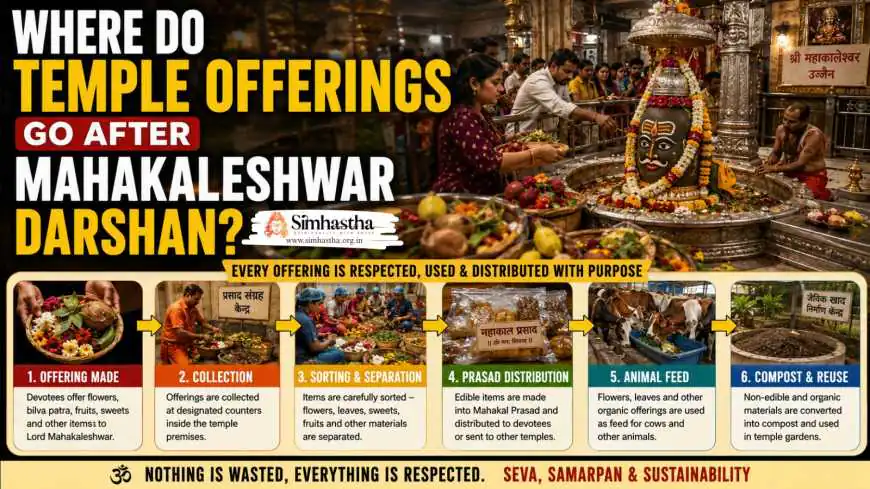


The First Touch and What Happens at the Moment of Offering
The journey of your offering begins in the most sacred, intense, and fleeting of moments—the few, breathless seconds when you stand before the Mahakaleshwar Jyotirlinga, the dark, ancient stone glistening with water, milk, and the sacred ash of the Bhasma Aarti, and you extend your hands to place your coconut, your garland, your bilva leaves, or your envelope of cash onto the small, silver offering platform that rests at the feet of the Lord. The attending priest, a hereditary servant of the deity whose family has performed this sacred duty for centuries, receives your offering with a swift, practiced, and deeply reverent gesture. For those few, sacred seconds, your coconut, your flowers, your humble, physical token of devotion, is in direct, tangible contact with the divine presence. It is believed, in that moment, to be imbued with a subtle, powerful, and transformative energy, the direct, personal blessing of the Lord of Time. The priest may touch the offering to the lingam, or simply hold it in the sanctum’s charged, incense-laden atmosphere, before placing it into a large, designated basket or a stainless-steel container that rests beside him. The offering, now sanctified, now transformed from a mere physical object into a vessel of divine grace, begins its silent, unseen journey from the inner sanctum, through a series of secure, priest-only corridors, into the bustling, highly organized, and deeply purposeful operational heart of the temple complex. 🙏
The Sacred Blossoms and the Alchemy of Flowers
Of all the offerings that flood the Mahakaleshwar Temple, the fragrant, colourful, and deeply perishable flowers are by far the most voluminous. On an ordinary day, the temple receives hundreds of kilos of marigolds, roses, jasmine, hibiscus, and the sacred, three-lobed bel patra leaves. On festival days, this can swell to several tonnes. The flowers, once they have been offered and have spent a brief, sacred time in the sanctum or the prayer halls, are carefully collected by a dedicated team of temple staff and volunteers. They are transported, in large, clean baskets, to the temple’s on-site flower processing and composting facility, a quiet, unseen corner of the complex that is a model of sustainable, eco-spiritual practice. Here, the flowers are sorted, any non-organic materials like plastic strings or foil are meticulously removed, and the sacred petals, leaves, and stems are deposited into large, specially designed composting pits. Over several weeks, through a carefully managed process of aerobic decomposition, the flowers break down into a dark, rich, crumbly, and intensely fragrant organic compost. This sacred, sanctified compost is not sold; it is used to nourish the temple’s own gardens, the groves of bel trees, and the flowering plants that will, in their turn, produce the very blossoms that will be offered to the Lord in the endless, beautiful, and self-sustaining cycle of sacred nature. Some of the more robust flowers, particularly the roses and the marigolds, are also carefully dried, their petals separated, and processed into a fine, fragrant, and deeply sacred powder that is used to make the temple’s own, unique incense sticks and dhoop, which are then sold to pilgrims or used in the temple’s own daily rituals. 🌺
The Coconut, the Cloth, and the Material Treasures
The coconut, the Shriphal, the fruit of the gods, is the single most iconic and universally offered item at the Mahakaleshwar Temple. The soft, gentle thud of a coconut being placed on the offering platform is the constant, rhythmic heartbeat of the sanctum. These coconuts, once blessed, are not merely discarded. A large portion of them are immediately broken by the temple staff, right there in the sanctum's antechamber, and the sweet, white kernel and the cool, refreshing water are distributed directly back to the pilgrims as a beloved, tangible, and deeply satisfying form of prasad. The remaining, whole coconuts are carefully collected and transported to the temple’s massive, continuous community kitchen, where they are used in the preparation of the sanctified meals that feed thousands of pilgrims, free of charge, every single day. The coarse, fibrous outer husk of the broken coconuts is not wasted; it is collected and sent to local coir industries, where it is transformed into ropes, mats, and brushes, providing a small but meaningful source of income for local artisans.
The vastra, the sacred cloth—the simple, unstitched lengths of cotton and silk, the sarees, the dhotis, and the small, red and yellow cloth bundles that pilgrims offer to the deity—follows a path of profound dignity and compassionate purpose. The finest, most exquisite pieces are used to adorn the deity during the daily Shringar, the ritual of dressing and decorating the lingam. The vast majority of the cloth offerings are meticulously sorted, cleaned, and then respectfully distributed to the poor, the needy, and the pilgrims themselves, often through the temple’s own charitable outlets, transforming the devotee’s humble gift of cloth into a warm, protective garment for a shivering body. Occasionally, valuable items, such as gold or silver jewelry, are offered in moments of profound, personal gratitude or desperate petition. These are treated with the highest, most meticulous security and reverence. They are carefully catalogued, securely stored in the temple’s main treasury, and either used to adorn the deity on special, grand festival occasions or, with the express permission of the trust’s board, periodically auctioned to raise substantial funds for the temple’s major charitable projects. 👕
Trending Guides Now

Ujjain Railway Station to Mahakaleshwar Temple Distance (2026 Guide)

Best Time to Visit Mahakaleshwar Temple Crowd And Weather Guide

Mahakaleshwar Sheeghra Darshan Booking Guide 2026

Why This Jyotirlinga Faces South and What It Means

Ujjain Simhastha 2028 Dates Announced: Full Shahi Snan & Event Timeline

Mahakaleshwar Temple Entry Rules 2026: Dress Code, Mobile & Bag Policy

Ujjain Railway Station to Kal Bhairav Temple: Distance, Auto Fare and Best Route

Triveni Ghat Ujjain – Simhastha 2028 Complete Guide
The Hundi and the Stream of Devotional Wealth
The most significant, by volume and financial value, of all the offerings at the Mahakaleshwar Temple is the stream of cash that flows, continuously and silently, into the dozens of large, brass hundis (offering boxes) that are strategically placed throughout the temple complex. Every day, under the strict, watchful supervision of a dedicated team of temple trust officials, independent auditors, and a heavy security presence, these hundis are ceremoniously opened. The contents—the crumpled notes, the shiny coins, the occasional foreign currency, and the envelopes containing large, specific donations—are poured onto long, clean tables in a secure, designated counting room. A team of trained, trusted staff, working in rotating, supervised shifts, then begins the meticulous, painstaking process of sorting, counting, and verifying the cash. Every single note and coin is accounted for, using both manual tallying and modern, high-speed currency-counting machines. The entire process is video-recorded for complete, irrefutable transparency and audit compliance. The funds are then deposited, on the same day, into the temple trust’s officially designated bank accounts. This immense, continuous stream of devotional wealth is the financial lifeblood of the temple’s vast, multi-faceted, and deeply compassionate charitable empire, funding the free kitchens, the hospitals, the schools, and the gaushalas. For the pilgrim who wishes to make a larger, specific, and tax-exempt donation, the temple operates official receipted donation counters, where a payment can be made via cash, cheque, or digital transfer, and an official, government-recognized receipt is issued immediately. 💰
The Mahaprasad and the Sanctified Food That Feeds Thousands
The food offerings, the bhog or naivedya, that pilgrims present to the deity—the simple, home-cooked sweets, the packets of fruits, the dry fruits, and the cooked meals—are treated with a special, profound, and deeply nourishing reverence. These offerings, once they have been ritually presented to the Lord, are never discarded as mere waste. They are transformed into Mahaprasad, the great, sanctified food, the tangible, edible grace of the divine. A significant portion of the fresh, uncooked offerings, such as the fruits and the grains, is immediately transported to the temple’s massive, continuous community kitchen, the Bhandara, where a dedicated, hereditary team of Maharaj cooks, working in a state of ritual purity, transforms them into the simple, sattvic, and deeply satisfying meals that are served, free of charge, to thousands of pilgrims every single day. The cooked offerings, the sweets, and the special, prepared dishes are also distributed, with great reverence and joy, as prasad to the devotees who are waiting in the long, patient queues. The entire process is governed by a single, unwavering spiritual principle: nothing that has been offered to the Lord is ever wasted. Every grain of rice, every piece of fruit, and every sweet is a sacred, blessed substance, a direct, personal gift from the deity to his children, and it is treated with a level of respect, care, and gratitude that transforms the simple act of eating into a profound, life-sustaining ritual of communion with the divine. 🍚
The Eco-Spiritual Cycle and the Temple's Quiet, Sustainable Revolution
Behind the ancient, echoing chants and the swirling, fragrant incense, the Mahakaleshwar Temple is quietly, determinedly, and inspiringly embracing a modern, eco-spiritual consciousness. The temple, which handles a colossal, continuous volume of organic and material offerings, has implemented a comprehensive and deeply thoughtful sustainability and waste management programme. The on-site flower composting facility, the careful segregation of all waste, the systematic collection and responsible recycling of the coconut husks, and the complete, stringent ban on single-use plastics within the temple precincts are all part of a larger, deeply held vision of a zero-waste sacred space. The temple’s administration has partnered with local environmental organizations and waste-management experts to ensure that every possible stream of material is diverted from landfills and is instead reintegrated into a productive, sacred, and environmentally responsible cycle. The temple’s ancient, sacred ethos of non-violence and respect for all creation is now being extended, with a quiet, modern, and deeply practical love, to the earth itself. The pilgrim who offers a flower or a coconut at the feet of Mahakal is now, whether they know it or not, participating in a beautiful, closed-loop, and deeply sacred ecological cycle, a silent, green prayer that honours the divine not just in the stone of the lingam but in the soil, the water, and the air of the sacred city. ♻️
The Treasury, the Trust, and the Ancient Accounting of Faith
The immense, continuous, and multi-faceted flow of offerings—the cash, the gold, the silver, the cloth, the food, and the other precious materials—is managed with a level of meticulous, transparent, and deeply accountable financial governance that is, in its own way, as ancient and as sacred as the temple's rituals themselves. The Shri Mahakaleshwar Temple Management Committee, a statutory body constituted by the state government and comprising senior administrators, respected local citizens, and hereditary priests, is the custodian of this immense, sacred wealth. Every single rupee that is received, from the smallest coin dropped into the hundi to the largest, receipted bank transfer, is meticulously accounted for. The temple’s accounts are subject to a rigorous, multi-layered, and fully transparent annual audit process, conducted by independent, government-appointed auditors, and the summary of the audited financial statements is made publicly available. The funds are allocated with a strict, predetermined, and deeply compassionate mandate. A significant portion is directed towards the maintenance, the upkeep, and the continuous, sensitive restoration of the temple’s ancient, sacred fabric. Another large, dedicated portion funds the temple’s immense, charitable, and life-sustaining social services: the free Bhandara kitchens, the charitable hospitals and dispensaries, the educational scholarships, the gaushalas that care for the sacred cows, and the support for widows, orphans, and the destitute. The temple trust is, in its deepest, most essential function, a massive, ancient, and deeply efficient engine of social welfare, an engine that is fuelled, entirely and continuously, by the quiet, humble, and deeply personal faith of millions of anonymous devotees. 🧾
The Unseen Grace and What Happens to Your Whispered Prayer
Beyond the physical, tangible journey of the coconut, the flower, and the rupee, there is another, more subtle, more mysterious, and infinitely more powerful offering that every pilgrim leaves at the feet of Mahakal: the whispered prayer, the silent, tearful petition, the unspoken, desperate hope of a human heart. This offering, invisible and weightless, does not follow the conveyor belt to the composting pit or the counting room. It is received, instantaneously and completely, by the divine presence, the Lord of Time, who is, in the deepest theology of the temple, the all-seeing, all-knowing, and all-compassionate witness to every thought, every intention, and every silent cry of every soul that stands before him. The stone lingam, the ancient, ash-smeared, and perpetually water-anointed stone, is not an idol; it is a living, conscious, and infinitely receptive presence, a cosmic ear that is always, eternally, and lovingly listening. The pilgrim’s prayer, once offered, is held, cradled, and absorbed into the very fabric of the temple’s sacred, subtle atmosphere, a silent, invisible, and eternal echo that continues to resonate, to work, and to transform, long after the pilgrim has left the sanctum, long after the coconut has been broken, and long after the flower has returned to the earth. This is the deepest, most beautiful, and most profoundly reassuring truth of the Mahakaleshwar Darshan: the offering that matters most, the offering that is never lost, never wasted, and never forgotten, is the sincere, humble, and utterly naked prayer of the human heart. 🙏
The Eternal Return and How Your Offering Comes Back to Bless You
The journey of the temple offering is, in its most beautiful and complete understanding, a perfect, sacred circle, a divine, self-renewing, and endlessly compassionate cycle of grace. You offer a coconut at the feet of the Lord, and a portion of its sweet, nourishing kernel is returned to you as sanctified prasad, a tangible, edible blessing that you carry home in your hands and in your heart. You offer a few, simple flowers, and they return to you as the cool, fragrant shade of a tree in the temple courtyard, or as the faint, beautiful, and deeply evocative scent of incense that will, one day, unexpectedly transport you back to that sacred, transformative moment of darshan. You offer a coin in the hundi, and it returns to you, multiplied a thousandfold, as a hot, nourishing meal that is placed before a hungry, grateful pilgrim, a child of God whom you will never meet but whose life you have, in a small, silent, and profoundly meaningful way, touched. And the deepest, most silent, and most powerful offering of all—your whispered prayer, your tearful petition, your desperate, silent hope—this, too, returns to you, transformed by the infinite, compassionate grace of the Lord of Time, not always in the way you demanded, but always, unfailingly, in the way that your soul most deeply, truly, and eternally needs. The offering is never a transaction; it is a seed. And the Lord of Time, the supreme, eternal, and all-loving gardener, plants it, nurtures it, and returns it to you, in ways you may never fully, consciously understand, as a tree of life, of love, and of unshakeable, eternal grace. 🔱

Frequently Asked Questions