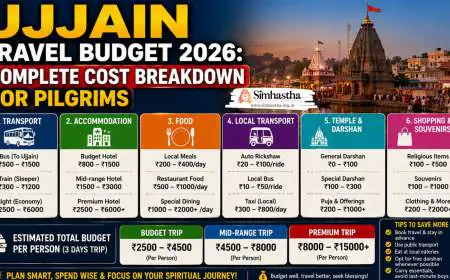























Total Budget for Ujjain Simhastha 2028 (Realistic Estimate)
Planning for Ujjain Simhastha 2028? Realistic budget breakdown for travel, stay, food, and puja. Plan your pilgrimage without breaking the bank.



What Will Simhastha 2028 Really Cost You? Let’s Talk Real Numbers
Let me be straight with you. Ujjain Simhastha 2028 is not just another pilgrimage. It is the Kumbh Mela of the Shipra River – a massive, once-every-12-years gathering of millions of devotees, sadhus, and travelers from across India and the world. And if you are planning to be there, you need to know what it will actually cost you. Not the inflated numbers that travel agents throw at you. Not the rock-bottom “I slept on the platform” budgets. I am talking about realistic, honest estimates for a normal person or family – covering travel, accommodation, food, puja, and those little unexpected expenses that always pop up. I have attended two Simhasthas (2016 and the Ardh Kumbh in between), and I have seen people spend anywhere from 5,000 rupees for a spartan 2-day trip to over a lakh for a luxury week-long stay. In this guide, I will break down every single expense category – from the cheapest dharamshala bed to the most comfortable tent city, from a crowded sleeper train to a private taxi from Delhi. I will tell you what you can book in advance, what you should leave for last minute, and where most pilgrims end up overspending. No vague ranges. No “it depends” without explanation. Just real numbers based on 2023-2024 prices, adjusted realistically for 2028 inflation. Let me help you plan your Simhastha 2028 without opening your wallet and crying.
Understanding Simhastha – Why 2028 Is Different
First, a quick reality check. Simhastha (also called Simhasth Kumbh) happens every 12 years in Ujjain when Jupiter is in Leo (Simha Rashi). The last one was in 2016. The next is in 2028. Exact dates will be announced closer to the event, but traditionally it falls between April and May (though some rituals start earlier). What does this mean for your budget? Peak season pricing on steroids. Hotels that charge 1,000 rupees a night normally will charge 5,000 to 8,000 rupees during Simhastha. A plate of simple poha that costs 20 rupees will cost 50 rupees. Taxis will quote you triple the normal fare. And if you think you can just show up and find a cheap room – you are in for a rude shock. Planning and advance booking are not optional for Simhastha 2028. They are the difference between a peaceful pilgrimage and a financial nightmare.
In this guide, I will give you two sets of numbers: budget options for the frugal pilgrim and comfort options for families or elderly travelers. I will also flag which expenses you can control and which are fixed.
Travel Cost – Getting to Ujjain from Major Indian Cities
Your journey to Ujjain for Simhastha 2028 will likely start from a major city like Mumbai, Delhi, Ahmedabad, Pune, Hyderabad, Bangalore, or Chennai. You may also come from smaller towns like Hisar, Kota, or Indore itself. Let me break down travel costs from different starting points.
Trending Guides Now

2 Days Ujjain Itinerary for Senior Citizens Easy Travel

Ujjain Simhastha 5 Day Itinerary for Couples

Safety Guidelines Every Ujjain Simhastha Pilgrim Must Follow
How Hotel Pricing Works in Ujjain Simhastha 2028

Ujjain Railway Station to Mahakaleshwar Temple Distance (2026 Guide)

Ujjain Simhastha 2028 Dates Announced: Full Shahi Snan & Event Timeline

Benefits of Becoming a Simhastha Volunteer
Ujjain Travel During Shravan Month: What Changes for Visitors
From Delhi to Ujjain (Approx 800 km)
By train (most common):
-
Sleeper class (budget): 500 to 700 rupees one way. But during Simhastha, Railways runs special trains, and regular trains get fully booked. Expect Tatkal or special fares to be 2x to 3x higher. Realistic Simhastha train fare in Sleeper: 1,200 to 1,800 rupees one way if you book late.
-
AC 3-tier (comfort): Normal fare 1,200 to 1,500 rupees. During Simhastha, with special quotas and demand, expect 2,500 to 4,000 rupees one way.
-
Shatabdi chair car: Normal 1,000 to 1,500 rupees. Simhastha time: 2,500 to 3,500 rupees.
By flight (via Indore):
-
Delhi to Indore flight: Normal 3,000 to 5,000 rupees. During Simhastha (April-May), flights will be in high demand. Realistic one-way fare: 6,000 to 10,000 rupees.

-
Indore airport to Ujjain taxi: Normal 1,200 to 1,800 rupees. Simhastha time: 2,500 to 4,000 rupees (if you can even find a taxi – many will be pre-booked). Shared taxis: normal 300 rupees, Simhastha time 600 to 1,000 rupees.

By road (self-drive or taxi):
-
Fuel from Delhi to Ujjain (approx 800 km one way): For a diesel car (20 km/l), fuel cost about 3,600 rupees (40 liters x 90 rupees). Tolls: 1,200 to 1,500 rupees. Total one-way driving cost: 4,800 to 5,100 rupees for the whole car. For 4 people, that is 1,200 to 1,300 rupees per person – cheaper than train AC. But parking in Ujjain during Simhastha is a nightmare. You may have to park 5-10 km away and take shuttle buses.
-
Hiring a taxi from Delhi: Normal one-way sedan fare is 10,000 to 12,000 rupees. During Simhastha, expect 18,000 to 25,000 rupees one way. Plus driver overnight allowance.
From Mumbai to Ujjain (Approx 650 km)
By train:
-
Sleeper: Normal 400 to 600 rupees. Simhastha realistic: 1,000 to 1,500 rupees.
-
AC 3-tier: Normal 1,000 to 1,200 rupees. Simhastha: 2,000 to 3,500 rupees.
By flight (via Indore):
-
Mumbai to Indore flight: Normal 2,500 to 4,000 rupees. Simhastha: 5,000 to 8,000 rupees.
-
Taxi from Indore as above.
By road: Shorter than from Delhi. Fuel cost approx 3,000 rupees one way + tolls 800 rupees = 3,800 rupees for the car. Per person for 4: 950 rupees.
From Ahmedabad to Ujjain (Approx 400 km)
By train:
-
Sleeper: Normal 250 to 350 rupees. Simhastha: 600 to 900 rupees.
-
AC 3-tier: Normal 600 to 800 rupees. Simhastha: 1,500 to 2,500 rupees.
By road: Fuel + tolls approx 2,000 rupees for the car. Per person for 4: 500 rupees – very economical.
From Bangalore / Hyderabad to Ujjain
Long distance. Flight via Indore is your best bet.
-
Bangalore to Indore: Normal 4,000 to 6,000 rupees. Simhastha: 8,000 to 12,000 rupees.
-
Hyderabad to Indore: Normal 3,000 to 5,000 rupees. Simhastha: 6,000 to 9,000 rupees.
Then taxi to Ujjain as above.
From Hisar / Kota / Other Nearby Cities
Refer to my previous guides for Hisar to Ujjain and Kota to Ujjain for detailed train and road costs. In summary, from Kota (250 km), a taxi during Simhastha will cost 5,000 to 7,000 rupees one way (normal 3,500 to 4,500). Train from Kota to Ujjain: Sleeper normal 150 rupees, Simhastha 400 to 600 rupees.
Bottom line on travel: If you are coming from Delhi or Mumbai, budget 3,000 to 5,000 rupees per person for a round trip in sleeper train (with advance booking). For AC train, budget 6,000 to 10,000 rupees round trip. For flights, budget 12,000 to 20,000 rupees round trip per person. For a family of four driving from Delhi, budget 10,000 to 12,000 rupees round trip for fuel and tolls – often the cheapest option if you have a car.
Accommodation Cost – Where Will You Sleep?
This is where Simhastha 2028 will hit your wallet the hardest. Ujjain has limited hotel rooms – maybe 15,000 to 20,000 beds in normal times. During Simhastha, millions come. The government sets up tent cities and temporary shelters, but even those fill up fast. Let me break down your options.
Tent Cities (Government and Private)
The Madhya Pradesh Tourism Board and private operators set up huge tent cities on the outskirts of Ujjain. These are organized, with beds, common toilets, and sometimes food courts.
-
Budget tent (non-AC, shared bathroom): Normal Simhastha price (based on 2016) was 1,500 to 2,500 rupees per night per person. Adjusted for 2028 inflation: 2,500 to 4,000 rupees per night. This includes a cot, mattress, bedsheet, blanket, and access to common toilets (which can get very dirty during peak days).
-
Deluxe tent (AC, attached bathroom): In 2016, these were 4,000 to 6,000 rupees per night. By 2028, expect 7,000 to 12,000 rupees per night for a double occupancy tent.
-
Luxury tent (AC, attached bathroom, meals included): 2016 prices 8,000 to 12,000 rupees. 2028 estimate: 15,000 to 25,000 rupees per night.
How to book: The government’s tent city booking usually opens 3 to 6 months before Simhastha. Book online through the official website. Do not wait. These sell out within days.
Hotels and Guesthouses
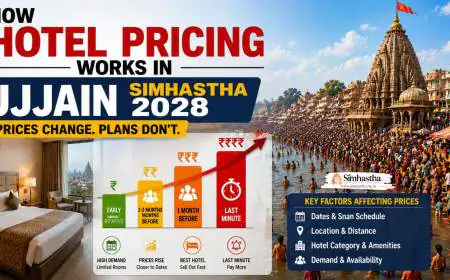
Normal hotels in Ujjain charge 800 to 2,000 rupees for a decent room. During Simhastha 2016, the same rooms went for 5,000 to 10,000 rupees per night – and they were still fully booked. For 2028, realistic budget hotel (no AC, basic): 4,000 to 6,000 rupees per night. Mid-range hotel (AC, decent): 8,000 to 15,000 rupees per night. Luxury hotel (good location, AC, restaurant): 20,000 to 35,000 rupees per night.
And here is the kicker: many hotels require minimum stay of 3 to 5 nights during Simhastha. Some ask for full advance payment. Be prepared.
Dharamshalas and Ashrams
These are pilgrim rest houses run by trusts. They are the cheapest option, but also the most basic. In 2016, a bed in a shared dormitory in a dharamshala cost 300 to 800 rupees per night. By 2028, expect 800 to 2,000 rupees per night. Some dharamshalas are free or donation-based, but you will need to arrive very early and wait in long lines. Not recommended for families or elderly.
Staying in Nearby Cities – The Smart Hack
Here is a money-saving secret that locals use. Instead of staying in Ujjain, stay in Indore (55 km away) or Dewas (35 km away) or Ratlam (85 km away). Hotel prices in Indore during Simhastha will also rise, but not as sharply as in Ujjain. A hotel in Indore that normally costs 1,500 rupees might cost 3,000 to 4,000 rupees during Simhastha – still much cheaper than Ujjain’s 8,000 to 15,000 rupees. Then take a train or bus from Indore to Ujjain each morning (trains take 1.5 hours, cost 50 to 150 rupees). Yes, you lose time commuting. But you save thousands of rupees per night.
Example budget for 5 nights: Staying in Ujjain mid-range hotel: 5 nights x 10,000 rupees = 50,000 rupees. Staying in Indore mid-range hotel: 5 nights x 4,000 rupees = 20,000 rupees + daily commute 200 rupees x 5 = 1,000 rupees. Total 21,000 rupees – saving of 29,000 rupees.
Camping on Your Own (Not Recommended)
Some pilgrims bring their own tents and camp in designated areas. The government usually sets up free or low-cost camping zones. You will need to carry your own tent, sleeping bag, food, and water. Cost is almost zero if you already have gear. But safety, sanitation, and weather (April-May heat) are major concerns. Only for experienced campers.
Accommodation summary for Simhastha 2028 (per night):
-
Dharamshala dormitory: 800 to 2,000 rupees
-
Budget tent city (non-AC): 2,500 to 4,000 rupees
-
Budget hotel (non-AC, basic): 4,000 to 6,000 rupees
-
Deluxe tent (AC): 7,000 to 12,000 rupees
-
Mid-range hotel (AC): 8,000 to 15,000 rupees
-
Luxury tent/hotel: 15,000 to 35,000 rupees
For a 5-night stay, budget:
-
Backpacker: 5,000 to 15,000 rupees
-
Mid-range family: 40,000 to 75,000 rupees
-
Luxury: 1,00,000 to 1,75,000 rupees (yes, it can go that high)
Food and Water Expenses – Eating During Simhastha
You cannot carry 5 days of food with you. You will eat in Ujjain. Here is what to expect.
Normal Ujjain food prices: Thali 60 to 100 rupees, poha 20 rupees, samosa 15 rupees, water bottle 20 rupees.
During Simhastha 2016: Thali 150 to 250 rupees, poha 50 rupees, samosa 30 to 40 rupees, water bottle 50 rupees (and sometimes fake “branded” water).
Estimated for 2028:
-
Simple breakfast (poha, jalebi, chai): 80 to 120 rupees
-
Lunch thali at a budget eatery: 150 to 250 rupees
-
Dinner thali at a mid-range place: 250 to 400 rupees
-
Bottled water (1 liter): 40 to 60 rupees
-
Snacks (samosa, kachori, bhaji): 30 to 60 rupees each
Daily food budget per person:
-
Budget (simple local food, no restaurant meals): 300 to 500 rupees
-
Mid-range (one restaurant meal, rest local): 600 to 1,000 rupees
-
Comfort (all meals at decent restaurants, occasional sweets): 1,200 to 2,000 rupees
Pro tip: Carry your own water bottle and refill at government RO water kiosks – they are free or very cheap (5 to 10 rupees). Do not buy 20 water bottles a day. Also carry some dry snacks (biscuits, nuts, energy bars) from home to avoid paying tourist prices.
For a 5-day stay, food budget per person:
-
Budget: 1,500 to 2,500 rupees
-
Mid-range: 3,000 to 5,000 rupees
-
Comfort: 6,000 to 10,000 rupees
For a family of four, multiply accordingly.
Puja, Donations, and Holy Dip – Spiritual Expenses
Simhastha is not just about seeing. You will want to take a holy dip in the Shipra River, offer puja at Mahakaleshwar Temple, visit other temples, and possibly donate to sadhus or organizations.
Holy dip: Free. But you may want to hire a boat to take you to the deeper parts of the river for a more private dip. Boat ride: Normal 100 rupees, Simhastha 300 to 500 rupees per person.
Puja at Mahakaleshwar Temple: The temple has different puja categories.
-
General darshan: Free but expect 3 to 8 hour queues.
-
VIP darshan ticket: 250 to 500 rupees normally. During Simhastha, special passes may cost 1,000 to 2,000 rupees and still have long queues.
-
Bhasma Aarti: Special ticket normally 250 to 500 rupees. Simhastha time, these tickets are extremely limited and may be priced at 1,500 to 3,000 rupees – if you can get one at all. Some agents sell them for 5,000+.
Puja at other temples (Harsiddhi, Kal Bhairav, etc.): Smaller donations expected. Keep 100 to 500 rupees per temple.
Donations to sadhus and ashrams: No fixed amount. But you will see many sadhus asking for money. Give what you feel. Keep some 10, 20, 50 rupee notes handy. Do not feel pressured.
Prasad and offerings: You can buy flowers, coconut, incense, and sweets to offer. Expect to spend 200 to 500 rupees per puja if you buy from outside the temple.
Total puja and donation budget for 5 days:
-
Minimal: 500 to 1,000 rupees
-
Moderate: 2,000 to 5,000 rupees
-
Generous: 10,000 rupees and up
Local Transport – Getting Around Ujjain
During Simhastha, the city becomes a sea of people. Walking is often faster than any vehicle. But you will still need transport from your tent/hotel to the river ghats and temples.
Auto-rickshaws: Normal fare within city 30 to 50 rupees. Simhastha fare: 150 to 300 rupees for a short trip – and you will have to bargain hard. Many autos will refuse to go by meter.
Electric rickshaws (E-rickshaws): Cheaper. Normal 10 to 20 rupees shared. Simhastha: 50 to 100 rupees shared.
Shuttle buses (government): The MP government runs free or very cheap shuttle buses from parking lots to the main ghats. These are your best bet. Cost: 10 to 50 rupees per ride.
Private taxis: Avoid. They will be stuck in traffic and charge 1,000 rupees for a 2 km trip.
Daily local transport budget per person:
-
Using shuttle buses and walking: 100 to 200 rupees
-
Using auto-rickshaws: 500 to 1,000 rupees
For 5 days: 500 to 5,000 rupees depending on your choices.
Miscellaneous and Hidden Costs
These are the expenses that first-time Simhastha visitors forget.
Luggage storage: If you arrive early and cannot check into your hotel, you may need to store bags. Cloakrooms at railway station and bus stand: 50 to 150 rupees per bag per day.
SIM card and mobile data: You will need a local SIM if coming from outside India. Indian SIM for foreigners: 500 to 1,000 rupees with data.
Medical emergencies: Carry basic medicines. But if you need a doctor, private clinics may charge 500 to 2,000 rupees for a consultation. Carry a small first-aid kit.
Lost and found: Keep photocopies of ID proofs. If you lose your phone or wallet, it is gone. Do not carry expensive jewelry.
Donations to “pandas” (priests): At the ghats, priests may approach you to perform a ritual and then ask for money. Decide beforehand how much you will give. Typical 100 to 500 rupees.
Shopping: Simhastha has huge markets selling religious items, Rudraksha, beads, clothes. If you plan to shop, budget extra. A simple Rudraksha mala: 200 to 1,000 rupees. A brass lamp: 300 to 1,500 rupees.
Unexpected price hikes: Everything – from a cup of chai to a band-aid – will cost double or triple. Keep a buffer of 2,000 to 5,000 rupees per person for “surprise” expenses.
Putting It All Together – Total Budget for Simhastha 2028
Let me give you realistic total budgets for a 5-day, 4-night stay at Ujjain Simhastha 2028, per person, assuming travel from Delhi (mid-distance). Adjust for your own starting point.
Budget Pilgrim (Backpacker Style)
-
Travel (train sleeper, round trip, advance booking): 3,000 rupees
-
Accommodation (dharamshala dorm or budget tent, 4 nights): 8,000 rupees (2,000 per night)
-
Food (simple local, 5 days): 2,500 rupees
-
Puja & donations (minimal): 1,000 rupees
-
Local transport (shuttle buses, walking): 500 rupees
-
Miscellaneous & buffer: 2,000 rupees
Total per person: 17,000 rupees (approx)
For a family of 4: 68,000 rupees.
Mid-Range Pilgrim (Family with Basic Comfort)
-
Travel (train AC 3-tier, round trip, booked in advance): 6,000 rupees
-
Accommodation (budget hotel non-AC or deluxe tent, 4 nights): 24,000 rupees (6,000 per night)
-
Food (mid-range, one restaurant meal daily): 5,000 rupees
-
Puja & donations (moderate): 3,000 rupees
-
Local transport (mix of auto and shuttle): 2,000 rupees
-
Miscellaneous & buffer: 4,000 rupees
Total per person: 44,000 rupees (approx)
For a family of 4: 1,76,000 rupees.
Comfort/Luxury Pilgrim (Stress-Free, All Conveniences)
-
Travel (flight from Delhi to Indore + taxi, round trip): 20,000 rupees
-
Accommodation (AC hotel or luxury tent, 4 nights): 60,000 rupees (15,000 per night)
-
Food (good restaurants, all meals): 10,000 rupees
-
Puja & donations (generous, VIP passes): 10,000 rupees
-
Local transport (private auto or taxi on call): 5,000 rupees
-
Miscellaneous & buffer: 10,000 rupees
Total per person: 1,15,000 rupees (approx)
For a family of 4: 4,60,000 rupees or more.
Extreme Budget (For the Truly Frugal)
-
Travel (general class train, standing ticket): 1,500 rupees round trip
-
Accommodation (free dharamshala or sleeping in designated open areas): 0 to 1,000 rupees
-
Food (only free prasad and cheapest street food): 1,000 rupees
-
All else minimal: 500 rupees
Total per person: 3,000 to 4,000 rupees – but this requires immense patience, physical fitness, and tolerance for discomfort. Not for elderly or children.
How to Save Money Without Ruining Your Experience
Let me share some hard-earned tips from previous Simhasthas.
Book travel at least 6 months in advance. Railways opens reservations 120 days before. Set a calendar reminder. Book the moment tickets are available. You will pay normal fares, not surge prices.
Stay in Indore or Dewas. I have already explained the math. It works. You save thousands on accommodation and still experience Simhastha fully. Just be prepared for 1 to 2 hours of commuting each day.
Go for 3 days instead of 5. The main bathing dates (auspicious days) are the most crowded and expensive. If you go a few days before or after, accommodation prices drop significantly. You can still take a dip and see the main sights.
Share a tent or room. If you are a group of 4 or 6, book a larger tent or family room. Per person cost goes down.
Avoid eating at “tourist restaurants.” Walk 10 minutes away from the main ghats and you will find local eateries with normal prices. The same thali that costs 300 rupees near the temple costs 100 rupees two streets away.
Carry your own water and snacks from home. A 1-liter bottle from outside Ujjain costs 20 rupees. The same bottle inside Simhastha area costs 50 to 60 rupees. Bring a reusable bottle and refill.
Do not pay for “special darshan” from touts. Many touts will offer to take you inside the temple quickly for 1,000 to 2,000 rupees. Often they take your money and disappear. Use official channels only.
Hidden Costs That Shock First-Timers
Let me warn you about a few things that catch people off guard.
Toilet fees. Public toilets, even the pay-and-use ones, will charge 20 to 50 rupees per use during Simhastha. Carry small coins.
Parking fees. If you drive, parking lots charge 200 to 500 rupees per day. Some lots are far away, and you then pay for a shuttle.
Mobile phone charging. Public charging stations may charge 20 to 50 rupees for 30 minutes. Carry a power bank.
Crowd control barriers. On main bathing days, the police create barricades and force people to walk long detours. You may have to walk 3 to 4 km extra without any vehicle access. Be prepared physically.
Lost items. I have seen people lose shoes, bags, even children (temporarily) in the crowd. Keep a whistle, write your contact number on a wristband for kids, and wear shoes that are easy to remove but hard to lose.
A Realistic Day-by-Day Expense Example
Let me give you a sample 3-day mid-range budget for a couple from Delhi, staying in Indore and commuting to Ujjain.
Day 1 (Travel from Delhi to Indore):
-
Train Delhi to Indore (AC 3-tier): 3,000 rupees for two
-
Taxi from Indore station to hotel: 200 rupees
-
Hotel in Indore (mid-range, AC): 4,000 rupees for one night
-
Dinner: 600 rupees for two
Day 1 total: 7,800 rupees
Day 2 (Simhastha day in Ujjain):
-
Early morning train Indore to Ujjain (round trip for two): 300 rupees
-
Auto from Ujjain station to Ram Ghat: 200 rupees
-
Holy dip (free) + boat ride for two: 600 rupees
-
Breakfast near ghat: 200 rupees for two
-
VIP darshan pass at Mahakal (if available): 2,000 rupees for two
-
Lunch: 400 rupees
-
Afternoon visit to Harsiddhi and Kal Bhairav (auto fares): 300 rupees
-
Evening aarti at Ram Ghat (free)
-
Dinner: 600 rupees
-
Train back to Indore (included above)
Day 2 total: 4,600 rupees
Day 3 (Second day at Simhastha + return to Delhi):
-
Similar to day 2 but with less puja: 3,000 rupees for two
-
Train Indore to Delhi (AC 3-tier, evening): 3,000 rupees for two
-
Dinner on train: 400 rupees
Day 3 total: 6,400 rupees
Grand total for couple (3 days): 18,800 rupees – that is 9,400 rupees per person. Very reasonable for a mid-range Simhastha experience.
Final Thoughts – Start Saving Now for 2028
Ujjain Simhastha 2028 is still a few years away, but the money you save today will determine how comfortably you can experience it. Do not wait until 2027 to start planning. Open a separate savings account or an envelope and put aside 500 to 1,000 rupees every month starting now. By 2028, you will have 25,000 to 50,000 rupees – enough for a very comfortable pilgrimage. And remember, the spiritual value of bathing in the Shipra during Simhastha is priceless. But that does not mean you should pay 50,000 rupees for a hotel room when you can pay 10,000 rupees by staying in Indore. Be smart, book early, travel light, and keep your heart open. Baba Mahakal will take care of the rest.
Frequently Asked Questions