


















How Pilgrims Can Avoid Financial Risks at Simhastha
Learn how pilgrims can avoid financial risks at Simhastha 2028. Theft prevention, insurance, payment safety, booking scams, and money protection tips.

How Pilgrims Can Avoid Financial Risks at Simhastha
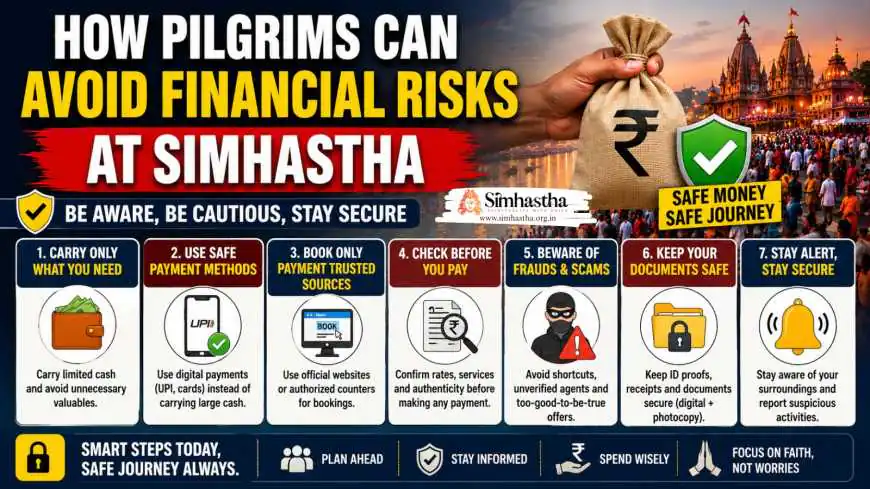
Pilgrims can avoid financial risks at Simhastha through seven key strategies: (1) purchase event-specific travel insurance covering theft, cancellation, and medical evacuation (₹850-3,500), (2) use a hidden money belt for extra cash, second card, and passport – never keep valuables in back pockets or bags, (3) carry multiple payment methods (cash in small denominations + two debit/credit cards + UPI on phone), (4) book accommodations through verified platforms or directly with hotels – avoid street touts promising "cheap tents," (5) set daily cash limits and withdraw from ATMs inside Ujjain city (not fairground ATMs which run out of cash), (6) take dated photos of all belongings at check-in for insurance proof, and (7) save bank helpline numbers offline to block cards immediately if stolen. The average pilgrim carries ₹15,000-25,000 in cash and cards. Without protection, theft or medical emergency can wipe out this entire amount. With basic precautions (₹1,500 insurance + ₹500 money belt + free document lamination), financial risk drops by 90%.
The Financial Risks Pilgrims Face at Simhastha
Over 5 crore pilgrims will attend Simhastha 2028. Crowds attract criminals. Stress causes mistakes. Here are the real financial risks:
Theft and Pickpocketing
Estimated losses at Simhastha 2016: 347 reported theft complaints (police figures). Estimated actual incidents: 1,500-2,000 (most not reported). Average loss per incident: ₹8,000-15,000. Total estimated theft losses: ₹1.5-3 crore.
Common theft scenarios:
Trending Guides Now

Ujjain Simhastha 7 Day Itinerary for Families

How Many Days Are Enough for Ujjain? Complete Trip Planner

Ujjain Simhastha 5 Day Itinerary for Couples
2 Days Ujjain Solo Female Travel Plan Safe Guide

Ujjain Railway Station to Mahakaleshwar Temple: Distance, Fare & Route

Ujjain Simhastha 2028 Dates Announced: Full Shahi Snan & Event Timeline
Mahakaleshwar to Kal Bhairav Temple: Distance, Auto Fare, Travel Time and Route Options
Mahakaleshwar to Gadkalika Temple: Distance, Auto Fare and Best Route
-
Pickpocketing in queues: Wallet or phone taken from back pocket or open bag
-
Tent burglary: Zippers cut while pilgrim is at ghat (₹5,000-25,000 loss)
-
Mobile phone snatching: Phone taken from hand or pocket in crowds
-
Hotel room theft: Unsecured room entered while pilgrim at temple (less common but happens)
Booking and Accommodation Scams
Fake tent bookings: Scammers create websites offering "Simhastha tent city" packages at 50% discounts. Pilgrims pay ₹10,000-25,000 upfront. Arrive to find no tent. Money gone.
Overbooking scams: Hotels accept 150 bookings for 50 rooms. You arrive with confirmed booking. Hotel says "sorry, overbooked" and offers no refund (blames "technical error" on booking platform).
Deposit non-refund scams: Hotels ask for "refundable deposit" of ₹1,000-2,000 for room key, TV remote, or "temple donation." At checkout, they claim damage and refuse refund.
Medical and Evacuation Costs
Without insurance, a single emergency can cost ₹2-5 lakhs:
| Emergency | Typical Cost Without Insurance |
|---|---|
| Heatstroke (3 days ICU) | ₹50,000-1,00,000 |
| Heart attack (angioplasty + 5 days) | ₹1,50,000-3,00,000 |
| Fracture (surgery + 7 days) | ₹1,00,000-2,00,000 |
| Air evacuation to Indore (helicopter) | ₹3,00,000-8,00,000 |
| Repatriation of mortal remains | ₹2,00,000-5,00,000 |
ATM and Card Fraud
-
Card skimming: ATMs near fairgrounds may have skimmers installed (especially temporary ATMs)
-
Cash-out ATMs: ATMs inside fairgrounds run out of cash within hours of refill
-
High fees: Non-bank ATMs charge ₹200-500 per withdrawal
Currency Exchange and Overcharging
-
Fake currency: Street vendors may give fake ₹500 notes as change
-
Dynamic pricing: Prices for food, water, puja items increase 2-3x during Shahi Snan days
-
"Prasad" scams: Fake priests demand ₹500-2,000 for "special prasad" (worth ₹50)
Cancellation Losses
Non-refundable bookings: Train tickets (₹2,000-5,000), hotel/tent (₹10,000-25,000), flight (₹5,000-15,000). If you fall ill before travel, you lose everything without cancellation insurance.

Layer 1: Travel Insurance – Your Financial Shield
Insurance is not an expense – it is financial protection. A ₹1,500 policy can save you ₹5 lakhs.
What Financial Risks Insurance Covers
| Risk | Insurance Coverage | Typical Limit |
|---|---|---|
| Theft of cash | ❌ NOT covered (cash excluded) | ₹0 |
| Theft of mobile, camera, bag | ✅ Covered (with police FIR) | ₹10,000-25,000 |
| Medical hospitalization | ✅ Covered (cashless) | ₹5-10 lakhs |
| Emergency evacuation | ✅ Covered | ₹2-5 lakhs |
| Trip cancellation (illness before travel) | ✅ Covered (with doctor certificate) | 75-100% of expenses |
| Trip interruption (illness during travel) | ✅ Covered | Pro-rated refund + return travel |
What Insurance Does NOT Cover – Critical to Know
-
Cash theft: Never covered. This is why you must carry cash in a hidden money belt.
-
Lost items without police FIR: No FIR = no claim.
-
Pre-existing conditions not disclosed: Claim denied entirely.
-
Intoxication-related incidents: If under influence of alcohol or bhang, claim denied.
-
Unattended items: Phone left on ghat step and stolen? Not covered.
Best Policies for Simhastha
| Insurer | Policy | Financial Coverage | Premium (15 days) |
|---|---|---|---|
| New India Assurance | Kumbh Mela Special | ₹10L medical, ₹2L evacuation, ₹25K baggage | ₹1,500-3,500 |
| Oriental Insurance | Pilgrim Safety Plus | ₹7.5L medical, ₹25K child reunification, ₹15K baggage | ₹1,800-4,000 |
| ICICI Lombard | Mass Gathering Protect | ₹5L medical, ₹10K baggage, WhatsApp claims | ₹2,000-3,500 |
Purchase deadline: Buy at least 14 days before travel (cancellation cover requires policy active before booking). For Simhastha, buy 6-8 months in advance.
Layer 2: Money Protection – The 3-Pocket System
Cash is your most vulnerable asset – insurance does NOT cover stolen cash. Protect it.
The 3-Pocket System
| Contents | Risk Level | Daily Amount | |
|---|---|---|---|
| Hidden money belt (under clothes) | Extra cash, second card, passport | Zero (thieves cannot access) | ₹10,000-15,000 reserve |
| Front pocket (buttoned/zippered) | Today's cash, one card | Low | ₹2,000-3,000 |
| Back pocket | Nothing except tissues | Never keep valuables here | ₹0 |
Money Belt Options
-
Classic money belt: Flat pouch that tucks under pants/shirt. Holds passport, ₹10,000-15,000 cash, one card. ₹200-500 on Amazon.
-
Neck pouch: Worn under shirt. Good for seniors who cannot reach waistband easily. ₹150-300.
-
Bra stash (for women): Small fabric pouch pinned inside bra. Discreet, accessible. ₹100-200.


What NOT to use: Waist pack/fanny pack worn outside clothes – easy to cut strap or unclip. Backpack – pickpockets access from behind.
Cash Management Strategy
Before travel:
-
Withdraw ₹15,000-25,000 in small denominations: ₹100 (20 notes), ₹200 (20 notes), ₹500 (20 notes). Avoid ₹2,000 notes – vendors cannot make change.
-
Divide cash: ₹3,000 in front pocket (today's money), ₹12,000 in money belt (reserve)
-
Each morning, move ₹2,000-3,000 from money belt to front pocket (today's spending)
-
Never pull out your money belt in public – go to bathroom or private area
-
Keep ₹500-1,000 in a different pocket for emergencies (if front pocket is picked)
If you run out of cash:
-
Use second card (in money belt) to withdraw from ATM
-
Use UPI (PhonePe, Google Pay) – but network congestion may cause delays
-
Never show your entire cash stack when paying – only take out what you need
Payment Methods – Diversify
| Method | Pros | Cons | Backup Needed? |
|---|---|---|---|
| Cash (small denominations) | Works everywhere, no network needed | Theft risk, no fraud protection | Yes – keep reserve |
| Debit card 1 | ATM access, fraud protection | Network may fail, skimming risk | Yes – second card |
| Debit card 2 (different bank) | Backup if first card blocked | Same risks | Yes – cash |
| UPI (PhonePe, GPay) | Convenient, no physical theft | Network congestion at Simhastha (delays 5-30 min) | Yes – cash backup |
| Credit card | Fraud protection, no immediate cash outflow | Not accepted by small vendors, high interest if not paid | No |
Recommended setup for Simhastha:
-
Money belt: ₹12,000 cash + second debit card + passport
-
Front pocket: ₹3,000 cash + primary debit card
-
Phone: UPI apps loaded with ₹5,000-10,000 balance
-
Back home: Family member with access to emergency funds
Layer 3: ATM and Card Safety
ATMs at Simhastha are high-risk. Follow these rules:
Before Using Any ATM
-
Use ATMs inside Ujjain city (not inside fairgrounds) – withdraw before entering the event zone
-
Check for skimmers: Pull at card slot – if it moves or feels loose, do NOT use. Look for tiny cameras on keypad.
-
Cover your PIN: Use your other hand to shield the keypad – thieves use tiny cameras or binoculars.
-
Prefer bank ATMs (SBI, HDFC, ICICI) over white-label ATMs (non-bank) – lower fraud risk, lower fees.
ATM Timing and Cash Availability
-
Best time to withdraw: 8-9 AM (ATM just refilled), 4-5 PM (before evening rush)
-
Avoid: 10 AM-2 PM (long queues, high chance ATM runs out before your turn), after 8 PM (security risk, may be empty)
-
Withdraw enough for 2-3 days (₹5,000-7,000) to minimize ATM visits
If Card Is Eaten or Stuck
-
Do NOT leave the ATM – call the bank helpline immediately (number on ATM)
-
Take a photo of the ATM machine and location (for bank dispute)
-
Use your second card (in money belt) for withdrawals
If Card Is Lost or Stolen – Immediate Action
Step 1: Call bank helpline (numbers saved in your notebook – NOT just phone)
Step 2: Block the card (note the complaint/reference number)
Step 3: Use your second card (in money belt)
Step 4: If both cards lost, use cash reserve (money belt) + UPI (phone)
Step 5: Arrange emergency funds from family back home (Western Union, bank transfer to a fellow pilgrim's account)
Bank helpline numbers to write in notebook before travel:
-
SBI: 1800 1234 (toll-free) / 1800 2100 (chargeable from mobile)
-
HDFC: 1800 202 6161
-
ICICI: 1800 1080
-
Your bank's specific number
Layer 4: Avoiding Booking and Accommodation Scams
Scammers target pilgrims booking tents and hotels for Simhastha.
Common Scams and How to Avoid
| Scam | How It Works | Prevention |
|---|---|---|
| Fake tent city website | Website offers "Official Simhastha Tent City" at 50% discount. Collects advance payment (₹10,000-25,000). No tent exists. | Only book through official Simhastha website (mp tourism) or verified hotel booking platforms (Booking.com, Agoda, Goibibo). Never pay by bank transfer to individual. |
| "Too good to be true" prices | Scammer offers luxury tent at ₹3,000/night (real price ₹10,000). Requires full advance payment. | Compare with real prices. If deal is 50%+ below market, it is a scam. |
| Overbooking at check-in | You book online. Arrive at hotel. Hotel says "overbooked" and offers no room. | After online booking, call hotel 48 hours before arrival to confirm. Get confirmation name. |
| Deposit non-refund | Hotel asks ₹1,000-2,000 "refundable deposit" for key/remote. At checkout, claims damage (broken TV remote, stained sheet) and keeps deposit. | Ask before paying: "Is deposit fully refundable at checkout if no damage? Can I inspect room with you at check-in and check-out?" |
| Street tout "cheap tents" | Near railway station, tout offers "cheap tent" (₹500/night). Takes you to a crowded dormitory or non-existent location. Takes commission and disappears. | Never follow touts. Book directly with hotel/tent city. |
Verified Booking Sources for Simhastha 2028
| Source | Type | Trust Level | Payment Method |
|---|---|---|---|
| Official Simhastha website (mp tourism) | Tent city bookings | Highest (government) | Online payment |
| Booking.com / Agoda / Goibibo | Hotels and some tents | High (consumer protection) | Online payment |
| Hotel direct (phone call) | Hotels | High (if verified number) | Cash at check-in or bank transfer to hotel account |
| Street touts | Anything | ❌ Zero (high scam risk) | Never use |
Red Flags – Do NOT Book If
-
Deposit required by bank transfer to individual name (not company name)
-
No GST number provided (legitimate hotels have GST numbers)
-
"Limited time offer – pay now or lose it" pressure tactics
-
Website has no phone number or address (only email form)
-
Price is 40%+ below market rates (too good to be true = scam)
Layer 5: Theft Prevention at the Event
At the Ghats and in Crowds
| Item | Protection Method |
|---|---|
| Mobile phone | Front pocket only. Consider neck pouch under shirt. Never back pocket. |
| Wallet | Money belt under clothes (ideal). Second best: front buttoned pocket. |
| Backpack | Wear on front in crowds. Lock zippers with small TSA lock. |
| Camera | Strap across body, not just over one shoulder. Keep hand on it in crowds. |
| Silver items (purchased at Simhastha) | Do not carry in open bags. Put in backpack immediately after purchase. |
At Your Tent or Hotel Room
-
Do not leave valuables in tent during the day – even locked tents can be cut open
-
Use hotel locker (if available) – most mid-range and luxury hotels have in-room safes
-
Carry passport, extra cash, second card with you in hidden money belt
-
Take a video walkthrough of your tent after check-in – showing all your belongings. This serves as proof for insurance claims if theft occurs.
If You Are Theft Victim
Do not chase the thief in a crowd – you will get lost or injured. Instead:
-
Go to nearest police chowki – file FIR immediately (within 2 hours)
-
Call insurer's theft helpline (number on your laminated card)
-
If phone stolen, go to tent/hotel and use backup phone or reception phone
-
Block any stolen cards using bank helpline (numbers in your notebook)
Without police FIR, no insurance claim for theft. Do not skip this step.
Layer 6: Avoiding Overcharging and Small Scams
Dynamic Pricing – Prices Change Based on Demand
During Shahi Snan days, prices for food, water, and puja items increase 2-3x. A ₹20 bottle of water becomes ₹50-60. A ₹50 thali becomes ₹150.
How to avoid overpaying:
-
Buy water and snacks before Shahi Snan days (stock up)
-
Eat at bhandaras (free meals) – quality is good, no overcharging
-
Carry your own water bottle and refill at RO stations (free)
-
Ask price before ordering – if too high, walk away
Fake Prasad and Donation Scams
Common scam: Person dressed as sadhu or temple priest approaches you near Gate No 1. Offers "special prasad" or "VIP darshan pass." Demands ₹500-2,000. Prasad is worth ₹50. Pass is fake.
Prevention:
-
Real temple prasad is sold only at official counters inside temple complex (fixed prices: ₹10-100)
-
VIP darshan passes are issued by temple trust office (₹200-500) – not by individuals on the street
-
Do not give money to anyone claiming to represent the temple unless they are inside a temple office
Fake Currency
Vendors may give counterfeit ₹500 notes as change, especially when you pay with ₹2,000 notes.
Prevention:
-
Carry small denomination notes (₹100, ₹200) to avoid needing change
-
Check notes when receiving change – feel for raised print, see watermark
-
If given fake note, refuse it immediately and ask for different change
-
Avoid using ₹2,000 notes at small vendors (they cannot make change and may give fake notes)
Layer 7: Emergency Financial Planning
Before Travel – Prepare for the Worst
-
Share itinerary and financial plans with family back home: hotel name, phone numbers, expected return date
-
Leave one credit card with a trusted family member (who can wire funds if needed)
-
Save bank helpline numbers offline (in notebook, not just phone)
-
Keep ₹5,000-10,000 in a separate hidden location (inside shoe, toiletry bag) as absolute emergency reserve
During Travel – Daily Financial Check-In
-
Each evening: Count remaining cash. Plan next day's withdrawal if needed.
-
Each evening: Check that you still have both cards, ID, and passport.
-
Share location with family back home via WhatsApp (when network permits)
If You Lose Everything (Wallet, Phone, Both Cards)
Scenario: Front pocket picked (₹3,000 + primary card). Money belt still has ₹12,000 + second card + passport.
Action:
-
Use second card from money belt to withdraw cash
-
Block primary card using bank helpline
-
Continue pilgrimage with reserve cash
Scenario (worse): Both front pocket AND money belt lost/stolen (entire wallet, both cards, passport, all cash). Phone also stolen.
Action:
-
Go to nearest police chowki – file FIR (copy needed for passport replacement)
-
Contact your country's consulate/embassy (if international pilgrim) for emergency passport
-
Contact family back home – they can wire funds via Western Union (pick up at Ujjain post office)
-
Use your emergency reserve (if hidden separately – in shoe, toiletry bag)
-
Seek help from your tent city/hotel – they may have provisions for destitute pilgrims
Layer 8: Cancellation Protection – Saving Non-Refundable Bookings
What Trip Cancellation Insurance Covers
| Reason for Cancellation | Covered? | Documentation Needed |
|---|---|---|
| You or immediate family hospitalized | ✅ Yes | Doctor's certificate, hospital admission papers |
| Death of immediate family | ✅ Yes | Death certificate |
| Government-issued travel ban | ✅ Yes | Official order |
| Natural disaster making home uninhabitable | ✅ Yes | Police/FIR report |
| Change of mind | ❌ No | – |
| Work-related cancellation | ❌ No | – |
| Fear of crowds (without official ban) | ❌ No | – |
How to Make a Cancellation Claim
-
Cancel bookings (tent, hotel, train, flight) – get cancellation confirmation from each provider
-
Gather documents: Doctor's certificate, hospital admission proof, booking confirmations, cancellation confirmations, payment receipts
-
File claim with insurer within 7 days of cancellation (check policy – some have shorter windows)
-
Submit documents via email or insurer's claim portal
Payout timeline: 15-30 days after claim approval.
To Protect Cancellable Bookings
-
Book refundable rates (₹200-500 extra per night) – may save ₹10,000-25,000 if you cancel
-
Book train tickets with cancellation cover (IRCTC offers 50-100% refund if cancelled 2-48 hours before)
-
Buy insurance BEFORE making non-refundable bookings (cancellation cover only applies to bookings made after policy purchase)
Financial Checklist for Simhastha Pilgrims
2-4 Weeks Before Travel
-
Buy Simhastha-specific travel insurance (with cancellation, theft, medical)
-
Withdraw ₹15,000-25,000 in small denominations (₹100, ₹200, ₹500)
-
Inform your bank of travel dates (prevents card blocking)
-
Save bank helpline numbers in notebook (not just phone)
-
Make photocopies of both cards (front and back) – store separately
-
Buy money belt (₹200-500) – practice wearing under clothes
1 Week Before Travel
-
Divide cash: ₹3,000 front pocket + ₹12,000 money belt
-
Load UPI apps (PhonePe, Google Pay) with ₹5,000-10,000
-
Confirm all bookings (call hotels directly)
-
Print hotel/tent confirmations (laminated copies)
-
Share itinerary and emergency plan with family back home
Daily During Simhastha
-
Morning: Move ₹2,000-3,000 from money belt to front pocket
-
Check that you still have both cards, ID, passport
-
Evening: Count remaining cash, plan next day
-
Never show money belt in public
-
Never put phone or wallet in back pocket
Emergency Contacts – Write in Notebook
-
Bank helpline (your bank): _______________
-
Insurance Simhastha helpline: _______________
-
Police chowki (your tent area): _______________
-
Family back home (name, phone): _______________
-
Tent city/hotel reception: _______________
-
Western Union (for emergency funds): _______________
Final Wisdom – Financial Preparedness Is Devotion
Money is not the purpose of your pilgrimage. But the lack of money – or the loss of it – can destroy your pilgrimage.
When you take the time to buy insurance, to wear a money belt, to laminate your documents, to save bank helpline numbers – you are not being paranoid. You are being wise. You are protecting not just your money, but your family's peace of mind. You are ensuring that if something goes wrong, you can focus on recovery, not on finances.
The great pilgrimages of history were not made by the reckless. They were made by the prepared – those who carried enough food, enough water, enough protection for the journey.
Simhastha is a journey of faith. But faith and foolishness are not the same. Protect your finances. Then walk to Mahakal with a calm heart and a full wallet – not because money matters to him, but because it matters to your safe return home. 🙏
Frequently Asked Questions