
















What Does Simhastha Travel Insurance Actually Cover?
What Simhastha travel insurance actually covers - medical emergencies, trip cancellation, theft, and hidden exclusions. Read before you buy for Ujjain 2028.
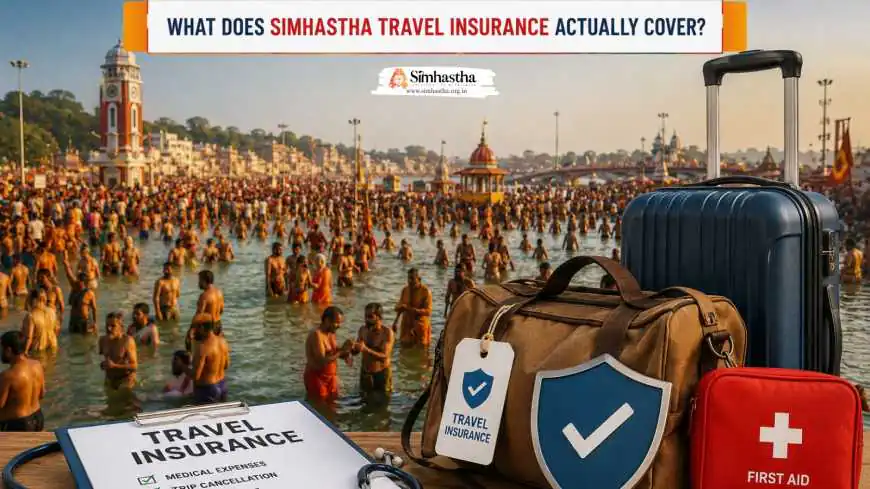


Why Simhastha is Different from Any Other Trip
Let me be very clear. Simhastha is not a normal vacation. You are not going to a resort in Goa or a hill station in Himachal. You are going to one of the largest human gatherings on planet Earth. Five crore pilgrims - that is fifty million people - will be in Ujjain over the course of the event. The Shahi Snan days will see crowds so dense that you cannot lift your arms. The tent cities are temporary structures with basic amenities. The medical infrastructure that works perfectly for Ujjain's normal population of 5 lakh people will be stretched beyond imagination.
In this environment, the risks are not theoretical. Heat stroke is real when temperatures hit 45°C. Dehydration sends thousands to medical camps every single day. Stampede injuries happen when crowd control fails. Theft is rampant in the chaos. Accidents - from slipping on wet ghat steps to falling out of overcrowded trains - increase dramatically.
Normal travel insurance policies, the ones designed for a weekend trip to Manali, will leave you stranded. You need a policy designed for mass gathering events or at least one that specifically does not exclude them. And you need to understand every single clause before you sign.
What Simhastha Travel Insurance Actually Covers
Let me break down the coverage into real categories. Not insurance company jargon. Real, human language about what you get.
Trending Guides Now
Ujjain Simhastha 7 Day Itinerary for Families
2 Days Ujjain Wheelchair Travel Plan Senior Guide
Ujjain Temple Tour by Auto, Taxi or Walking: Best Choice
Ujjain Family Trip Guide: Temples, Hotels and Travel Tips
Ujjain Railway Station to Mahakaleshwar Temple Distance (2026 Guide)

Ujjain Simhastha 2028 Dates Announced: Full Shahi Snan & Event Timeline
Mangalnath Temple Trip Budget: Puja, Local Transport, Food and Stay Planning
Omkareshwar Trip Budget Guide: Transport, Stay, Food and Local Travel Costs
Medical Emergencies and Hospitalization
This is the most important coverage. If you have a heart attack, a stroke, a severe allergic reaction, or any other medical emergency during Simhastha, your insurance should cover the cost of hospitalization, doctor fees, medicines, diagnostic tests, and ambulance services .
But here is the catch. Most policies have a sub-limit for specific expenses. They might cover hospitalization up to ₹5 lakhs, but only ₹10,000 for ambulance. Or ₹25,000 for doctor consultations. Or ₹15,000 for medicines. Read the policy document and look for these sub-limits. They are where the hidden gaps live.
Also check if the policy covers pre-existing conditions. If you have diabetes, high blood pressure, heart disease, or asthma, many travel insurance policies will exclude any claim related to these conditions. Some policies offer coverage for pre-existing conditions if you pay an extra premium and declare them at the time of purchase. If you are an elderly pilgrim or have known health issues, this is not optional. It is essential.
Emergency Medical Evacuation
This coverage is critical for Simhastha. If you suffer a medical emergency that the local hospitals in Ujjain cannot handle - for example, a severe head injury or a major cardiac event requiring specialized surgery - emergency medical evacuation covers the cost of transferring you to a better hospital in Indore (which has larger medical facilities) or even to your home city .
The evacuation can be by road ambulance, air ambulance, or even helicopter if the situation is dire and roads are blocked by crowds. An air ambulance from Ujjain to Mumbai can cost ₹15-20 lakhs. Without insurance, that bill is yours alone. With insurance, it should be covered up to the policy limit.
Check the sub-limit for evacuation. Some policies cap it at ₹2 lakhs. An air ambulance costs far more than that. Look for policies with at least ₹10 lakhs of evacuation coverage, or better yet, unlimited or actual expense coverage.

Trip Cancellation and Interruption
You booked your train tickets six months ago. You paid a deposit for your tent in the authorized camps. You took leave from work and your family made their plans. Then, two days before you are supposed to leave, a close family member is hospitalized. Or you fall sick yourself and the doctor says you cannot travel. Or a natural disaster hits Ujjain and the mela dates are changed.
Trip cancellation coverage reimburses you for the non-refundable expenses you have already paid - train tickets, accommodation deposits, and other pre-booked services. Trip interruption coverage kicks in if you have to cut your trip short and return home early, covering the cost of last-minute transport and unused accommodation.
But read the fine print carefully. Most policies only cover cancellation for specific reasons listed in the policy document. These usually include: death or serious illness of you or an immediate family member, natural disaster at your destination, jury duty or court summons, and being called for military service. They do NOT cover cancellation because you changed your mind, because you are afraid of crowds, or because you got a better offer.
Loss of Baggage and Personal Belongings
Your suitcase contains your clothes, your medicines, your phone charger, your wallet, and your jewelry. You check it into the cloakroom at Ujjain Junction while you go for your holy bath. When you return, the bag is gone. Or your tent gets slashed open while you are at the ghat and your laptop and camera are stolen.
Baggage loss coverage reimburses you for the value of your lost belongings, up to a certain limit. Most policies have a per-item limit (for example, ₹10,000 per item) and a total limit (for example, ₹50,000 total). They also have exclusions - cash, jewelry, electronics, and important documents are often capped at much lower amounts or excluded entirely.
For Simhastha, where theft is unfortunately common in the chaos, check if the policy covers theft from a tent. Some policies consider a tent a "temporary structure" and exclude coverage. Others require proof of forced entry - which is hard to prove if your tent had only a zipper. Call the insurance company and ask this question directly before buying.
Accidental Death and Dismemberment
This is the most grim coverage, but it exists for a reason. If you die in an accident during Simhastha - for example, a stampede, a fall from a crowded train, or a road accident - the policy pays a lump sum benefit to your nominee. If you lose a limb or eyesight in an accident, the policy pays a percentage of the sum insured.
This coverage is usually a fixed benefit amount, not reimbursement of actual expenses. A typical policy might offer ₹5-10 lakhs for accidental death. This money is meant to cover funeral expenses, outstanding bills, and provide some financial support to your family.
Repatriation of Remains
This is the coverage no one wants to think about, but it is essential. If a pilgrim dies during Simhastha, repatriation of remains coverage pays for preparing the body, the coffin, the legal paperwork, and transporting the remains back to the family's hometown .
Without this coverage, the family faces a bill of ₹50,000 to ₹2 lakhs depending on the distance. With it, the insurance company handles the arrangements and pays the costs. Some policies offer this as part of medical evacuation coverage. Others have a separate sub-limit. Check before you buy.
What Travel Insurance Does NOT Cover (The Shocking Exclusions)
Now for the part that insurance companies do not advertise. The exclusions. The things you assume are covered but absolutely are not.
Pre-Existing Medical Conditions
This is the number one reason claims are denied. If you have diabetes and you have a diabetic emergency during Simhastha, your claim will likely be rejected if you did not declare the condition and pay an extra premium. If you have high blood pressure and you have a stroke, same story. If you have asthma and you have a breathing attack in the polluted, dusty mela environment, denial.
Some policies offer coverage for pre-existing conditions if you buy a specific add-on and provide a medical certificate from your doctor. This add-on costs extra. Buy it. Do not try to hide your medical history. Insurance companies have access to your medical records through databases. When they find out you lied on the application, they void the entire policy and refund your premium - leaving you with zero coverage.
Participation in Adventure Sports or Risky Activities
Are you planning to take a dip in the Shipra River? That is fine. But if you decide to go white water rafting on a side trip to the Narmada, that is likely excluded. Paragliding, bungee jumping, rock climbing - all excluded unless you buy specific adventure sports coverage.
Self-Inflicted Injuries or Suicide
Any injury you cause to yourself intentionally is excluded. This is standard across all insurance policies.
Alcohol or Drug Related Incidents
If you consume alcohol or illegal drugs and then have an accident or medical emergency, the claim will be denied. Most policies have a specific exclusion for incidents "while under the influence of intoxicating substances."
War, Terrorism, or Civil Unrest
This is a tricky one for Simhastha. If there is a terrorist attack or civil unrest at the mela grounds and you are injured, many standard policies exclude this. Some policies offer terrorism coverage as an add-on. Given the high profile of Simhastha and the massive crowds, this is worth considering.
Pandemics or Epidemics
Post-COVID, many travel insurance policies added specific pandemic exclusions. If a new virus spreads during Simhastha 2028 and you get sick, your claim might be denied. Check the policy wording carefully. Some policies offer limited coverage for COVID-19 specifically. Few cover unknown future pandemics.
Normal Pregnancy and Childbirth
If you are pregnant and go into labor during Simhastha, the delivery and newborn care are excluded unless you bought specific pregnancy coverage. Complications of pregnancy are sometimes covered. Read the fine print.
Theft from Unattended Vehicles
If you leave your phone or camera in your car and the car is broken into, many policies exclude theft from an unattended vehicle. Some cover it only if the item was in a locked glove compartment or trunk. Most require proof of forced entry.
How to Choose the Right Simhastha Travel Insurance Policy
Do not buy the first policy Google shows you. Do not buy the cheapest policy. Do this instead.
Step One: Identify Your Personal Risks
Are you elderly? Do you have pre-existing health conditions? Are you traveling with expensive camera equipment? Are you bringing jewelry for offerings? Are you responsible for elderly parents or young children? Each of these factors changes what coverage you need.
Step Two: Look for Mass Gathering Coverage
Some insurers specifically offer Kumbh Mela or mass gathering policies. These policies are designed for events like Simhastha and have higher coverage limits for medical evacuation, better theft coverage for temporary accommodations, and fewer exclusions related to crowd-related incidents. Search for "Kumbh Mela travel insurance" or "Simhastha insurance" specifically.
Step Three: Read the Policy Document - Not the Brochure
The brochure is marketing. The policy document is the legal contract. Read every single exclusion. Read every sub-limit. Look for words like "maximum of," "subject to," "excluding," and "not covered." If you do not understand a clause, call the insurance company and ask. Record the call if possible.
Step Four: Check the Claim Settlement Ratio
Insurance companies publish their claim settlement ratios - the percentage of claims they actually pay. Choose a company with a ratio above 90%. Avoid companies with low ratios. This information is available on the Insurance Regulatory and Development Authority of India (IRDAI) website.
Step Five: Buy Early, Not at the Station
Do not wait until you reach Ujjain to buy insurance. Buy it when you book your train tickets. Some policies have a waiting period of 24-72 hours before coverage begins. If you buy at the station and have an accident on the train, you are not covered.
The Real Cost of Not Having Insurance
Let me give you some real numbers. A private ambulance from the mela grounds to a hospital in Indore costs ₹5,000-10,000. A night in a private hospital for dehydration with IV fluids costs ₹3,000-5,000. A surgery for a broken hip from a fall costs ₹1.5-3 lakhs. An air ambulance to your home city costs ₹15-20 lakhs. Repatriation of remains costs ₹50,000-2 lakhs.
A travel insurance policy for Simhastha costs ₹500-2,000 for a week of coverage.
Do the math.
The Fine Print Every Pilgrim Must Read
Before you click "buy" on any travel insurance policy for Simhastha 2028, find these specific clauses in the policy document. If they are not there, call and ask. If the answer is unclear, buy a different policy.
"Temporary structure" definition - Does your policy consider a tent a "temporary structure"? If yes, theft from a tent may be excluded. If no, theft from a tent is covered.
"Mass gathering" exclusion - Does the policy exclude injuries or illnesses caused by "crowd crush" or "stampede"? Some do. Read carefully.
"Load shedding" coverage - If your medical equipment (like a CPAP machine for sleep apnea) stops working because of a power cut, does the policy cover the consequences? Most do not.
"Act of God" coverage - If a sudden storm floods your tent and you lose your medicines, is that covered? Usually not.
"Political event" exclusion - If a protest or riot blocks roads and you miss your flight home, does the policy cover the rebooking cost? Unlikely.
Your Safety Net for the Holiest Journey
Simhastha 2028 will be the spiritual highlight of your life. The sight of Naga sadhus emerging from the Shipra River, the sound of a million voices chanting "Har Har Mahadev," the feeling of the holy water on your skin - these moments are priceless. But the road to those moments is paved with real risks. Crowds. Heat. Illness. Theft. Accidents. Travel insurance is not about being fearful. It is about being smart. It is a small price to pay for the peace of mind that if something goes wrong, you and your family are protected. Buy the right policy. Read the fine print. Keep the policy number saved on your phone and a printed copy in your bag. And then go, with a light heart and a protected wallet, to receive the blessings of Lord Mahakal.
Frequently Asked Questions