

























Unexpected Costs During Ujjain Simhastha 2028
Real unexpected costs during Ujjain Simhastha 2028 that no one warns you about. From emergency shelter fees to last-minute ritual charges, plan your budget properly.
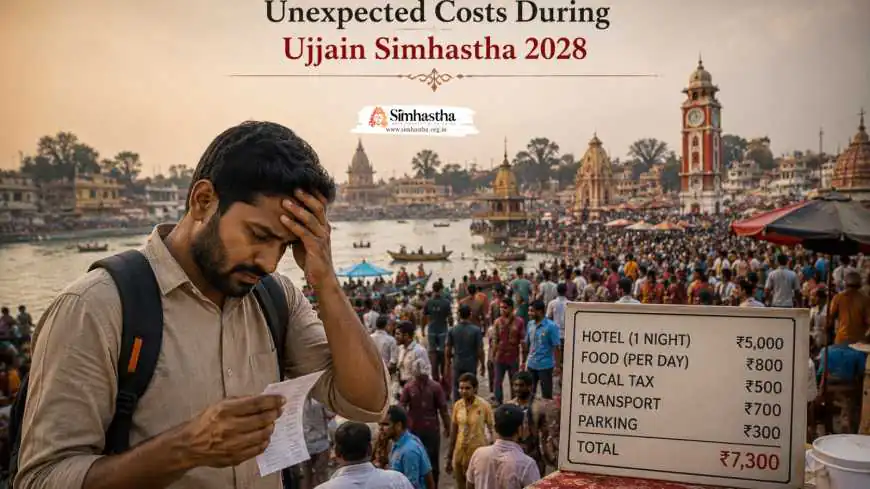


Emergency Shelter When Your Booking Vanishes
You arrive at the tent city after a fourteen hour train journey. Your confirmation email is on your phone. You have the payment receipt. But the person at the registration counter shakes their head. Your name is not in the system. Or worse, they say "sorry sir, your tent was given to someone else because you did not confirm forty eight hours before arrival." This happens more often than organizers admit. The unexpected cost here is not just finding new accommodation. It is finding it instantly, at midnight, in a city with zero vacancies.
What do you do? You run to the emergency accommodation counters set up by the district administration. These are basic dormitories in schools and government buildings. They cost ₹500 to ₹1,000 per person per night for a floor mat and a blanket. No privacy. No security for your valuables. But you have no choice. Your other option is a private agent who stands outside every major tent city entrance holding a "room available" sign. Their rates start at ₹5,000 per night for a dirty room in a house ten kilometers from the ghat. And they demand full payment in cash upfront. No receipt. No negotiation.
Then there is the auto rickshaw driver who becomes your savior for a price. You ask them to find you any shelter. They drive you to five different places, all full. Finally, they take you to their cousin's house where a single cot in a verandah costs ₹3,500 per night. The driver demands ₹500 as "search fee" whether you take the room or not. By sunrise, you have spent ₹4,000 to ₹10,000 more than you ever planned, and you still do not have a proper place to keep your bags.
Medical Emergencies and the Ambulance Shock
You wake up at 3 AM with severe stomach cramps. The food from last night's street stall did not agree with you. Or a family member has sudden high fever and is shivering in the tent. The free government medical camps are wonderful for small issues. But at 3 AM, they are closed. The staffed ones are overwhelmed with hundreds of patients. You need a private clinic or a hospital immediately.
Trending Guides Now

2 Days Ujjain Itinerary for Senior Citizens Easy Travel

Ujjain Simhastha 5 Day Itinerary for Couples

Safety Guidelines Every Ujjain Simhastha Pilgrim Must Follow
Mumbai to Ujjain for Simhastha 2028: Fastest Routes & Budget Tips

Ujjain Railway Station to Mahakaleshwar Temple Distance (2026 Guide)

Ujjain Simhastha 2028 Dates Announced: Full Shahi Snan & Event Timeline

Mahakaleshwar Sandhya Aarti Online Booking 2026: Fee, Timings, Entry Gate and Step-by-Step Process
Mangalnath Temple Trip Budget: Puja, Local Transport, Food and Stay Planning
Here comes the unexpected cost. Calling a private ambulance during Simhastha costs ₹2,500 to ₹5,000 just for pickup and drop to the nearest hospital. This is not an emergency room ambulance with sirens. This is a basic van with a stretcher. The driver explains that "Mela surcharge" applies to everything. When you reach the private hospital, the outpatient consultation fee that is normally ₹300 is now ₹1,500. The doctor sees you for five minutes. A drip for dehydration that costs ₹800 in normal times is ₹3,500. Medicines from the hospital pharmacy are priced at double the MRP because "stock is limited during Mela."
If your condition requires admission, the deposit demanded is ₹25,000 to ₹50,000 upfront even if you have insurance. The hospital staff will explain that insurance claims take three to five days to process, and they cannot wait. You pay in cash or you do not get a bed. And the room rent for a shared ward that normally costs ₹1,000 per night becomes ₹4,000 per night with a seven day minimum payment in advance.
Lost and Found Retrieval Fees That Feel Like Robbery
In the chaos of Shahi Snan, you lose your bag. Or your phone slips from your pocket into the crowd. Or your child wanders away and is found by a volunteer. The official lost and found center at Simhastha does excellent work reuniting people with their belongings. What no one tells you is that retrieving your item comes with a service fee.
For a lost mobile phone, the center charges ₹500 to ₹1,000 as a "handling fee" before they release it to you. For a wallet with cash, they take 10% of the cash amount as "administrative charges" up to a maximum of ₹2,000. For a lost suitcase, the fee is ₹300 per day of storage from the day they received it until the day you claim it. So if your bag went missing three days ago and you are just now finding out it was turned in, you owe ₹900 before touching your own clothes.
The most shocking unexpected cost is child retrieval. If your child gets separated and a good Samaritan brings them to the lost and found center, there is no fee to take your child back. But if the police found your child and kept them at a designated shelter, you need to produce identity documents and pay a ₹1,000 "verification fee" to cover the cost of running background checks and paperwork. Parents have cried at this counter not because of the money, but because of the insult of paying to hold their own crying child again.
Weather Emergencies and the Rain Tax
Ujjain Simhastha 2028 could fall in the pre-monsoon or monsoon window depending on the planetary calendar. If rain hits during your stay, prepare for a cascade of unexpected costs. Your tent floor turns into a small pool within thirty minutes of heavy rain. The tent operator offers you two choices. First, relocate to a higher tent that is still dry. This costs ₹2,000 extra per night plus a "relocation logistics fee" of ₹500. Second, they can provide plastic tarpaulins and sandbags to build a barrier around your existing tent. This "emergency waterproofing kit" costs ₹1,500 and you have to install it yourself.

Your footwear becomes useless in the mud. The gumboots that normally cost ₹400 are sold by roadside vendors for ₹1,500 during the first hour of rain. Within three hours, the price climbs to ₹2,500. The same vendors sell umbrellas for ₹800 instead of ₹150. Ponchos that are ₹100 in a normal shop become ₹600. And here is the cruelest unexpected cost: mobile phone water damage repair. There will be a temporary phone repair stall every fifty meters during a rainy day. A simple drying and cleaning service that costs ₹200 at a normal shop costs ₹1,500 at the Mela. Replacing a water damaged screen starts at ₹5,000.
If the rain continues for more than twenty four hours, the pathways between tents and ghats become rivers of mud. The platform walkways that were installed for free access now have "toll collectors" charging ₹20 per person per crossing to use the wooden planks that keep your feet out of the mud. You will cross these walkways at least six times a day. That is ₹120 per day per person just to walk.
Ritual Demands That Appear After the Blessing
You are standing at Ram Ghat after completing your holy bath. A pandit approaches and offers to perform a simple puja for your family's well being. He says "no fee, only your devotion." You agree. He chants for two minutes, puts a tilak on your forehead, and gives you a small red thread for your wrist. Then he asks for dakshina (offering). You give ₹100. He shakes his head. He says "for Simhastha bath, minimum dakshina is ₹1,100 for family." You are shocked. He explains that this is the rate card for 2028 decided by the pandit association. There is even a laminated sheet he pulls from his pocket showing ₹1,100 for families, ₹501 for individuals, and ₹2,501 for special blessings.
This is an unexpected cost because the puja was presented as free or donation-based. But at the moment of completion, it becomes a fixed fee with social pressure. The pandit stands there with his hand out. Other pilgrims are watching. Your family is waiting. You pay.
Similarly, if you visit any of the smaller temples around the Shipra River during Simhastha, the priests inside will insist on performing an abhishekam (ritual bathing of the idol) for you. They will pour milk, curd, honey, and ghee over the idol while chanting. It looks beautiful and feels blessed. Then they present you with a bill: ₹500 for the milk, ₹400 for the curd, ₹600 for the honey, ₹700 for the ghee, and ₹300 for the priest's time. Total ₹2,500. You never asked for this ritual. They simply started doing it as soon as you entered the inner sanctum. Now you either pay or create a scene inside a temple.
Transport Breakdown and the Tow Truck Trap
You hired a private cab for the day to visit the temple circuit outside Ujjain city. The driver quoted ₹2,500 for eight hours. Halfway to your destination, the car breaks down. The driver calls for a replacement vehicle. The replacement arrives after two hours of waiting on a hot roadside. The new driver demands ₹5,000 for the remaining trip because "emergency call out and lost time." Your original driver says his responsibility ended when the car broke down. Now you are stranded with no transport and a demand for double payment.
If you are using your own vehicle to reach Ujjain, a breakdown during Simhastha is a financial nightmare. Local tow truck operators know that you are desperate. Towing your car to the nearest garage costs ₹3,000 to ₹6,000 for a distance that would normally be ₹1,000. The garage mechanics work on "Mela time" which means you pay a ₹2,000 "express service fee" just to have them look at your car within twenty four hours. Parts that cost ₹500 are sold for ₹2,000 because "we had to send a person on a bike through Mela traffic to fetch this for you."
And if your car cannot be repaired quickly, you now need parking for a broken vehicle. The designated long term parking zones charge ₹300 per day for cars. But these zones are far from the tent areas. Getting from the parking zone to your tent costs another ₹500 in auto fares. Within three days of your car breaking down, you have spent ₹10,000 to ₹15,000 unexpectedly, and you still have not taken a single holy dip.
Last Minute Documentation and Permit Costs
You have travelled from another state to Ujjain Simhastha 2028. At the entry checkpoint to the main Mela area, security personnel ask for your identity proof. You show your Aadhaar card on your phone. They say "original needed, not photocopy or digital." Your original is back in your home state. Now you need an emergency identification certificate issued by the temporary government camp set up for lost documents. This certificate costs ₹500 and takes four hours of standing in line.
If you are a foreign pilgrim or an NRI, the unexpected documentation costs are worse. The FRRO (Foreigners Regional Registration Office) sets up a temporary desk at Simhastha. Every foreign national must register their presence within twenty four hours of arrival. The registration fee is ₹1,000. The late fee if you miss the twenty four hour window is ₹5,000. Many foreign pilgrims do not know this rule exists until they try to leave Ujjain and are stopped at the railway station. They pay the late fee in tears.
Then there is the special permit for photography and videography with professional equipment. If you carry a camera with a lens longer than six inches or any video camera that is not a phone, the Mela authorities require a media permit. The fee is ₹5,000 for still photography and ₹10,000 for video. Without this permit, your equipment can be confiscated at any checkpoint. Getting it back requires paying the permit fee plus a ₹2,000 release charge.
The Pilgrim Who Paid for Everything Twice
Here is the story of one real pilgrim from the 2016 Simhastha. His name does not matter. His lesson matters. He booked everything online from his home in Mumbai. He arrived at the Ujjain railway station and took an auto to his pre-booked tent. The auto dropped him at the wrong tent city. Same name, different location. He walked forty minutes in the heat to his actual tent. Exhausted, he paid ₹200 for a cold drink that normally costs ₹30. That night, he kept his wallet in his back pocket while sleeping. Someone cut the pocket and took ₹8,000 cash. The next morning, he had no cash, no nearby ATM with money left, and a phone with 5% battery. He borrowed ₹2,000 from a fellow pilgrim at 20% interest (₹400 extra) just to survive the day. He spent ₹1,500 on a portable charger from a stall. It stopped working after two hours. He bought another for ₹2,000. That one worked but cost double the normal price. By the end of seven days, he had spent ₹32,000 more than his planned budget of ₹25,000. His total pilgrimage cost ₹57,000 for a trip he thought would cost ₹25,000. He paid for everything twice - once in his planned budget, and once again in unexpected costs.
Protecting Yourself from the Unseen Drain
You cannot prevent every unexpected cost during Ujjain Simhastha 2028. But you can reduce the damage. First, carry two separate wallets. One in your front pocket with your daily spending cash of ₹2,000 to ₹3,000. Another hidden somewhere on your body (inside your shoe, a money belt under your shirt, or a small pouch pinned inside your underwear) with your emergency reserve of ₹15,000 to ₹20,000. Second, photograph every document including your ID, train ticket, tent booking confirmation, and insurance card. Email these photos to yourself and to a trusted family member. Third, identify the locations of the official police stations, lost and found center, and government medical camp within your first hour of arrival. Do not wait until you need them. Fourth, make friends with a local shopkeeper near your tent. Buy a small item from them every day. When you need help or reliable information, they will guide you honestly. Fifth, accept that some money will be wasted. This is not a normal trip. This is five crore people squeezing into a small holy city. Unexpected costs are not failures of your planning. They are the price of participating in something ancient, massive, and beautifully chaotic.
What No One Tells You Until You Are There
The Shipra River will purify your soul. The sadhus will bless you. The mantras will lift your spirit. But the marketplace does not care about your devotion. It cares about your rupees. The most unexpected cost of Simhastha 2028 is not a single big expense. It is the death by a thousand cuts - small charges here, tiny fees there, little premiums everywhere that add up to a shocking total by the time you board your train back home. You will pay ₹50 for a cup of tea that should cost ₹10. You will pay ₹100 to use a bathroom. You will pay ₹500 to a guide who simply points you towards a line you already saw. You will pay ₹2,000 for a ritual you never asked for. And you will pay all of it because in the moment, with the crowd pressing around you and the holy chants ringing in your ears, the only thing that matters is getting through the day. Plan for the unexpected. Keep your emergency fund untouchable until the real emergency comes. And remember - every pilgrim before you has paid these same unexpected costs. You are not being singled out. You are simply learning the real price of Ujjain Simhastha.
Frequently Asked Questions