






















Emergency Budget Reserve for Ujjain Simhastha 2028 Travel
Plan your emergency budget for Ujjain Simhastha 2028 with realistic cost buffers, contingency funds, medical backup, and smart financial safety nets for a stress‑free pilgrimage.


Why an Emergency Budget Reserve Is Non‑Negotiable for Simhastha 2028
Simhastha Kumbh Mela attracts an estimated 14 crore pilgrims over 60 days. When millions of people descend on a relatively small city like Ujjain, prices for everything – from a bottle of water to a hospital bed – surge unpredictably. Normal market economics break down. Supply becomes extremely constrained. And when supply is tight, vendors and service providers often charge emergency premiums.
Here are the specific risks that an emergency budget reserve protects you against:
-
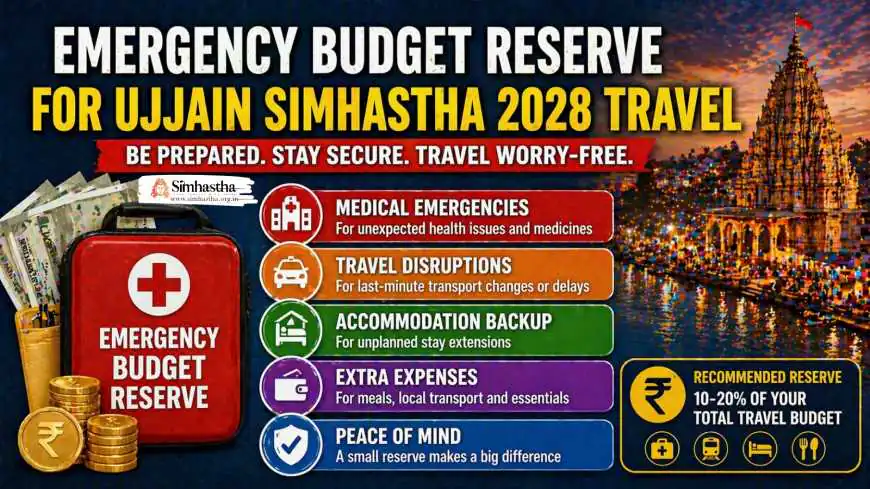
Accommodation last‑minute failures – Your prepaid tent or hotel might overbook. You may arrive to find your room given to someone else. You then need to find alternate lodging at peak rates, sometimes 3–5 times the normal price.
-
Medical emergencies – Dehydration, heatstroke, food poisoning, injuries in crowd crushes, or chronic conditions flaring up. Hospital bills in private clinics can be shockingly high.
Trending Guides Now

Ujjain Temple Photography Rules Every Visitor Should Know

Ujjain Simhastha 5 Day Itinerary for Couples

2 Days Ujjain Itinerary: Complete Temple Darshan Plan
Surat to Ujjain Travel Guide: Routes, Distance and Time

Ujjain Railway Station to Mahakaleshwar Temple Distance (2026 Guide)

Ujjain Simhastha 2028 Dates Announced: Full Shahi Snan & Event Timeline

Benefits of Becoming a Simhastha Volunteer
Ujjain Travel During Shravan Month: What Changes for Visitors
-
Transport disruptions – Your train gets cancelled. Your flight is overbooked. You miss your connection. You need to book an emergency cab or an alternate train at last‑minute fares.
-
Price gouging on essentials – During Shahi Snan days, a simple meal that costs ₹50 normally may be sold for ₹300. A 500 ml water bottle may cost ₹50–₹100. You cannot bargain when you are thirsty and exhausted.
-
Lost or stolen valuables – Crowds are ideal for pickpockets. If you lose your wallet, phone, or bag, you need immediate cash for food, transport, and a place to sleep.
-
Unforeseen temple expenses – Special poojas, VIP darshan upgrades, or offerings that you did not plan for but feel spiritually called to make.
An emergency budget reserve is not being paranoid. It is being a smart Simhastha pilgrim.
How Much Emergency Reserve Should You Carry? A Realistic Breakdown
The amount depends on your travel style (budget, mid‑range, or luxury) and the duration of your stay. Below are minimum recommended emergency reserves per person for Simhastha 2028. These are cash‑on‑hand or instantly accessible funds above and beyond your pre‑paid accommodation, pre‑booked transport, and daily food budget.

| Traveler Type | Minimum Emergency Reserve (per person) | What It Covers |
|---|---|---|
| Budget solo pilgrim (staying in dharamshala / economy tent) | ₹5,000 – ₹7,000 | One night alternate lodging, 2 days of inflated food/water, local transport, basic medicines |
| Family of 4 (mid‑range tent or guest house) | ₹15,000 – ₹20,000 (total) | Alternate hotel for one night, medical consultation, taxi to Indore if needed, emergency food |
| Couple (luxury tent or hotel) | ₹10,000 – ₹15,000 (total) | Last‑minute upgrade, private cab, private clinic visit, extra darshan passes |
| Senior citizen / person with medical condition | ₹20,000 – ₹30,000 (per person) | Hospital admission deposit, ambulance, specialist consultation, repatriation to Indore |
| International traveler (NRIs / foreigners) | $250 – $500 equivalent (₹20,000 – ₹40,000) | Embassy contacts, last‑minute flight changes, premium medical care, translator assistance |
Important note: These are cash reserves. Digital payments may fail due to network congestion. Keep a significant portion in physical cash (see section below).
Breaking Down the Emergency Reserve: Category by Category
Let me show you exactly how that emergency budget reserve might be spent in real Simhastha scenarios.
1. Emergency Accommodation Buffer (₹3,000 – ₹10,000 per incident)
Scenario: Your prepaid tent operator calls you at 9 PM saying they overbooked. They offer you a tent in a distant, less hygienic camp. You refuse. You now need to find a last‑minute hotel room near Mahakaleshwar Temple or a guest house on the outskirts. On a normal day, such a room costs ₹1,500. During Shahi Snan, prices can touch ₹6,000–₹10,000 per night. Your emergency reserve must cover at least one night of surge‑priced accommodation.
2. Medical Emergency Buffer (₹5,000 – ₹25,000)
Scenario: You develop severe food poisoning after eating from a roadside stall. You need to visit a private clinic because the government hospital is overwhelmed with crowd‑related injuries. A consultation with a general physician in a private clinic may cost ₹800–₹1,500. Medicines (antibiotics, ORS, antacids) may cost ₹500–₹1,000. If you need intravenous fluids (drip) at a clinic, add ₹1,500–₹3,000. If you need hospitalization (e.g., for dehydration or a minor fracture), a private hospital in Ujjain or nearby Indore may demand an advance deposit of ₹10,000–₹15,000. Your emergency reserve must cover this without derailing your entire trip.
3. Transport Breakdown Buffer (₹2,000 – ₹8,000)
Scenario: You have a confirmed train ticket from Ujjain Junction back to your hometown. But due to an accident or signal failure, the train is cancelled 2 hours before departure. The railway station is chaos. You need to book an emergency taxi from Ujjain to Indore (55 km) to catch a flight home. Normal taxi fare: ₹1,000–₹1,500. During a Simhastha crisis, drivers may charge ₹3,000–₹5,000. Your budget must absorb this.
4. Food and Water Price Gouging Buffer (₹1,000 – ₹3,000 per day)
During Shahi Snan days, even simple meals become expensive. A veg thali that costs ₹80 normally may be sold for ₹250–₹350. A bottled water (1 litre) may cost ₹40–₹80 instead of ₹20. If you are stuck in a queue for 6 hours, you will need to buy food and water from whatever vendor is nearby. Your emergency reserve should include a daily buffer for such inflated prices.
5. Darshan / Pooja Upgrade Buffer (₹1,500 – ₹5,000)
You planned for general darshan. But when you see the 5‑kilometer queue, you decide you need a VIP Sheeghra pass (₹750–₹1,500) or a Bhasma Aarti ticket (₹1,500–₹2,000) to avoid waiting 12 hours. Or a priest offers you a special Rudra Abhishek that costs ₹2,500. Your emergency reserve allows you to say “yes” without financial panic.
6. Lost / Stolen Belongings Buffer (₹2,000 – ₹5,000)
Pickpocketing is common in massive crowds. If your wallet is stolen, you need cash for a local SIM card (₹300–₹500), a cheap phone (₹1,500–₹2,000), and food/transport until you reach your accommodation. Keep a separate hidden emergency cash (see below) so you are not left stranded.
Where and How to Store Your Emergency Budget Reserve
Do not keep all your cash in one wallet. Use a layered storage system.
Layer 1: Primary Wallet (Daily spending)
-
Carry ₹1,000 – ₹2,000 in small denominations (₹100, ₹200, ₹500 notes).
-
Use this for chai, snacks, auto rickshaws, temple offerings, and minor purchases.
-
If this wallet is lost or stolen, you still have layers 2 and 3.
Layer 2: Body‑Worn Emergency Cash (Hidden)
-
Keep ₹5,000 – ₹10,000 (depending on your reserve) in a money belt worn under your clothes, or in a neck pouch tucked inside your kurta/shirt.
-
Use this only for absolute emergencies: medical treatment, last‑minute hotel, taxi to another city.
-
Do not open this in public. Retreat to a private place (e.g., a temple office or your hotel room) to access it.
Layer 3: Digital Backup (Cards and UPI)
-
Carry two debit/credit cards from different banks. Store them in separate bags.
-
Ensure your UPI apps (Google Pay, PhonePe, Paytm) are loaded with sufficient balance. Note that during peak Simhastha days, mobile networks may be overloaded. UPI may work slowly or not at all. Do not rely solely on digital payments.
-
Inform your bank about your travel dates to avoid card blocks.
Layer 4: Trusted Contact Backup
-
Keep ₹2,000 – ₹3,000 with a fellow traveler in your group (if you are traveling with family or friends).
-
Also, save the phone number of a local contact (e.g., your hotel manager, a known pandit, or a relative in Indore) who can help you with emergency funds if everything else fails.
Creating Your Personal Emergency Budget Reserve: A Step‑by‑Step Worksheet
Follow this simple process to calculate your required emergency budget reserve for Ujjain Simhastha 2028.
Step 1: Identify your traveler profile – Solo, couple, family, senior citizen, or international.
Step 2: Multiply the base reserve from the table above by your profile. Adjust for longer stays.
Step 3: Add specific risk buffers – If you have a medical condition, add ₹10,000 – ₹20,000. If you are visiting during a Shahi Snan date, add ₹5,000 extra.
Step 4: Convert to cash – Aim to keep 60–70% of your emergency reserve as physical cash (in layers 1 and 2). Keep 30–40% in digital/card form as backup.
Step 5: Test your access – Before leaving home, ensure you know how to withdraw cash from an ATM in Ujjain (state‑owned banks like SBI, Bank of Baroda, and PNB are most reliable). However, ATMs may run out of cash during Simhastha. Hence the emphasis on physical cash.
Real‑Life Emergency Scenarios and How Your Reserve Saves You
Let me walk you through three true‑to‑life situations from Simhastha 2016 (adapted for 2028). Your emergency budget reserve directly addresses these.
Scenario 1: The Overbooked Hotel – Mid‑night Crisis
A family of four from Mumbai had pre‑booked a guest house near Ram Ghat at ₹4,000 per night. They arrived at 9 PM. The owner claimed “no booking in his system” (a common scam) and said the only available room was at ₹12,000. The family had only ₹5,000 cash left. They had to sleep in their car parked outside the city. Lesson: Their emergency reserve should have included ₹8,000 – ₹10,000 for exactly this situation. They could have paid the higher rate, then disputed the pre‑payment later.
Scenario 2: Heatstroke During Shahi Snan
An elderly pilgrim from Pune collapsed from dehydration while waiting for the Amrit Snan at Shipra River. A volunteer rushed him to a nearby private clinic. The clinic demanded ₹5,000 upfront before even examining him. The pilgrim’s son had to run around for an hour trying to find an ATM that dispensed cash. Lesson: Keep a body‑worn emergency cash of at least ₹5,000 – ₹7,000. That money would have gotten immediate care.
Scenario 3: Train Cancellation – No Way Home
A group of students had booked Sleeper class tickets from Ujjain to Delhi. The train was cancelled at midnight due to a derailment elsewhere. The railway station was packed. The only way to reach Delhi was to hire a private cab to Indore (₹4,000) and then a last‑minute flight (₹8,000 each). The students did not have that kind of cash. Lesson: Your emergency reserve should cover one alternate transport route – either a taxi to a major city or an emergency train ticket in a higher class.
Smart Tactics to Reduce Your Emergency Reserve Needs
You cannot avoid having an emergency budget reserve, but you can reduce the amount you need by following these tactics.
Tactic 1: Travel in a Group of 4–6 People
Share the risk. A group can pool their emergency reserves into a single group contingency fund. If one person loses their wallet, the group covers them. If a taxi needs to be hired, the cost is split. This reduces each person's individual cash holding.
Tactic 2: Book Fully Refundable / Flexible Accommodation
When booking tents or hotels, pay the extra 10–15% for a fully refundable rate or a flexible cancellation policy. This protects you from vendor scams (you can simply book elsewhere and dispute the original payment) and reduces the need for a large accommodation buffer.
Tactic 3: Purchase Comprehensive Travel Insurance
Most Indian pilgrims skip travel insurance, thinking "nothing will happen". For Simhastha 2028, I strongly recommend buying domestic travel insurance that covers:
-
Medical emergency hospitalization (minimum coverage ₹1 lakh)
-
Trip cancellation / interruption
-
Loss of checked baggage
-
Emergency cash advance (some policies offer this)
Cost: Approximately ₹300 – ₹800 for a 7‑day trip. This drastically reduces the amount of physical emergency cash you need to carry.
Tactic 4: Pre‑Identify Emergency Service Providers
Before you leave, save these contacts in your phone:
-
Nearest hospital to your accommodation (e.g., District Hospital Ujjain, Arora Hospital, J.K. Hospital)
-
Police station near your tent city (Ram Ghat police outpost)
-
Your bank's 24x7 helpline (for card blocks)
-
MP Tourism emergency helpline (likely to be announced for Simhastha)
-
Indore airport taxi service (pre‑booked numbers)
Having these contacts means you spend less time panicking and more time solving problems. That translates to lower emergency buffer required.
Common Mistakes Pilgrims Make with Emergency Money
Avoid these errors that I have seen dozens of pilgrims regret.
Mistake 1: Keeping All Cash in One Place
One wallet. One bag. One theft. You lose everything. Use layered storage as described above.
Mistake 2: Relying Solely on ATMs
During Simhastha, ATMs run out of cash within hours of being refilled. The queues at ATMs can be 100+ people long. Even if you have a card, you may not be able to withdraw. Keep physical cash for at least 3 days of emergency expenses.
Mistake 3: Not Having Small Denominations
A taxi driver demands ₹500 for a short ride. You have only ₹2,000 notes. He refuses to give change (or claims he has no change). You either overpay or walk. Keep a supply of ₹100, ₹200, and ₹500 notes in your emergency stash.
Mistake 4: Forgetting to Inform Your Bank
Your bank sees multiple transactions in Ujjain during Simhastha and blocks your card for “suspicious activity”. Then you cannot access your digital funds. Call your bank before traveling and register your travel itinerary.
Emergency Budget Reserve for International Travelers (NRIs / Foreigners)
If you are coming from abroad, your emergency budget reserve must be larger due to currency conversion, lack of local support network, and higher medical costs.
Specific recommendations for international travelers:
-
Carry USD or EUR as emergency cash (₹20,000 – ₹40,000 equivalent). You can exchange it at authorized money changers in Ujjain or Indore (rates will be poor, but it is an emergency).
-
Register with your embassy’s consular services in India (New Delhi or Mumbai). Save the 24/7 emergency contact number.
-
Purchase international travel insurance with medical evacuation coverage. Some policies will airlift you to a better hospital in Indore or Delhi.
-
Keep a separate credit card with a high limit (₹1 lakh+) for genuine emergencies. Do not use it for daily expenses.
Your Emergency Budget Reserve Worksheet (Simple Calculation)
Use this fill‑in‑the‑blanks approach to determine your exact emergency budget reserve for Ujjain Simhastha 2028.
| Component | Your Amount (₹) |
|---|---|
| Base emergency reserve (from table) | _________ |
| Extra for medical condition (if any) | + _________ |
| Extra for Shahi Snan date travel | + _________ |
| Extra for international traveler (if applicable) | + _________ |
| Total Emergency Reserve | = _________ (Goal) |
| – Physical cash in money belt (70%) | _________ |
| – Digital / card backup (30%) | _________ |
Example for a couple (mid‑range, no medical issues, traveling on a Parva Snan day):
-
Base reserve: ₹12,000 (for 2 people)
-
No medical extra
-
No Shahi Snan extra (Parva Snan)
-
Total emergency reserve = ₹12,000
-
Physical cash (70%) = ₹8,400
-
Digital/card backup (30%) = ₹3,600
They would keep ₹8,400 in a money belt (hidden) and ₹3,600 split between two cards and UPI apps.
Final Word: Your Emergency Reserve Is Your Freedom
Many pilgrims think of emergency funds as “extra money they will never use”. That mindset is wrong. Your emergency budget reserve is not a waste. It is the price of peace of mind. It allows you to stand in the long queue for Mahakal darshan without secretly worrying about what happens if you faint. It allows you to say “yes” to a last‑minute VIP pass without calculating every rupee. It allows you to help a fellow pilgrim in distress without depleting your own food money.
Ujjain Simhastha 2028 will be an experience of a lifetime – spiritually elevating, culturally rich, and deeply moving. Do not let a temporary financial crisis overshadow that. Build your emergency budget reserve now, store it wisely, and then focus on what truly matters: the holy dip in Shipra River, the divine sight of Bhasma Aarti, and the blessings of Baba Mahakal.
Har Har Mahadev.
Frequently Asked Questions