



















Why Shahi Snan Is NOT a Public Bath
A deeply explanation of why Shahi Snan in Ujjain Simhastha and Kumbh Melas is a sacred, hierarchical ritual governed by spiritual authority, not a public bathing practice.


What Shahi Snan Actually Is
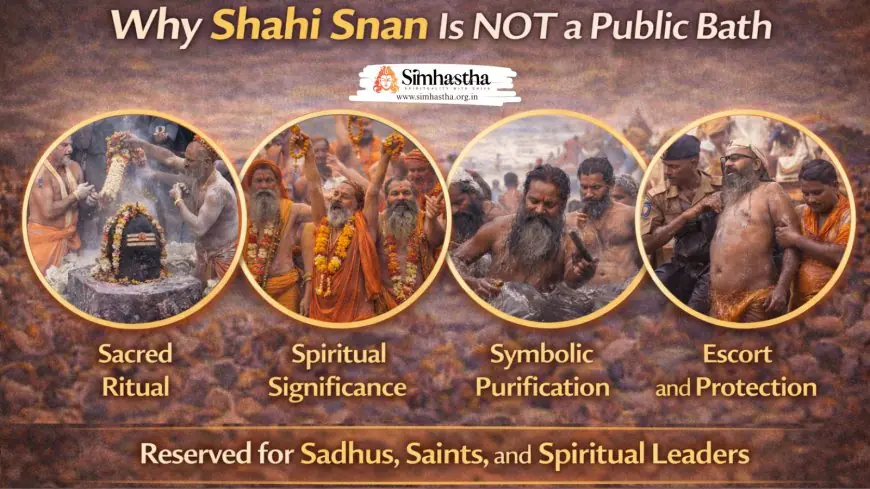
Shahi Snan is not a public bath because it is not intended for general participation, open access, or symbolic cleansing. It is a ritual act of spiritual authorization, performed exclusively by eligible ascetic orders to consecrate sacred time and space during Simhastha and Kumbh Melas, after which public bathing becomes ritually valid.
This single distinction changes everything.
A public bath focuses on who can enter.
Shahi Snan focuses on who must enter first.
Until that first act is completed, the river has not yet entered its highest ritual state. The water exists physically, but it has not been activated spiritually. Shahi Snan is the mechanism that performs that activation.
Trending Guides Now
Why Certain Rituals Are Allowed Only at Specific Ghats During Simhastha

What Is Shahi Snan in Ujjain Simhastha Kumbh Mela?

Difference Between Shahi Snan and General Snan

What Happens Before the First Royal Bath of Simhastha

Ujjain Railway Station to Mahakaleshwar Temple Distance (2026 Guide)

Ujjain Simhastha 2028 Dates Announced: Full Shahi Snan & Event Timeline

Ujjain Simhastha Update: CM Mohan Yadav Reviews 2028 Works

Ujjain Railway Station to Kal Bhairav Temple: Distance, Auto Fare and Best Route
Why the Confusion Exists
The confusion around Shahi Snan is modern. Historically, there was no ambiguity. Everyone involved understood that different acts occur at the river for different reasons, under different rules.
The confusion arises when all river immersion is treated as identical.
In Sanatan Dharma, actions are never judged by appearance alone. Two people may enter the same water, but the act is not the same if:
-
Their eligibility differs
-
Their role differs

-
Their authority differs

Modern language collapses this structure. Ancient ritual systems do not.
Snan Is Common. Shahi Snan Is Singular.
Snan is one of the most common spiritual acts in Sanatan practice. It can be performed:
-
Daily
-
Individually
-
Without witnesses
-
Without hierarchy
Shahi Snan is the opposite.
It is:
-
Rare
-
Collective but exclusive
-
Highly visible
-
Strictly hierarchical
A common snan cleanses the individual.
Shahi Snan reorganizes the spiritual order of the gathering itself.
This is why the two cannot be placed in the same category.
Also read the official Shahi Snan dates and schedule for Ujjain Simhastha 2028 for a complete timeline of the sacred bathing ceremonies.
The Principle of Adhikara: Eligibility Over Equality
Sanatan Dharma does not operate on the principle of equal access. It operates on adhikara, the principle that eligibility is earned, not assumed.
Adhikara is determined by:
-
Discipline
-
Renunciation
-
Training
-
Responsibility
Shahi Snan requires the highest adhikara because it does not benefit only the performer. It affects millions who come after.
Those who lead Shahi Snan do not receive privilege. They accept burden.
Why the First Entry Matters More Than the Crowd
In public bathing, numbers matter.
In Shahi Snan, sequence matters.
The first entry into the river establishes:
-
Ritual purity
-
Temporal alignment
-
Hierarchical order
If the order is broken, the act loses coherence. This is why Shahi Snan is never flexible. It cannot be adjusted for convenience, pressure, or sentiment.
The river does not respond to crowds.
It responds to correct action performed by correct authority at the correct moment.
Every sacred act performed during Simhastha carries centuries of Sanatan tradition, from the timing of holy baths to the disciplined order of Akharas and temple rituals. To truly understand how these ancient practices unfold on the ghats of Ujjain, our detailed guide on Simhastha rituals explains each ceremony, its spiritual meaning, and its role in the larger flow of Ujjain Simhastha and the Simhastha Kumbh Mela, helping pilgrims experience the festival with clarity, devotion, and cultural authenticity.
Why Shahi Snan Is Called “Shahi”
The term Shahi does not signify luxury or royal spectacle. It signifies sovereign authority, but not of kings.
Historically, during Shahi Snan:
-
Kings stepped aside
-
Administration waited
-
Military power withdrew
Spiritual authority moved first.
This inversion is essential. It declares that worldly power is irrelevant in the ritual domain. Only renunciation has precedence.
A public bath reinforces equality.
Shahi Snan enforces hierarchy for the sake of order.
Akharas as the Legitimate Bearers of Authority
Akharas are not festival groups assembled for spectacle. They are continuous institutions with:
-
Lineage
-
Internal governance
-
Scriptural grounding
-
Disciplinary enforcement
Their right to lead Shahi Snan is not honorary. It is functional. They alone maintain the discipline required to enter sacred time without contaminating it with personal desire.
Without akharas, Shahi Snan would be impossible.
Without Shahi Snan, Simhastha and Kumbh Melas would collapse into ordinary gatherings.
Why Renunciation Must Lead
The leading participants in Shahi Snan are those who have renounced:
-
Family identity
-
Social status
-
Personal ambition
-
Material continuity
This is not symbolism. It is necessity.
Only those without personal claims can enter first without distorting the ritual space. If householders entered first, the act would become personal. Shahi Snan must remain impersonal.
A public bath centers the individual.
Shahi Snan erases the individual from the act.
Why Shahi Snan Cannot Be Opened to All
Opening Shahi Snan to all would not make it inclusive. It would make it meaningless.
Rituals lose power when:
-
Order is replaced by enthusiasm
-
Eligibility is replaced by emotion
-
Authority is replaced by access
Sanatan Dharma protects its most potent acts through restriction, not secrecy. Shahi Snan is restricted because it holds consequence.
Shahi Snan as Activation, Not Participation
This is the final distinction that must be understood.
Shahi Snan is not something people take part in.
It is something that makes participation possible afterward.
Once Shahi Snan is completed:
-
Public snan becomes meaningful
-
The river enters its peak sanctity
-
The gathering becomes ritually coherent
Before it, the water is present.
After it, sacred time is open.
Why This Must Be Understood Before Anything Else
If this distinction is not understood, every discussion about:
-
Simhastha
-
Kumbh Melas
-
Akharas
-
Sacred bathing
will remain shallow.
Shahi Snan is the spine of the entire system. It is not a side ritual. It is the act that holds everything else upright.
Shahi Snan is not a public bath because it was never designed to serve the public directly. It serves order, so that the public may later benefit.
It is not exclusion.
It is structure.
What follows in the next part is the deeper question:
Why does Sanatan Dharma insist on hierarchy instead of equality in its most sacred acts?
That answer reveals why Shahi Snan has survived unchanged for centuries.
Why Sanatan Dharma Rejects Equality in Sacred Acts
Modern thought treats equality as the highest virtue. Sanatan Dharma does not. It treats order as the highest necessity. Equality may exist in human dignity, but sacred acts operate under responsibility, not rights.
Shahi Snan exists precisely because not everyone can perform every action at every time. Sacred power is not neutral. When handled without discipline, it destabilizes rather than liberates.
Hierarchy in Shahi Snan is not social ranking.
It is functional arrangement.
The Difference Between Social Hierarchy and Ritual Hierarchy
Social hierarchies divide people.
Ritual hierarchies protect processes.
In Shahi Snan, hierarchy does not determine who is superior as a human being. It determines:
-
Who bears responsibility for opening sacred time
-
Who carries the burden of correctness
-
Who absorbs ritual consequence
Those who lead Shahi Snan accept accountability not just for themselves, but for the entire gathering.
A public bath carries no consequence beyond the individual.
Shahi Snan carries consequence for millions.
Responsibility Precedes Access
In Sanatan Dharma, access follows responsibility, not the other way around. This principle governs temples, mantras, and rituals alike.
Shahi Snan follows the same rule.
The akharas lead because they:
-
Maintain lifelong discipline
-
Live under constant vows
-
Are trained to operate within ritual danger
Sacred time is not benign. Entering it incorrectly is believed to create imbalance. This is why only those trained to absorb consequence are allowed to enter first.
Why Sequence Is Non-Negotiable
Sequence in Shahi Snan is not ceremonial choreography. It is ritual engineering.
Each entry:
-
Stabilizes the space
-
Prepares the next layer
-
Reduces volatility
If the order were changed, the ritual would not fail symbolically. It would fail structurally.
This is why Shahi Snan cannot be hurried, reordered, or democratized.
A public bath tolerates chaos.
Shahi Snan collapses under it.
Renunciation as the First Qualification
The highest qualification for Shahi Snan is not knowledge, seniority, or popularity. It is renunciation.
Renunciation removes:
-
Desire for outcome
-
Attachment to recognition
-
Fear of loss
Only a person without personal stakes can perform an act that affects countless others without distortion.
This is why Naga sadhus lead. Not because of spectacle, but because they have already surrendered identity.
Why the Body Itself Must Be Disciplined
Shahi Snan is not an intellectual ritual. It is physical, temporal, and spatial. The body entering the river must already be disciplined through:
-
Austerity
-
Control
-
Endurance
An undisciplined body introduces instability into ritual space. Sanatan practice understands this deeply.
A public bath does not care who enters.
Shahi Snan cares about what enters.
The Cost of Mistakes in Sacred Time
Mistakes in public activities inconvenience people.
Mistakes in sacred acts carry cosmic consequence within Sanatan worldview.
This belief is not superstition. It is an acknowledgment that sacred systems are delicate.
Those who lead Shahi Snan accept this risk. They do not seek privilege. They accept potential blame.
This is why eligibility is narrow.
Why Devotion Alone Is Insufficient
Devotion without discipline is unstable. Shahi Snan does not respond to emotion. It responds to preparedness.
Many are devoted. Few are trained.
Public baths reward sincerity.
Shahi Snan requires competence.
The River as an Active Participant
In Shahi Snan, the river is not passive. It is treated as an entity that must be approached correctly.
Hierarchy ensures that the first contact is made by those least likely to contaminate the space with ego or expectation.
Once the river is stabilized through correct entry, others may approach.
Why This System Cannot Be Reformed
Every attempt to modernize Shahi Snan has failed quietly. The ritual resists reform because its structure is not cultural. It is functional.
Change the structure, and the ritual ceases to work within its own logic.
Living traditions survive because they cannot be redesigned without dying.
Why the Many Depend on the Few in Shahi Snan
Hierarchy in Shahi Snan exists for one reason only: to make mass participation meaningful without letting it become chaos.
If everyone entered first, no one would truly arrive.
If access replaced order, sanctity would dissolve into movement.
If authority were removed, the river would remain water, not time.
This is the paradox that Simhastha and all Kumbh Melas solve with precision: the many are served only when the few act first.
The crowd does not diminish Shahi Snan.
Shahi Snan protects the crowd.
This leads to the most misunderstood question of all, and the one most people never think to ask:
If Shahi Snan is not meant for the public, why are millions drawn to witness it?
The answer explains why Simhastha is not just a ritual cycle, but a civilizational magnet.
Witnessing as a Sacred Act in Sanatan Dharma
In modern thinking, value is placed on participation. In Sanatan Dharma, witnessing itself is a form of spiritual engagement. This principle is essential to understanding why millions gather for Shahi Snan even though they know they will not be the ones entering the river first.
Shahi Snan is not designed to include everyone in action.
It is designed to include everyone in alignment.
To witness a perfectly ordered sacred act is believed to realign the observer internally. This is why darshan, not touch, is central in temples. The same principle operates here.
Why Seeing Order Restores Inner Order
Human life is chaotic. Desire, urgency, fear, and competition dominate daily experience. Shahi Snan presents the opposite image: restraint before movement, silence before immersion, order before access.
For the observer, this produces a subtle but powerful effect. The mind slows. Expectation drops. Attention sharpens. The ritual becomes a lesson without words.
This is why people travel long distances just to stand quietly at the ghats during Shahi Snan. They are not missing out. They are receiving something different.
Collective Presence Without Collective Action
Simhastha and other Kumbh Melas allow millions to gather without forcing them into the same act. This is rare. Most mass events collapse into uniform behavior.
Shahi Snan avoids this collapse by:
-
Assigning action to the few
-
Assigning witnessing to the many
-
Assigning meaning to both
The public is not sidelined. They are positioned where their presence does not disturb the ritual structure.
A public bath erases difference.
Shahi Snan preserves roles.
Why Anticipation Matters More Than Access
For many pilgrims, the hours before Shahi Snan carry more intensity than the moment itself. The waiting, the silence, the controlled movement all build a sense of gravity.
This anticipation is not accidental. It prepares the observer internally. By the time the ascetics enter the river, the crowd is already aligned.
If everyone were allowed immediate access, this preparatory phase would vanish. The ritual would lose its pedagogical force.
The River as a Boundary, Not an Invitation
During Shahi Snan, the river functions as a boundary, not an invitation. Boundaries create focus. They prevent diffusion of attention.
When the public sees the river protected, approached with care, and entered only by those with authority, the river’s status changes in the collective mind. It stops being scenery and becomes presence.
This transformation cannot happen in an open-access environment.
Why Silence Is Enforced During Shahi Snan
Silence during Shahi Snan is not crowd control. It is ritual necessity. Noise disperses attention. Silence concentrates it.
Even those far from the water sense the difference. The absence of shouting, bargaining, and rushing creates a temporary suspension of ordinary life.
This shared silence is itself a collective experience, even without collective action.
Shahi Snan as a Lesson in Restraint
Most spiritual teachings speak of restraint. Shahi Snan demonstrates it.
The public sees:
-
Desire delayed
-
Authority accepted
-
Movement controlled
-
Ego restrained
This visual lesson often penetrates deeper than instruction. People leave with a sense of having witnessed something intact and uncompromised.
That feeling stays long after the bath.
Why People Feel Fulfilled Without Entering the River
Many pilgrims report feeling complete even if they do not bathe immediately after Shahi Snan. This confuses observers who equate fulfillment with physical action.
The fulfillment comes from alignment, not immersion. Seeing the ritual completed correctly assures the pilgrim that sacred time has opened. Their later participation, even hours later, carries meaning because the foundation is intact.
The Difference Between Spectacle and Revelation
A spectacle demands attention. A revelation reorders attention.
Shahi Snan is not staged to impress. It is structured to reveal how sacred order functions when left undisturbed.
This is why it resists cameras, commentary, and narration. The less explained it is in the moment, the more it teaches.
Why This Draw Has Never Weakened
Despite modern impatience, shrinking attention spans, and increasing crowd pressure, people still gather in silence for Shahi Snan. This endurance proves that the attraction is not novelty.
It is recognition.
Something ancient, intact, and uncompromised still exists. People come not to change it, but to stand near it.
Shahi Snan does not belong to the public, yet the public belongs around it. This balance is deliberate. It ensures that meaning flows outward without being diluted at the source.
The act remains precise.
The effect becomes widespread.
The next question follows naturally:
What happens after Shahi Snan, and why does public bathing only make sense once it is complete?
The answer explains how sacred time moves from authority to society.
Related Simhastha 2028 Guides :
Frequently Asked Questions