













What Happens to Temple Operations During Major Festivals
Discover how temple operations transform during major festivals in Ujjain. From extended darshan hours and massive queue systems to special rituals, crowd control, and a hidden army of volunteers, explore the sacred machinery behind Mahakaleshwar and other shrines.


The Clock Expands and the Temple That Never Sleeps
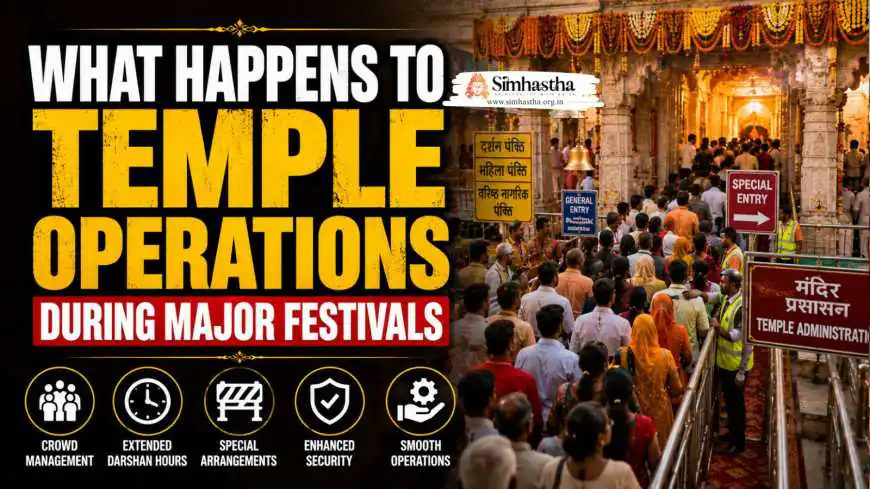
The first and most immediately visible operational shift during a major Ujjain festival is the dramatic, often total, expansion of the temple's opening hours. The Mahakaleshwar Temple, which on a normal day opens for the pre-dawn Bhasma Aarti and closes for a few hours in the late afternoon, simply ceases to close during the peak festival periods. During Shravan Mondays and Mahashivratri, the temple remains open continuously for darshan, often for twenty-four hours or more, the great silver doors never shutting, the stream of devotees never ceasing. The daily ritual schedule, which is normally a fixed, predictable sequence of aartis and pujas, is both compressed and expanded. The four Prahar Pujas of Mahashivratri, for instance, are special night-long rituals that are not performed on ordinary days. The normal Bhasma Aarti, which is a single, pre-dawn event, may be replicated in an abbreviated form at multiple times during a festival day to accommodate the overwhelming demand of pilgrims who could not secure the limited passes. The temple's internal clock, which usually beats to the slow, ancient rhythm of the water-clock and the position of the sun, accelerates to a frantic, modern pace, driven by the sheer, relentless pressure of the waiting crowd. The priests, who on a normal day might serve in shifts, are all called to duty, often working for sixteen or eighteen hours without rest, their voices hoarse from the continuous chanting, their hands moving with a swift, mechanical precision born of immense, repetitive practice. The temple, in its festival mode, becomes a perpetual, tireless machine of grace, a place where the Lord of Time, ironically, seems to exist in a state of eternal, sleepless wakefulness to receive his children. ⏰
The Architecture of the Crowd and the Transformed Physical Space
The physical layout of the temple complex is fundamentally, and temporarily, redesigned. The open, spacious Mahakal Lok corridor, which on a normal day allows pilgrims to stroll and admire the carved panels, is transformed into a vast, highly organized, and tightly controlled queueing system. A maze of stainless-steel barricades, erected by the temple administration and the police in the days leading up to the festival, creates a long, winding, and deliberately slow path that snakes through the entire corridor. This is not designed to frustrate the pilgrim; it is a critical piece of crowd engineering. The long, winding queue absorbs the immense pressure of the incoming crowd, preventing the kind of sudden, uncontrolled surge that can lead to a fatal stampede. The temple's entry and exit points are strictly segregated, often changed from their normal configuration, and multiple layers of security checkpoints are introduced at various stages of the queue. Holding areas, often large, open tents with basic seating and water, are set up on the approaches to the corridor, where pilgrims can be temporarily staged before being released in controlled batches. The inner sanctum's normal darshan route is often modified. On the most crowded days, the general darshan may not permit the usual, close, face-to-face encounter with the lingam; instead, pilgrims are moved along a slightly distanced path, where they can still see the deity but are kept moving at a steady, safe pace by the marshals. The entire temple complex becomes a carefully engineered, fluid-dynamic circuit board, designed for the single, sacred purpose of safely conducting the maximum number of souls past the central, divine point. 🚶
The Security Fortress and the Multi-Layered Shield of Protection
The security apparatus of the temple, which is always present, swells to a massive, multi-agency fortress during major festivals. The regular temple security force is augmented by hundreds of Madhya Pradesh Police personnel, the Home Guards, and, during the Simhastha, by paramilitary forces. The entire complex is divided into clearly defined sectors, each under the command of a designated officer who is in constant radio contact with the Integrated Command and Control Centre (ICCC) . The ICCC, which receives a live feed from over 500 CCTV cameras, becomes the operational nerve centre, with its AI-powered crowd analytics platform monitoring every square metre of the queue and the sanctum periphery. Plainclothes officers mingle with the crowds, their eyes trained to spot pickpockets, touts, and any individual exhibiting suspicious behaviour. The temple's entry points are fortified with additional metal detectors and baggage scanners, and the list of prohibited items—which always includes leather and electronics—is enforced with an uncompromising, zero-tolerance rigor. A dedicated, all-female security unit is deployed to manage the women's queue sections and to provide a safe, immediate point of contact for any woman who feels distressed. The security force's role during the festival is not merely to prevent crime; it is to be the calm, authoritative, and ever-present human barrier that stands between order and chaos, absorbing the immense, raw energy of the crowd and gently, firmly, guiding it towards a peaceful, safe, and orderly darshan. 👮
The Hidden Army of Volunteers and the Spirit of Seva
The paid staff and the security forces are massively supplemented by a hidden, saffron-and-white-clad army of volunteers, drawn from the temple's own devotee networks, the National Service Scheme (NSS) , the National Cadet Corps (NCC) , and a wide array of local religious and social organizations. During a major festival, the temple can deploy several thousand trained volunteers, each assigned a specific, critical role. They are the smiling, helpful faces who guide a lost pilgrim to the correct queue, who offer a cup of water to a dehydrated devotee, who manage the chaotic, mountain of footwear at the shoe-stalls, and who assist the elderly and the disabled with a gentle, supportive arm through the dense, pressing crowd. A large contingent is deployed in the temple's massive, festival-mode kitchen, peeling vegetables, rolling rotis, and serving the thousands of free meals that are distributed to the pilgrims. These volunteers are not casual helpers; they have undergone specific training sessions in the weeks leading up to the festival, learning basic crowd management, first aid, and the essential, spiritual protocol of interacting with pilgrims. Their service, their seva, is entirely unpaid, driven by a deep, personal devotion to the deity and a desire to be part of the great, communal act of worship. They are the human heart of the temple's festival operations, the compassionate, tireless, and deeply faithful force that transforms a massive, impersonal logistical operation into a warm, welcoming, and profoundly caring spiritual embrace. 🤝
Trending Guides Now

Ujjain Railway Station to Mahakaleshwar Temple Distance (2026 Guide)

Best Time to Visit Mahakaleshwar Temple Crowd And Weather Guide

Mahakaleshwar Sheeghra Darshan Booking Guide 2026
Why This Jyotirlinga Faces South and What It Means

Ujjain Simhastha 2028 Dates Announced: Full Shahi Snan & Event Timeline

Mahakaleshwar Temple Entry Rules 2026: Dress Code, Mobile & Bag Policy

Ujjain Simhastha Update: CM Mohan Yadav Reviews 2028 Works

Omkareshwar Trip Budget Guide: Transport, Stay, Food and Local Travel Costs
The Temple Kitchen and the Sacred Logistics of Mass Feeding
The temple's kitchen, which on a normal day prepares a modest, sanctified bhog for the deity and a small amount of prasad for the attending devotees, undergoes an industrial-scale transformation. During festivals like Mahashivratri or the Shravan Mondays, the kitchen must produce sanctified food for tens of thousands, sometimes lakhs, of pilgrims. This is not a simple matter of cooking larger quantities. The entire supply chain must be pre-arranged months in advance. Truckloads of flour, rice, lentils, ghee, sugar, and seasonal vegetables are contracted from trusted suppliers, often from farming communities that have served the temple for generations. The kitchen's physical capacity is expanded with temporary cooking stations, enormous wood-fired cauldrons, and long, open-air assembly lines for rolling rotis. A dedicated team of volunteer cooks, many of whom have been serving the temple in this capacity for decades, work in continuous, rotating shifts, their labour a form of silent, devoted meditation. The distribution of the sanctified food, the Mahaprasad, is itself a major logistical operation. Long, orderly rows of pilgrims are seated on the ground in vast, temporary pandals, and an army of volunteers moves swiftly down the lines, serving the simple, hot, and blessed meal on leaf plates. The kitchen's operation during a festival is a profound, edible sermon on the core Hindu principle of annadanam, the giving of food as the highest act of charity, and it is a massive, silent, and deeply moving engine of sacred nourishment that hums at the very heart of the festival's operational machinery. 🍛
The Ritual of Cleanliness and the Battle Against the Mountain of Offerings
The immense, surging crowds of a festival generate a corresponding mountain of physical waste and ritual offerings. The temple's housekeeping and sanitation operations, which are always important, become a frantic, round-the-clock battle to maintain the sanctity and the physical cleanliness of the sacred space. The floors of the Mahakal Lok corridor, the queue lines, and the sanctum periphery, which are quickly covered with a thick layer of crushed flowers, spilled water, scattered bel patra leaves, and the inevitable dust and debris of a million feet, must be swept and mopped continuously by a dedicated, rotating team of sanitation workers. The hundreds of kilos of floral offerings—marigolds, roses, jasmine, and the sacred bel leaves—that are piled before the deity and in the offering areas are collected with reverence, and are then processed at a dedicated, on-site composting facility, ensuring that nothing that has touched the Lord is treated as mere garbage. The vast network of temporary festival toilets, deployed by the municipal corporation, is maintained by an army of workers on performance-linked contracts, with the ICCC monitoring their cleanliness levels in real time. The entire temple complex is a continuous, silent, and largely unseen battle between the forces of devotion, which leave their beautiful, physical residue, and the forces of cleanliness, which work tirelessly to restore the space to a state of pristine, sacred order, ready for the next wave of pilgrims. 🧹
The Shifting Hours and the Divine Calendar of the Panchang
The operational hours of Ujjain's temples are not dictated by a fixed, secular clock, but by the ancient, celestial clock of the Panchangam, the Vedic almanac. During major festivals, the temple's entire schedule of aartis, pujas, and darshan hours is carefully re-calibrated to align with the specific, astrologically determined timings of that festival. On Mahashivratri, the night-long vigil is punctuated by the four precise Prahar Pujas, each conducted at a specific Muhurta, a sacred window of time that has been calculated by the temple's astrologers. During the Simhastha Kumbh, the timing of the great Shahi Snans, which dictate the entire rhythm of the Mela, is determined by the entry of Jupiter into Leo, a celestial event that directly influences the bathing schedule and the temple's associated rituals. The temple's daily darshan hours, which on a normal day might include an afternoon closure, are completely suspended during many festivals, the doors remaining open to accommodate the continuous, unceasing flow of pilgrims. The pilgrim who wishes to navigate the festival darshan successfully must consult not just a wristwatch, but the festival's specific, published schedule, which is often made available on the temple's official website and displayed on large notice boards. The temple, during its sacred festivals, operates on divine time, a time that is aligned with the movement of the planets and the eternal rhythms of the cosmos, and the pilgrim who synchronizes their watch with this celestial clock is the one who receives the fullest measure of the day's grace. 📅
The Priesthood in Overdrive and the Unseen Spiritual Exhaustion
Behind the closed doors of the inner sanctum, away from the pushing crowds and the constant roar of the public address system, the temple's priesthood operates in a state of intense, sustained, and often physically grueling spiritual overdrive. On a festival day, the head priest and his team may be on their feet, performing the intricate, precise sequences of the abhishek, the aarti, and the shringar, for sixteen or eighteen hours with only the briefest of breaks. Their bodies are exhausted, their voices are raw from the continuous chanting of the Vedic mantras, and their hands ache from the repetitive motions of pouring sacred water, offering the heavy, multi-tiered lamps, and applying the sacred ash. Yet, their concentration must remain absolute and unwavering, for a single, mistaken syllable of a mantra or a misstep in the ritual sequence is not just a personal error; it is a cosmic, liturgical failure that could, in the profound belief system of the temple, disrupt the entire, delicate flow of divine grace. The priests are sustained not by coffee or by the adrenaline of the crowd, but by their deep, inherited sense of duty, their unshakeable personal faith, and the quiet, powerful knowledge that they are the ordained, hereditary instruments of a sacred transmission that has been flowing, uninterrupted, through their family lineages, in this very sanctum, for over a thousand years. When the festival finally winds down and the great silver doors close for a few brief hours, they retreat to their quarters, not to celebrate, but to collapse into a deep, dreamless, and utterly exhausted sleep, before waking to begin the whole, ancient, sacred cycle again. 🧘
The Financial and Administrative Metamorphosis and the Receipt of Grace
The temple's administration and its financial operations also undergo a significant transformation. A large team of additional, temporary staff is deployed to manage the surge in official puja bookings, the donation counters, and the locker rooms. The temple trust's official counters, which issue receipts for all formal offerings and special pujas, operate extended hours with additional windows to handle the long, patient queues of devotees wishing to sponsor a specific abhishek or to make a recorded, tax-exempt donation. The hundi (offering box) collections, which on a normal day are a modest, steady flow, swell to a massive, logistical operation, requiring secure, supervised collection on an hourly basis to prevent the strongboxes from overflowing. The small, informal economy that surrounds the temple—the flower sellers, the puja-thali vendors, the bookstores, and the chai stalls—all operate at their absolute peak capacity, their daily earnings multiplying many times over. The temple trust itself sees a dramatic spike in its revenue, funds that are carefully accounted for, audited, and then channeled back into the temple's maintenance, its charitable activities, and its preparations for the next great festival. The entire administration shifts from a mode of steady, routine management to a mode of intense, high-alert crisis management, where every decision, from the rerouting of a queue to the emergency repair of a faulty water pipe, must be made instantly and correctly. 💰
The Festival Ends and the Temple Exhales in Silence
The final aarti concludes. The last, weary pilgrim shuffles out of the sanctum, the ash still fresh on their forehead. The great, snaking queues dissolve into the night. The barricades are slowly, clankingly, dismantled by the tired but efficient volunteer crews. The massive kitchens, their fires finally banked, fall into an exhausted, steaming silence. The priests, their voices now barely a whisper, perform the final, simple ritual to put the Lord to rest, and then retreat to their quarters. The temple, which for the past twenty-four or forty-eight hours has been a roaring, ecstatic, and intensely alive organism, suddenly exhales. The silence that descends is not an emptiness; it is a profound, sacred, and palpable presence. It is a silence that contains, within it, the accumulated, absorbed, and blessed energy of a million prayers, a million tears, and a million acts of utter, selfless surrender. The floor, still damp from its final washing, gleams under the few remaining, softly lit oil lamps. The air, cleansed by the night breeze, carries only the faint, lingering fragrance of marigolds, incense, and the ever-present sacred ash. The temple operations have returned to their normal, quiet rhythm, but the temple itself, its ancient stones, its sacred idols, and its very subtle atmosphere, has been immeasurably enriched, recharged, and re-sanctified by the great, divine storm of devotion that has just passed through it. It rests, now, in the quiet, certain knowledge that it has, once again, fulfilled its ancient, sacred purpose: to be the physical, loving, and unshakeable bridge between the human and the eternal. 🔱

Frequently Asked Questions