


















Why is Kumbh Mela Celebrated? Origin Story, History & Spiritual Significance
Discover why Kumbh Mela is celebrated and how it originated — the ancient story, mythological significance, holy rivers, spiritual purpose and cultural impact of the world’s largest pilgrimage.


Why is Kumbh Mela Celebrated? How Was It Started?
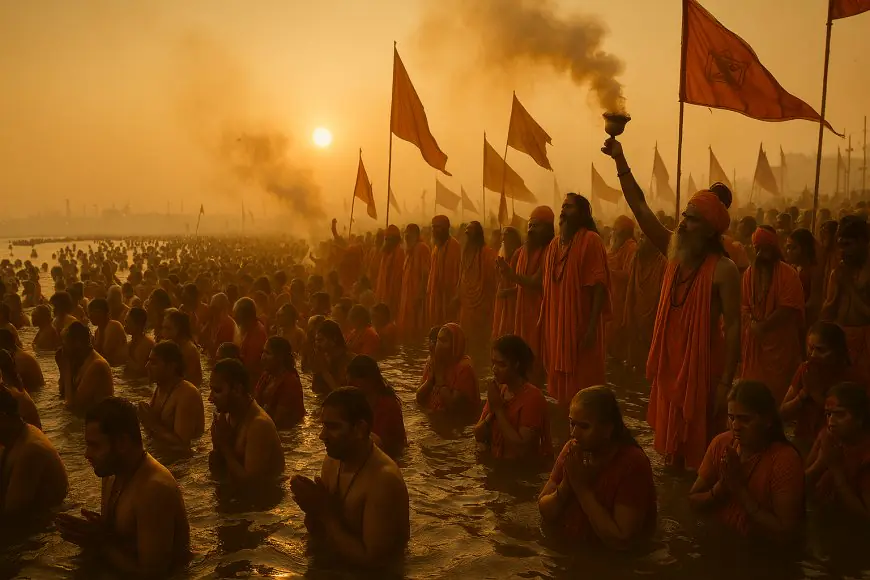
Kumbh Mela is not just a festival — it is the world’s largest spiritual gathering, a living symbol of Sanatan Dharma where millions of devotees travel to the banks of sacred rivers to receive blessings, purify karma and awaken inner wisdom. From ancient sages to modern pilgrims, from ordinary households to ascetic saints, Kumbh unites humanity under one eternal truth: the search for liberation.
To understand why Kumbh Mela is celebrated, we must look beyond the event itself and enter the heart of the Sanatan tradition — where mythology, astrology, cosmology, history and spiritual science merge.
For Every pilgrims, understanding Simhastha 2028 dates and the official Shahi Snan timeline is essential before booking flights or accommodation, as these sacred dates are completely non-negotiable.
The Origin of Kumbh Mela — The Samudra Manthan Story
According to ancient scriptures, the story of Kumbh begins during the Samudra Manthan — the churning of the cosmic ocean. When the devas (gods) and asuras (demons) churned the ocean to obtain Amrit — the nectar of immortality, a celestial battle occurred over who would receive it.
Trending Guides Now
The First Ever Kumbh Mela: Complete History, Rituals & Legacy That Continue Today

What Makes Ujjain Simhastha a Living Spiritual Tradition

How Ujjain Became a Center of Learning in Ancient India

How Ujjain Influenced Ancient Indian Astronomy

Ujjain Railway Station to Mahakaleshwar Temple Distance (2026 Guide)

Ujjain Simhastha 2028 Dates Announced: Full Shahi Snan & Event Timeline

Ujjain Simhastha Update: CM Mohan Yadav Reviews 2028 Works

Ujjain Railway Station to Kal Bhairav Temple: Distance, Auto Fare and Best Route
When the pot of nectar emerged, the Kumbh (Amrit Kalash) became the center of cosmic conflict. To protect the nectar from falling into the wrong hands, Lord Vishnu’s divine carrier, Garuda, flew away with the pot. During the flight, drops of nectar fell at four places on Earth:
Prayagraj (confluence of Ganga, Yamuna, Saraswati)
Haridwar (Ganga)
Nashik (Godavari)
Ujjain (Kshipra)
Where the nectar touched the Earth, the rivers became sacred gateways of liberation. Kumbh Mela is celebrated in these four places, each aligned with a different planetary configuration.
Why Kumbh Mela Is Celebrated
Kumbh Mela is celebrated for spiritual upliftment — not as a cultural show, but as a cosmic invitation. During specific planetary alignments involving Jupiter, Sun and Moon, the subtle spiritual energy around the rivers rises to its highest intensity.
Bathing in the river during Kumbh is believed to:
-
Purify inner karmic burdens

-
Strengthen spiritual memory
-
Awaken devotion and wisdom
-
Bring blessings of health, peace and prosperity
-
Guide the soul toward liberation (moksha)

The sacred dip is not symbolic — it is a ritual of transformation.
Spiritual Meaning of the Holy Bath (Shahi Snan)
The Shahi Snan is performed by the Akhadas and ascetic orders before the general public. It represents:
-
Victory of divine consciousness over ego
-
Surrender of the soul to the Supreme
-
Cleansing of past limitations
-
Awakening of divine potential within
Pilgrims believe that bathing on this day is equal to performing thousands of sacred rituals.
Why Kumbh Mela Happens in Different Locations
Each location represents a sacred convergence of:
-
Mythology
-
Astronomy
-
Planetary energy
-
The power of the river itself
When cosmic alignment activates the spiritual potential of the river, the Kumbh Mela begins.
The Role of Akharas and Saints
Kumbh is also a gathering of sadhus, yogis, Naga saints, mahants and ascetic orders who come together to:
-
Share spiritual knowledge
-
Demonstrate yogic mastery
-
Resolve religious matters
-
Guide people on the path of dharma
For seekers, even one moment in the presence of a realized saint is considered a blessing accumulated through many lifetimes.
Cultural and Social Significance
Kumbh Mela preserves the living heritage of India:
-
Ancient chants and rituals
-
Sacred baths
-
Devotional music and discourses
-
Gurukul traditions
-
Spiritual debates and teachings
-
Service (seva) to pilgrims
It is the cultural heartbeat of India, where time seems to stop and faith becomes the center of life.
Scientific and Psychological Perspective
Even though the origin of Kumbh is rooted in mythology, modern science recognizes several benefits:
-
Cold river water improves circulation and immunity
-
Devotional gatherings reduce stress and emotional burdens
-
Chanting synchronizes brainwaves and calms the nervous system
-
Feeling of belonging improves mental health
Spirituality and science do not oppose each other — they complement one another.
The Essence of Kumbh Mela
To experience Kumbh is to remember who we truly are — not just the body or mind, but the eternal soul connected to the divine. Devotees do not visit Kumbh to escape life; they visit to understand life deeply.
Kumbh Mela teaches:
-
Faith is powerful
-
Devotion purifies the heart
-
Selflessness elevates the soul
-
Dharma unites humanity
-
Every soul has divine potential
Kumbh Mela is not an event — it is an awakening.
Frequently Asked Questions