



















Why Ujjain Is Called the Navels of the Earth: Ancient Secrets Behind Simhastha
Discover why Ujjain is called the Navel of the Earth — exploring ancient geography, cosmic alignment, mythology and Simhastha’s deep spiritual connection.



Why Ujjain Is Called the Navel of the Earth: Ancient Secrets Behind Simhastha
Ujjain is known by many holy names — Avantika, Mahakaal ki Nagari and Moksha-Nagar. But the most mysterious and spiritually charged title is “the Navel of the Earth.” For thousands of years, sages, astronomers and yogis have referred to Ujjain as the point where cosmic energy converges with earthly geography. This belief is not only rooted in mythology but also supported by ancient scientific observations, astronomical measurements and the city’s role in Simhastha.
For Every pilgrims, understanding Simhastha 2028 dates and the official Shahi Snan timeline is essential before booking flights or accommodation, as these sacred dates are completely non-negotiable.
The Concept of the “Navel of the Earth” in Sanatan Dharma
In the spiritual geography of Hinduism, the “Navel” represents the axis where creation and energy flow are balanced. Just as the navel connects life within the womb, the Navel of the Earth represents the point of energetic connection for the world. Ujjain is believed to be this sacred center, where divine flow enters the physical world.
Reasons Ujjain Is Symbolically the World’s Spiritual Navel
- The convergence of spiritual energies at the Mahakaleshwar Jyotirlinga
- The highest density of siddha sadhus and cosmic practitioners historically
- The city’s role in scriptural cosmology and Kalchakra teachings
- Unique spiritual sensitivity experienced by seekers and yogis
These beliefs are reflected through thousands of years of rituals, pilgrimages and the gathering of saints — especially during Simhastha.
Trending Guides Now
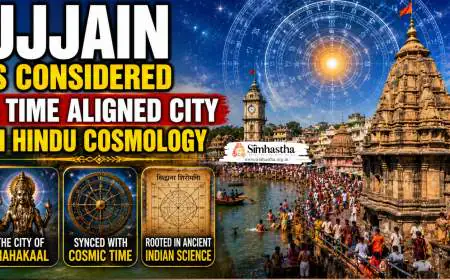
Ujjain Is Considered a Time Aligned City in Hindu Cosmology

Why is Kumbh Mela Celebrated? Origin Story, History & Spiritual Significance

How Astrology Determines Simhastha’s Location: Why Ujjain Becomes the Anchor

Why Travel to Ujjain Before the First Snan Is Sacred

Ujjain Railway Station to Mahakaleshwar Temple Distance (2026 Guide)

Ujjain Simhastha 2028 Dates Announced: Full Shahi Snan & Event Timeline

Ujjain Simhastha Update: CM Mohan Yadav Reviews 2028 Works

Karkateshwar Mahadev: 22/84 Mahadev of Ujjain
Ancient Astronomical Significance: Ujjain as the Earth’s Prime Meridian
Long before Greenwich became the international zero meridian, ancient scholars used Ujjain as the reference point for global timekeeping and astronomy. The city was considered the base longitude for astronomical calculations in the Surya Siddhanta and other ancient texts.
Astronomical Features That Make Ujjain Unique
- Ujjain sits exactly on the Tropic of Cancer
- Ancient scholars calculated planetary positions from this point
- Used as a reference hub for the Indian calendar and zodiac system
- Location where day and night cycles were measured with precision
Even today, time calculations for traditional Hindu panchangs take Ujjain as the spiritual reference point.
Mythological Secrets: Mahakaleshwar and the Cosmic Center
According to ancient lore, Mahakaleshwar Jyotirlinga manifests at the point where the energy of Lord Shiva stabilizes the world. Legends say that the trident of Shiva marked three cosmic energy nodes — Kailash, Kashi and Ujjain — with Ujjain at the balancing point.
The Cosmic Role of Ujjain in Mythology
- The strongest center for Tantric and Shaivic energy worship
- The seat of timeless cosmic power of Mahakaal
- The location where time (Kaala) is believed to dissolve into Shiva
- The point that anchors the invisible stream of spiritual energy (Nadi)
This is why saints say Ujjain is not a city — it is a yantra, an energy field.
The Kalchakra and Simhastha: Where Time, Space and Ritual Unite
The Kumbh is not based on mythology alone but on astronomical cycles. Simhastha in Ujjain occurs when the Sun, Jupiter and Moon align in the zodiac sign of Leo (Simha), forming a cosmic window that opens once in 12 years. This alignment amplifies the already existing spiritual charge of Ujjain.
Why Simhastha Happens Only in Ujjain Under This Alignment
- Only Ujjain vibrates at the central node of Kalchakra
- The city’s cosmic positioning magnifies the spiritual merit of rituals
- Astronomical-energy alignment transforms the Ganga-Kshipra confluence into a purification portal
- Spiritual masters witness heightened awareness during this period
This is why Simhastha is not just a festival — it is a cosmic event with Ujjain as its nucleus.

Scientific Interpretations of Ujjain’s Energy Pull
Modern researchers studying sacred geography and geobiology have proposed that ancient civilizations mapped spiritual “energy lines” across the earth — often called telluric lines or earth energy grid. Ujjain falls exactly at a major intersection point of these lines.
Scientific Theories That Align With Ancient Beliefs
- Magnetic field anomalies detected near the Mahakal ward
- Recorded high frequency of meditative brain wave resonance among yogis
- Unusual sensitivity felt by spiritually trained individuals
- Energetic symmetry between temples located on the city’s ley-line axis
While not officially proven, these findings fascinate researchers and seekers alike.
Why Pilgrims Feel Deep Emotional and Spiritual Pull Toward Ujjain
Millions say that Ujjain “calls” rather than invites. For many, the emotional pull begins even before arrival, and the vibration of peace begins as soon as one enters sacred areas around Mahakaleshwar, Shipra ghats or Akhara land.
Common Spiritual Experiences Reported by Pilgrims
- Strong feeling of inner calm near Mahakal corridor
- Unexplained tears or joy during darshan
- Unexpected surge of devotion during aarti
- Deep sleep or emotional release after the first ritual bath
For many devotees, these experiences confirm that Ujjain is not just a place — it is a gateway.
Ujjain: A City Where the Universe, Geography and Spirit Meet
Whether seen through mythology, astronomy or personal experience, Ujjain stands as a rare meeting point of cosmic alignment and inner awakening. This is why saints say that visiting Ujjain during Simhastha is not a journey — it is a return to one’s spiritual origin.
The city is called the Navel of the Earth because it connects the pilgrim to the source — of time, energy, devotion and liberation. Those who arrive at Ujjain do not simply visit; they remember who they are.
Frequently Asked Questions