























When Hotels Sell Out in Ujjain During Simhastha
Hotels sell out months before Simhastha in Ujjain. Learn exact sell-out dates, booking timelines, and backup accommodation options for the Kumbh Mela.

When Hotels Sell Out in Ujjain During Simhastha
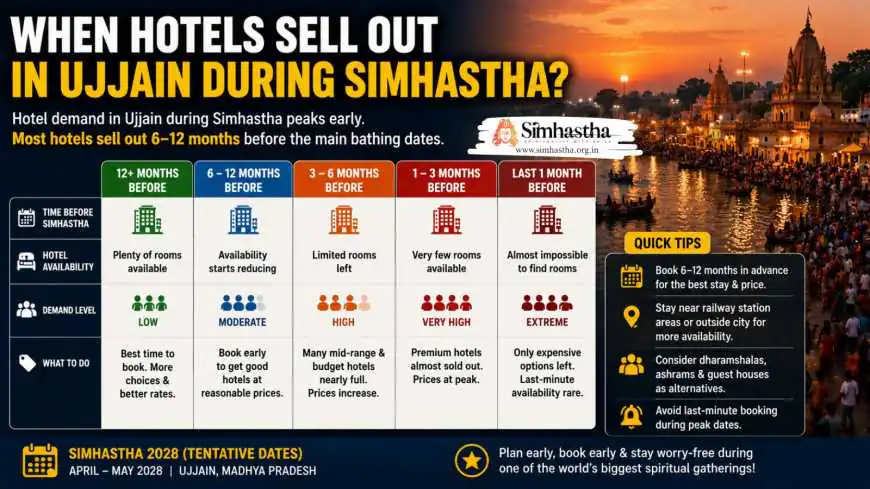
Hotels in Ujjain start selling out 12 to 18 months before The Simhastha Kumbh Mela begins. That is not an exaggeration or a scare tactic—it is the ground reality of the world’s largest religious gathering, where 50 to 80 million pilgrims descend upon this small city over 30 to 45 days.
If you are reading this anywhere near a Simhastha year (next one is 2028 , then 2036), you need to understand exactly when rooms disappear, which dates trigger the rush, and most importantly—what to do when every hotel displays the dreaded “No Vacancy” sign.
I have witnessed two Simhastha cycles in Ujjain and spoken with pilgrims who arrived without bookings during the last Kumbh. The stories range from miraculous last-minute finds to families sleeping on railway station platforms. Let me help you land in the first category. 🛕
Understanding the Simhastha Hotel Demand Curve
The hotel sellout pattern during Simhastha follows a predictable curve based on the Shahi Snan (royal bath) dates. Understanding this curve is your first defense against ending up without a room.
Trending Guides Now
How to Choose the Right Hotel in Ujjain Near Mahakal

Where Pilgrims Stay During Ujjain Simhastha Event

Family Friendly Hotels Near Mahakal Corridor

Best Hotels in Freeganj Ujjain Near City Center

Ujjain Railway Station to Mahakaleshwar Temple Distance (2026 Guide)

Ujjain Simhastha 2028 Dates Announced: Full Shahi Snan & Event Timeline
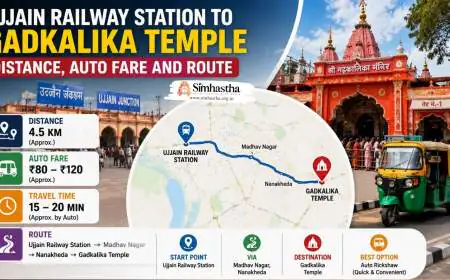
Ujjain Railway Station to Gadkalika Temple: Distance, Auto Fare and Route
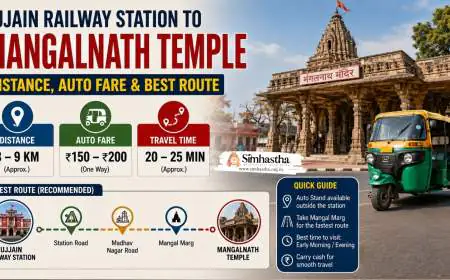
Ujjain Railway Station to Mangalnath Temple: Distance, Auto Fare and Best Route
12 to 18 Months Before Simhastha – Premium Properties Sell Out
This is when luxury hotels, branded chains, and Service Apartments on Ring Road receive advance block bookings from tour operators, spiritual organizations, and wealthy families. These rooms never appear on public booking websites because they are reserved through direct contracts.
Sellout timeline for premium properties: 18 months prior to the first Shahi Snan date.
9 to 12 Months Before Simhastha – Mid-Range Hotels Disappear
Once premium inventory is gone, mid-range hotels (₹1,500-3,500 range) begin filling rapidly. This is when online booking portals show the first “fully booked” messages for peak dates. Pilgrims who plan at this stage still get decent rooms at reasonable prices.
Sellout timeline for mid-range hotels: 9-12 months prior to first Shahi Snan.
6 to 9 Months Before Simhastha – Budget Hotels and Lodges Fill
Budget properties, including basic lodges and guest houses, start taking advance deposits at this stage. Prices have already risen 100-200% above normal rates. Availability becomes limited to specific dates only—continuous stays of 5+ days are very hard to find.
Sellout timeline for budget hotels: 6-9 months prior to first Shahi Snan.
3 to 6 Months Before Simhastha – Dharamshalas Reach Capacity
Even the most basic dharamshalas and temple accommodations fill during this window. These properties typically do not take advance bookings—but during Simhastha, many start accepting prepaid reservations for the first time. By 3 months out, even walk-in-only dharamshalas have waiting lists.
Sellout timeline for dharamshalas: 3-6 months prior to first Shahi Snan.
1 to 3 Months Before Simhastha – Everything Is Gone
By this stage, the official Simhastha control room starts publishing daily updates about accommodation shortages. Tent cities and temporary shelters become the only options for new arrivals without pre-booked rooms.
Sellout timeline for all accommodation: 1-3 months prior to first Shahi Snan.
Critical Sellout Dates: The Shahi Snan Calendar
During Simhastha, hotel sellouts are not uniform across all dates. The four to six Shahi Snan dates drive extreme demand, with rooms selling out completely around these specific days.
First Shahi Snan (Start of Simhastha)
This date sees maximum arrival of pilgrims who want to begin their Kumbh experience from day one. Hotels sell out 12 months in advance for the 3-day window around the first Shahi Snan.
Main Shahi Snan (Peak Auspicious Date)
The most important bathing date of the entire Simhastha attracts the largest crowds—often 10-15 million pilgrims on a single day. No hotel rooms available within 50 kilometers of Ujjain for 5 days around this date unless booked 18+ months ahead.
Second and Third Shahi Snans
Subsequent royal bath dates see slightly lower demand, but still massive. Hotels sell out 6-9 months in advance for these dates.
Final Shahi Snan (Closing Date)
The last major bathing day of Simhastha sees another surge as pilgrims want to complete their Kumbh experience. Sellout timeline similar to main Shahi Snan but with slightly more last-minute availability.

Between Shahi Snans
The intervening days (2-5 day gaps between royal baths) see reduced but still very high demand. Hotels may show limited availability for single-night stays, but continuous week-long stays are extremely hard to secure.
When Specific Hotel Categories Sell Out
Let me break down sellout timing by hotel type so you know exactly when to book based on your budget.
Luxury Hotels (₹5,000+ per night normal rate)
-
Sellout timing: 18-24 months before Simhastha
-
Booking method: Direct contracts, not online
-
Alternative: Virtually impossible to get during Simhastha unless booked through tour packages
-
Examples: The Grand Ujjain, Hotel Abika Elite premium floor
Mid-Range Hotels (₹1,500-3,500 normal rate)
-
Sellout timing: 9-12 months before Simhastha
-
Booking method: Online portals and direct booking
-
Alternative: Some cancellations appear 2-3 weeks before dates—monitor aggressively
-
Examples: Hotel Atharva, Hotel Siddhant, Hotel Rudraksh Height
Budget Hotels (₹500-1,200 normal rate)
-
Sellout timing: 6-9 months before Simhastha

-
Booking method: Direct booking with advance deposit (50-100% payment upfront)
-
Alternative: Very rare last-minute vacancies; backup plan essential
-
Examples: Hotel Shree Ji Palace, Shree Ram Dharamshala

Dharamshalas and Temple Accommodation
-
Sellout timing: 3-6 months before Simhastha
-
Booking method: Some take advance bookings during Simhastha (unlike normal years)
-
Alternative: Waiting lists with daily check-ins possible but stressful
-
Examples: Shri Mahakal Dharamshala, Gayatri Dharamshala
The 2028 Simhastha Projected Timeline
The next Simhastha in Ujjain falls in 2028. Based on previous cycles (2004, 2016), here is your definitive booking calendar.
By Early 2027 (18 months before) : Premium hotels completely sold out for Shahi Snan dates. Tour operators have block-booked all luxury inventory.
By Mid 2027 (12 months before) : Mid-range hotels vanish from online booking portals for peak dates. Only scattered availability on non-bath days.
By Late 2027 (9 months before) : Budget hotels start demanding full advance payment. Prices have tripled from normal rates.
By Early 2028 (6 months before) : Dharamshalas implement advance booking systems. Tent city bookings open through official Simhastha portal.
By Mid 2028 (3 months before) : Every hotel room within 30 kilometers of Ujjain is booked. Backup options (tents, schools, private homes) become primary accommodation.
During Simhastha (2028 dates TBD based on planetary positions) : Daily updates from control room. Temporary shelters operate 24/7. No hotel rooms available for walk-ins.
⚠️ Critical warning: Do not wait until 2028 to plan. Start researching and booking in 2027 at the latest. Every month you delay reduces your options significantly.
Why Hotels Sell Out So Early – The Numbers Behind the Rush
Understanding the scale of Simhastha explains why accommodation disappears years in advance.
Population explosion: Ujjain’s normal population is approximately 500,000. During Simhastha, 50-80 million pilgrims visit over 30-45 days. At peak times, the city hosts 10-15 million people simultaneously—20 to 30 times its normal population.
Hotel room inventory: Ujjain has roughly 10,000 to 15,000 hotel rooms across all categories (including unregistered guest houses). This includes everything from luxury suites to basic lodge beds.
Simple math: 15,000 rooms x 2-4 persons per room = 30,000 to 60,000 people accommodated in commercial lodging. The remaining millions stay in tents, temporary shelters, schools, private homes, railway stations, or simply sleep in the open.
Tour operator blocks: Large travel companies book 500-1000 rooms each months or years in advance. These rooms never appear on public booking sites. By the time you search online, half the inventory is already gone through offline channels.
Corporate and VIP bookings: Government officials, media teams, security forces, and VIP pilgrims receive priority allocations. Another 10-20% of inventory disappears through these channels.
The remaining rooms (perhaps 30-40% of total) become available for individual pilgrims booking online. Those rooms sell out within hours or days of becoming available—not weeks or months.
Real Stories from Last Simhastha (2016)
Let me share真实的pilgrim experiences from the previous Simhastha. These are not hypothetical warnings but actual accounts from people who lived through the accommodation crisis.
The Family Who Booked 14 Months Early: A family from Maharashtra booked their mid-range hotel in January 2015 for the April-May 2016 Simhastha. They paid ₹4,000 per night for a room that normally costs ₹1,200. By January 2016, their hotel was quoting ₹8,000 for remaining rooms. They had the last laugh—and a confirmed booking.
The Devotee Who Arrived Without Reservation: An elderly pilgrim from Gujarat arrived on a Shahi Snan day without any booking. He spent 8 hours searching, walked 12 kilometers, and finally found a chai shop owner who let him sleep on the floor for ₹500. He said later, “Mahakal arranged my stay, but I will never test him again.”
The Group That Booked Through a Trust: A spiritual organization from Pune booked 50 beds at a dharamshala 8 months in advance through their local contact. Without that network connection, they would have been scattered across different tent cities.
The Couple Who Stayed in Dewas: A young couple realized Ujjain was impossible 6 months before Simhastha. They booked a hotel in Dewas (35 km away) for ₹2,500 per night and commuted daily by train. Their total daily commute: 2 hours. But they had a confirmed bed and hot meals.
The International Pilgrim Who Used a Tour Operator: A devotee from the USA paid $2,500 (₹1,75,000) for a 5-day Simhastha package including hotel, meals, and transport. Expensive by Indian standards, but she had air conditioning, hot water, and guaranteed darshan access while others struggled.
The lesson: Advance planning is not optional during Simhastha. It is survival.
Backup Accommodation Options When Hotels Sell Out
When every hotel in Ujjain is full, you still have options. None are luxurious, but all will give you a roof and a place to rest.
Tent Cities – The Official Simhastha Solution
The Ujjain administration sets up massive tent cities (called “Kumbh Nagari” or “Pilgrim Cities”) on vacant land around the city. These tents range from basic to surprisingly comfortable.
Basic tents: Canvas tents on concrete floors, shared bathroom blocks, common dining. Cost: ₹500-1,000 per night (2016 rates; expect ₹1,000-2,000 in 2028).
Deluxe tents: Wooden flooring, attached bathrooms, cot beds, electricity, sometimes AC. Cost: ₹2,500-5,000 per night.
How to book: Official Simhastha website opens booking 3-6 months before the event. Priority given to advance bookings. Walk-ins accepted but subject to availability.
Location: Tent cities are typically on the outskirts of Ujjain—Nana Kheda, Dewas Road, Maksi Road areas. Free shuttle buses connect to the main temple and bathing ghats.
Schools and Colleges as Temporary Shelters
During Simhastha, the district administration converts government schools and colleges into temporary pilgrim shelters.
Facilities: Classrooms converted to dormitories (floor sleeping), common toilets (often pit style), drinking water, basic first aid. No meals provided.
Cost: Free or nominal (₹50-100 per night donation).
How to access: Report to the Simhastha Control Room near the railway station. They assign shelters based on availability. Do not expect privacy or comfort—this is emergency accommodation.
Best for: Solo pilgrims and very small groups with extreme budget constraints and high flexibility.
Private Homes – Homestays During Simhastha
Many Ujjain residents rent out rooms or entire homes during Simhastha and relocate to relatives’ houses outside the city.
How to find: Local classifieds, word-of-mouth, Simhastha-specific Facebook groups, and the official homestay registration portal (launched a few months before the event).
Cost: ₹2,000-8,000 per night depending on location, amenities, and proximity to ghats.
Quality: Highly variable. Visit before paying if possible. Some homes offer excellent hospitality; others are just profiteering.
Pro tip: Build connections with Ujjain-based acquaintances or spiritual organizations months in advance. The best homestays never get listed publicly.
Nearby Cities – Commuting to Ujjain
If you cannot find accommodation in Ujjain, the following cities are within commuting distance:
Dewas (35 km) : Regular trains (30-45 minutes) and buses (1 hour). Hotels moderately expensive during Simhastha but available. Best backup option.
Indore (55 km) : Major city with hundreds of hotels. Trains every 30-60 minutes (1 hour journey). Buses even more frequent. Expect higher prices but much better availability.
Ratlam (120 km) : Further but still manageable for determined pilgrims. Trains take 2-2.5 hours. Hotels available at near-normal rates.
Agar (60 km) : Smaller town with basic lodges. Limited options but very affordable.
Commuting reality check: You will spend 2-4 hours daily traveling to and from Ujjain. For Shahi Snan days, add another 2 hours for crowd delays. This is exhausting but workable for 2-3 days. For longer stays, prioritize moving closer.
Railway Station and Bus Stand – Last Resort
The Ujjain Junction retiring room (book at station master’s office) has 10-15 rooms that become available on a daily basis. Queue starts at 4 AM. Most days during Simhastha, the waiting list exceeds capacity by 10x.
Waiting hall at the station remains open 24/7. No booking required—first-come, first-served bench space. Hundreds of pilgrims sleep here nightly during Simhastha.
Bus stand waiting area offers similar floor space. No facilities, but sheltered from rain and sun.
These are absolute last resorts. Do not plan on these. Use them only when every other option has failed.
How to Book Hotels for Simhastha – Step by Step
Follow this timeline for the highest chance of securing confirmed accommodation.
18-24 Months Before Simhastha
-
Identify your travel dates based on Shahi Snan calendar (announced by Ujjain Simhastha authority)
-
Contact premium hotels directly via phone or email—not booking portals
-
Ask for “Simhastha advance booking” and be prepared to pay 50-100% advance
-
Join Simhastha information groups on WhatsApp and Facebook
-
Action item: Secure your premium hotel or decide on mid-range/budget alternative
12-18 Months Before Simhastha
-
Mid-range hotels open their Simhastha booking windows. Book immediately.
-
Check online portals weekly—some hotels release inventory in batches
-
Book refundable rates wherever possible (flexibility matters)
-
Start researching tent city options and official portal opening dates
-
Action item: Mid-range hotel confirmed OR premium hotel deposit paid
9-12 Months Before Simhastha
-
Budget hotel booking window opens. Act within weeks—not months.
-
Book backup accommodation in Dewas or Indore even if you have Ujjain booking (cancellation coverage)
-
Register for official homestay program if available
-
Action item: All primary and backup accommodation booked
6-9 Months Before Simhastha
-
Tent city bookings typically open on official portal
-
Book tents even if you have hotel—sell your extra booking later if needed
-
Arrange transport to Ujjain (trains sell out as fast as hotels)
-
Action item: Tent city confirmed as backup
3-6 Months Before Simhastha
-
Confirm all bookings with hotels (reconfirm 30 days before arrival)
-
Pay any pending balances
-
Join Simhastha volunteer groups for local contacts and support
-
Action item: All payments completed, confirmations saved
1-3 Months Before Simhastha
-
Monitor your hotel’s contact information—some properties change management during Simhastha
-
Print all booking confirmations, payment receipts, and contact numbers
-
Download offline maps of Ujjain (network congestion is severe)
-
Action item: Travel documents ready
During Simhastha
-
Arrive with printed confirmations—do not rely on phone screenshots only
-
Call your hotel 1 hour before arrival to confirm room readiness
-
Have backup cash (ATMs run dry during peak days)
-
Action item: Check in, breathe, offer thanks to Mahakal
Common Booking Mistakes During Simhastha
Learn from others’ errors—avoid these pitfalls.
❌ Booking through unverified online portals: During Simhastha, fake booking websites appear. Some collect money and disappear. Use only official hotel contacts or major aggregators (MakeMyTrip, Goibibo, Agoda).
❌ Assuming you can “just walk in and find something”: Based on real pilgrims who tried this in 2016. Most ended up sleeping on platforms or paying 5x rates to touts for illegal sublets.
❌ Booking non-refundable rates without backup: If your train gets canceled (common during Simhastha due to crowd management), you lose your payment. Pay marginally more for refundable rates.
❌ Waiting for “better deals”: There are no better deals as Simhastha approaches. Prices only increase. Availability only decreases. Book early, stop checking prices.
❌ Ignoring accommodation outside Ujjain: The “only Ujjain” mindset leaves thousands stranded. Dewas and Indore are perfectly viable options.
❌ Not reconfirming bookings: Hotels sometimes double-book during Simhastha, honoring whoever arrives first. Call 7 days, 3 days, and 1 day before arrival to reconfirm.
❌ Paying 100% advance to unknown entities: Legitimate hotels ask for 50-75% advance during Simhastha. 100% upfront is suspicious unless through major aggregators.
❌ Forgetting transport bookings: Even with a hotel, you need to reach Ujjain. Trains, buses, and flights sell out alongside hotels. Book your travel simultaneously.
Price Escalation During Simhastha
Let me prepare you for sticker shock. Simhastha pricing is unlike anything in normal Ujjain tourism.
Normal vs. Simhastha Rates
| Hotel Category | Normal Nightly Rate | Simhastha Rate (Shahi Snan days) | Multiplier |
|---|---|---|---|
| Budget lodge | ₹600 | ₹3,000-5,000 | 5-8x |
| Mid-range hotel | ₹1,800 | ₹6,000-10,000 | 3-5x |
| Premium hotel | ₹4,000 | ₹12,000-20,000 | 3-5x |
| Dharamshala | ₹300 | ₹1,500-3,000 | 5-10x |
| Tent city basic | N/A | ₹1,000-2,000 | N/A |
Minimum stay requirements: Most hotels enforce 3-7 night minimum stays during Simhastha, especially around Shahi Snan dates. You cannot book a single night on peak days.
Payment terms: Full advance payment (50-100%) required at booking. No “pay at hotel” options during Simhastha.
Cancellation policies: Many Simhastha bookings are non-refundable. Refundable options cost 30-50% more.
Price negotiation: Zero. Completely zero. Hotels have all the power during Simhastha. Pay quoted rate or find another hotel (there is none).
Is it worth it? For sincere pilgrims, yes. The spiritual energy of Simhastha is transformative. Treat inflated prices as part of your sadhana—acceptance of what is required for this sacred opportunity.
Alternative Strategies from Seasoned Simhastha Pilgrims
Here is advice from veterans who have successfully navigated multiple Kumbh Melas.
The Split Stay Strategy: Book 3 different hotels across your 10-day visit. Move every 2-3 days. You will get confirmations more easily than finding one hotel for the entire duration.
The Swap Network: Join Simhastha WhatsApp groups 6 months before. Connect with other pilgrims. Some will need early dates, others late dates. Swap rooms to create continuous stays.
The Early Arrival Advantage: Arrive 5-7 days before the first Shahi Snan. Hotels have vacancies immediately before the rush. Check in, then extend your stay daily. Many pilgrims successfully extend through the peak by already being in-house.
The Late Night Check-In: Hotels release unclaimed reserved rooms at 8 PM and 10 PM. If you are already in Ujjain, walk to hotels at these times. Some pilgrims score rooms abandoned by no-shows.
The Temple Connection: If you have a relationship with any Ujjain temple or math, reach out. Religious institutions often reserve accommodation for their devotees. This network access is priceless during Simhastha.
The Volunteer Path: Register as a Simhastha volunteer through the official portal. Volunteers receive accommodation, meals, and transport in exchange for 4-6 hours daily service. Applications open 12-18 months in advance.
What the Government Does to Help
The Ujjain administration is not blind to the accommodation crisis. Multiple official initiatives operate during Simhastha.
Simhastha Control Room (24/7 helpline): Call for real-time accommodation availability across all registered properties. Number published 3 months before the event.
Pilgrim Assistance Booths: Located at railway station, bus stand, and major entry points. Staff help direct you to available shelters and tent cities.
Free Shuttle Services: Connect tent cities and shelters to main pilgrimage sites. Operate 24 hours during peak days.
Water and Food Distribution: Free drinking water stations and community kitchens (annadanam) operate across the city. No pilgrim goes hungry even if accommodation is basic.
Medical Camps: Free primary healthcare at multiple locations. Serious cases transported to Choithram Hospital.
Lost and Found Centers: For separated family members. Mobile number registration recommended.
The government cannot create more hotel rooms, but they ensure no pilgrim is entirely abandoned. The tents, shelters, and free services mean you will always have somewhere to rest and eat—even if it is not what you imagined.
Preparing Mentally for Simhastha Accommodation
Beyond logistics, mental preparation determines whether you experience Simhastha as a struggle or a sadhana.
Release expectations: Your “hotel Near Mahakal Temple With AC and Wi-Fi” may become “canvas tent on dusty ground with shared toilet.” This is Simhastha. Millions of pilgrims share this reality. You are not alone.
Embrace simplicity: The saints who bathe at Shahi Snan often sleep on the ghat steps. Their devotion transcends comfort. Let their example inspire you.
Carry essentials: Pack a sleeping bag, toilet paper, hand sanitizer, water bottle, basic medicines, and power bank. These transform basic accommodation into bearable shelter.
Practice flexibility: Your confirmed hotel may overbook. Your tent location may change. Your transport may get rerouted. Flow with Simhastha’s chaos rather than fighting it.
Find your why: When you are exhausted, crowded, and overpaying for a basic room, remember why you came. The Shahi Snan at Simhastha is considered one of the most spiritually powerful acts in Hinduism. This discomfort is your tapasya (austerity). Offer it to Mahakal.
Final Word – The Sacred Rush
Hotels selling out during Simhastha is not a failure of Ujjain’s infrastructure. It is a testament to the unwavering devotion of millions who prioritize Mahakal’s darshan over personal comfort.
The city that houses 5 lakh people daily suddenly embraces 5 crore souls. Of course hotels sell out. Of course prices rise. Of course you will compromise.
But here is what also happens: strangers share their last roti. Families who never met before sleep side by side in tents. The spirit of Sanatan Dharma becomes visible in how pilgrims care for each other when official systems cannot.
Book early. Plan meticulously. Have backups. Carry patience. And then release all attachment to outcomes. Mahakal called you to Simhastha. He will also arrange your stay—perhaps not in a hotel, but in the vast, messy, miraculous embrace of his Kumbh.
🔱 Har Har Mahadev. 🔱
Frequently Asked Questions