















The Untold Story Behind Harsiddhi Temple's Twin Deep Stambhs
Uncover the untold story behind Harsiddhi Temple's twin Deep Stambhs in Ujjain. Explore their Maratha origins, hidden tantric symbolism, the secret of the thousand flames, and why these pillars are the spiritual axis of the Shaktipeeth.



The Maratha Matriarch and the Pillars Born from a Queen's Vision
To understand the Deep Stambhs, one must first journey back to the 18th century, to the twilight of the Mughal Empire and the rising, confident power of the Maratha Confederacy. The Simhastha.org.in/best-hotels-near-ram-ghat-ujjain-pilgrims-guide" class="contextual-link" data-post-id="743">Harsiddhi Temple, though a Shaktipeeth of immense, primordial antiquity—the sacred spot where the elbow of the Goddess Sati is believed to have fallen—had, like so many of Ujjain's ancient shrines, suffered the ravages of time, invasion, and neglect. Its physical fabric was diminished, its grandeur faded. The task of restoring this supreme seat of the Goddess to a magnificence befitting her cosmic power fell to a woman of extraordinary vision, piety, and political acumen: Devi Ahilyabai Holkar, the philosopher-queen of the Maratha Malwa kingdom, who ruled from her fortress at Maheshwar on the Narmada. Ahilyabai, a deeply devout Shakta, was not merely a patron of temples; she was a builder of a resurgent Hindu civilization. She understood, with a profound, intuitive genius, that architecture was a form of scripture, a visible, tangible theology.
When she commissioned the grand reconstruction of the Harsiddhi Temple, she did not merely restore its sanctum and its spire. She added something entirely new, something that had no precedent in the temple's original, ancient design, and something that would forever become its defining, unforgettable signature: the twin Deep Stambhs. These were not traditional temple elements like a shikhara or a mandapa; they were a specifically Maratha innovation, a synthesis of the military victory tower and the sacred lamp pillar of the Deccan tradition. Ahilyabai, the warrior-queen who personally led her armies into battle, and the devotee who spent her nights in deep, tearful meditation at the feet of the Goddess, fused these two identities into a single, magnificent architectural statement. The pillars, rising from the courtyard like the masts of a great, celestial ship, were a declaration, in stone and flame, that the sovereignty of the Goddess was absolute, that her power was both fiercely protective and infinitely nurturing, and that her temple was not merely a place of private worship but the strategic, spiritual command centre of the entire kingdom. The queen’s vision, encoded into these pillars, was of a Shakti that was not hidden in a cave but was boldly, publicly, and unapologetically proclaimed to the world, a flame that would be visible, every single evening, from the farthest corners of the city she protected. 👑
The Two That Are One and the Pillars as the Cosmic Couple
The most fundamental, and the most consistently overlooked, secret of the twin Deep Stambhs is that they are not identical, interchangeable pillars. They are a deliberate, meticulously conceived architectural representation of the primordial, cosmic duality that is the very foundation of all Hindu, and particularly all Shakta, theology: the inseparable, eternal, and ecstatically creative union of Shiva and Shakti. The pillar that stands on the right, as you face the main sanctum, is understood, in the esoteric tradition of the temple, to be the Shiva Stambha, the pillar of the masculine principle. It represents pure, unmanifest consciousness, the silent, still, and absolute witness, the formless, unchanging ground of all being. The pillar on the left is the Shakti Stambha, the pillar of the feminine, creative, dynamic principle. It represents energy, power, manifestation, the endless, playful, and awe-inspiring unfolding of the material universe. Shiva is the wordless, silent potential; Shakti is the spoken, dancing, and magnificent actualization. Shiva without Shakti is, in the famous tantric aphorism, a shava, a corpse, utterly inert and powerless. Shakti without Shiva is undirected, chaotic, and ultimately destructive. The two pillars, standing in eternal, silent partnership, are a permanent, monumental sermon on this most profound of cosmic truths.
The hundred small lamps that are lit, every evening, in the niches of each pillar, further elaborate this sacred, hidden teaching. The flames in the Shiva Stambha burn with a steady, unwavering, and deeply serene light, representing the still, eternal consciousness that is the foundation of the universe. The flames in the Shakti Stambha, by contrast, are understood to dance, to flicker, and to move with the wind, representing the dynamic, creative, and ever-changing nature of manifest reality. And yet, the pilgrims who witness the great Deep Malika ceremony from the courtyard below see, with their own eyes, that the two pillars, for all their subtle, philosophical differences, are ultimately a single, unified, and breathtakingly beautiful vision of fire. The light of the Shiva pillar and the light of the Shakti pillar merge, in the soft, smoky, and deeply sacred Ujjain dusk, into a single, radiant, and indivisible glow. The teaching is silent, wordless, and utterly profound: the ultimate reality is not Shiva alone, nor Shakti alone, but the inseparable, ecstatic, and world-creating union of the two. The twin pillars are the greatest, most beautiful, and most enduring love story in the universe, told not in words but in the eternal, flickering, and deeply sacred language of fire. 🔥
Trending Guides Now

Why Evening Visits to Harsiddhi Temple Are So Popular
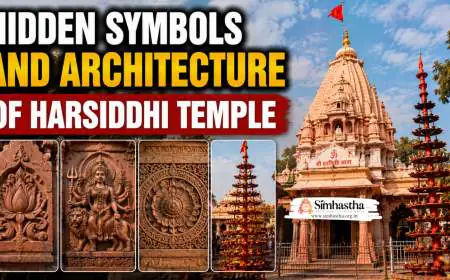
Hidden Symbols and Architecture of Harsiddhi Temple

Harsiddhi Temple Darshan Guide for First-Time Visitors
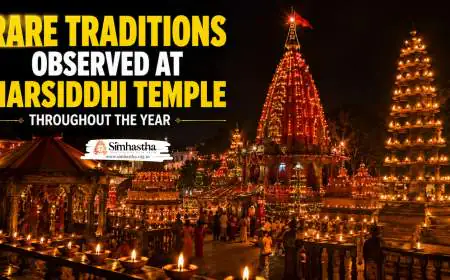
Rare Traditions Observed at Harsiddhi Temple Throughout the Year

Ujjain Railway Station to Mahakaleshwar Temple Distance (2026 Guide)

Ujjain Simhastha 2028 Dates Announced: Full Shahi Snan & Event Timeline

Ujjain to Mahakaleshwar Temple Distance & Taxi Fare (2026)

Ujjain Railway Station to Mangalnath Temple: Distance, Auto Fare and Best Route
A Thousand Souls and the Hidden Meaning of the Flames
Each of the hundreds of small, earthen lamps that are carefully placed, one by one, into the carved niches of the twin Deep Stambhs is not merely a source of physical light. In the profound, esoteric, and deeply personal theology of the Shakta tradition, each individual flame is the atman, the individual soul of a devotee. The lamp, small, fragile, and flickering, its light threatened by every passing breeze, is a perfect, poignant symbol of the human condition: a small, radiant spark of divine consciousness that is, for a brief, beautiful moment, encased in the fragile, earthen vessel of the physical body, always vulnerable, always flickering on the edge of being extinguished by the winds of karma, desire, and time. The great, towering, and immovable stone pillar, into whose body the small lamp is placed, is the divine, the cosmic, the eternal and all-embracing reality of the Mother Goddess herself. The ritual of the Deep Malika, the lighting of the thousand lamps, is thus far more than a beautiful, photogenic spectacle. It is a profound, participatory, and deeply moving sacred drama of the soul's ultimate journey. When the priest, chanting the ancient, secret mantras, places a lit lamp into the niche, he is enacting, in a physical, visible, and unforgettable ritual, the final, blissful union of the individual soul with the universal divine. The small, flickering, and fearful "I" is gently, lovingly, and irrevocably placed into the great, stable, and radiant body of the Mother, and in that moment, the individual flame does not lose its identity; it becomes, instead, an integral, luminous, and indispensable part of a vast, unified, and unimaginably beautiful constellation of light. The pilgrim who witnesses the Deep Malika, who sees the pillars slowly, steadily, and majestically transforming into cascading columns of a thousand flames, is witnessing, in the most direct and powerful way possible, the ultimate, promised destiny of their own, individual soul. ✨
The Secret Geometry and the Unseen Architecture of Energy
The profound, hidden power of the twin Deep Stambhs is not merely in their stone or their fire; it is in their precise, calculated, and deeply secret sacred geometry. The pillars are not placed at random in the temple courtyard; they are positioned, with a precision that would challenge a modern surveyor, at the exact threshold between the outer, profane, and chaotic world of the city and the inner, sacred, and ordered realm of the Goddess's sanctum. They function, in the subtle, esoteric anatomy of the temple, as the nadis, the subtle energy channels of the temple's living, breathing body. They are the ida and pingala, the two great, serpentine energy currents that, in the yogic tradition, coil around the central, dormant channel of the sushumna, the spine of the universe. The temple's main sanctum, the garbhagriha where the dark, powerful, and wish-fulfilling goddess resides, is the sushumna itself, the central, silent, and supremely powerful channel of pure consciousness.
The pillars, therefore, are not merely decorative structures; they are an active, functioning, and deeply sophisticated technology of spiritual transformation. The pilgrim, entering the courtyard and passing between the two pillars, is not simply walking through an open space; they are walking through a precisely calibrated, energetically charged gateway. They are, symbolically and, it is believed, literally, passing through the ida and pingala nadis, entering a state of subtle, energetic balance and alignment, a necessary, preparatory purification before they are fit to approach the central, supreme, and utterly still channel of the divine mother in the inner sanctum. The pillars are a permanent, silent, and deeply powerful energy device, an architectural mandala that is continuously, silently, and invisibly at work, cleansing, balancing, and elevating the consciousness of every single pilgrim who passes through their sacred, protective, and deeply loving field. 📐
The Ahilya Code and the Maratha Empire's Statement in Stone and Fire
The twin Deep Stambhs are not only a spiritual and philosophical statement; they are also a powerful, encoded, and deeply political declaration. Ahilyabai Holkar, the great queen who built them, was not merely a pious, benevolent widow; she was the undisputed, fiercely intelligent, and strategically brilliant sovereign of a vast, wealthy, and militarily powerful kingdom during one of the most turbulent and contested periods of Indian history. Her rule was constantly challenged by rival Maratha chieftains, by the fading but still dangerous Mughal authority, and by the encroaching, aggressive presence of the British East India Company. In this intensely competitive, high-stakes political landscape, the building of a magnificent, monumental temple, adorned with these unprecedented, towering, and unforgettable lamp pillars, was an act of deliberate, calculated, and supremely confident soft power.
The pillars, with their visible, blazing proclamation of the Goddess's supreme, protective sovereignty, were a message, in stone and fire, to every rival power, every visiting dignitary, and every pilgrim from across the subcontinent. They declared, with an unshakeable, silent, and deeply intimidating authority, that the kingdom of Malwa was not merely a political entity; it was a sacred realm, a Devi Rajya, a kingdom personally protected and sanctioned by the most powerful, fierce, and benevolent goddess in the Hindu pantheon. The wealth, the labour, the immense, imported oil required to light a thousand flames every single evening, and the sheer, breathtaking, and undeniable magnificence of the spectacle were all part of a deliberate, intelligent, and deeply effective political and cultural strategy. Ahilyabai was not just building a temple; she was consolidating her dynasty's legitimacy, asserting her kingdom's sovereignty, and wrapping her temporal, political power in the divine, unassailable, and eternally radiant mantle of the Mother Goddess herself. The pillars are a monument to a queen who understood, with a genius that was centuries ahead of her time, that the most enduring and unshakeable power is the power that flows from a sincere, humble, and deeply devoted faith. 🏛️
The Unbroken Chain of Fire and the Priests Who Guard the Secret
The magnificent, towering stone pillars are, in themselves, silent and inert. They come to life, they fulfill their profound, sacred purpose, only through a specific, secret, and meticulously performed ritual that has been passed down, through an unbroken chain of hereditary priests, for over two and a half centuries. The lighting of the Deep Malika is not a casual, open-to-all act. It is a precise, liturgical, and deeply esoteric ceremony, performed only by a designated priest of a specific family lineage that has served the Harsiddhi Temple since the days of Ahilyabai herself. The ritual begins with the purification of the pillars, the offering of a specific, secret mantra that is never spoken aloud to the uninitiated, and the lighting of a single, sacred, foundational flame from the temple's eternal, inner-sanctum lamp. From this single, divine source, all the hundreds of lamps are kindled, in a specific, prescribed sequence that follows the subtle, energetic map of the pillar's architecture. The priest, as he climbs the narrow, internal staircase of the pillar, chanting the ancient, powerful mantras, is not merely lighting lamps; he is, in the profound, esoteric understanding of the tradition, awakening the pillar, activating its latent, spiritual energy, and transforming it, for the duration of the evening, into a living, breathing, and radiant body of the Goddess herself. The secret of the Deep Malika, the specific mantras, the precise sequence, and the inner, meditative state of the priest during the ritual, is a closely guarded treasure, passed down from father to son, and it is this living, breathing, and fiercely protected chain of human transmission that ensures that the pillars are not dead monuments but living, pulsing, and eternally potent channels of divine grace. 🕉️

The Silent Witnesses and What the Pillars Have Seen Across the Centuries
The twin Deep Stambhs have stood, silent and flame-wreathed, on their ancient, sacred plinth, witnessing the relentless, ever-changing tide of Indian history. They saw the last, defiant glimmers of Maratha sovereignty before the British Raj finally, and completely, consolidated its iron grip over the subcontinent. They saw the terrible, bloody, and traumatic violence of Partition, and they saw the quiet, steady, and determined dawn of a new, independent, and hopeful India. They have seen the slow, incremental, and often frustrating improvements of the modern era—the arrival of electricity, the growth of the city, and the immense, surging crowds of the Simhastha Kumbh Mela—and they have endured, with a silent, stoic, and deeply moving patience, the inevitable decay and weathering that time, pollution, and the elements inflict upon even the most noble and sacred stone. They were lovingly, painstakingly, and respectfully restored by the Scindia dynasty, the successors of the Holkars, who understood the profound, symbolic, and political importance of maintaining the temple's grandeur. They have survived the fierce, violent storms of the Malwa monsoon and the intense, unrelenting, and parching heat of the central Indian summer. And through it all, through every war, every famine, every political upheaval, and every passing, fleeting generation, they have performed their sacred, silent, and unwavering duty. Every single evening, without fail, for over two hundred and fifty years, the lamps have been lit, the flames have flickered, and the great, twin pillars have blazed with the silent, eternal, and deeply comforting message of the Goddess's enduring, protective, and all-loving presence. They are the most faithful, the most consistent, and the most deeply moving storytellers in the entire, ancient city of Ujjain. ⏳
The Inherited Flame and the Legacy of the Twin Sentinels
The twin Deep Stambhs of the Harsiddhi Temple are, in their deepest, most beautiful, and most enduring truth, a love letter written in stone and fire. They are a love letter from a queen to her goddess, from a mother to her people, and from the eternal, formless divine to every fragile, flickering, and deeply precious human soul. They are a promise, written in the silent, unchanging language of sacred architecture, that the small, trembling, and vulnerable flame of your individual life is not alone, is not lost, and is not insignificant. It is seen, it is held, and it will, when the evening lamps are lit and the great pillars blaze with their thousand flames, be gathered, lovingly and irrevocably, into the vast, radiant, and unquenchable fire of the Mother's eternal, cosmic, and all-embracing love. The next time you stand in the ancient, red-stone courtyard of Harsiddhi, as the sun sinks below the Malwa horizon and the priests begin their ancient, silent, and secret ritual, do not just see two magnificent, photogenic pillars. See the love, see the power, see the silent, profound, and deeply transformative philosophy that they embody. See the story of your own soul, waiting, with infinite patience and divine grace, to be placed, gently and eternally, into the loving, fiery, and unshakeable embrace of the Mother. 🔱
Frequently Asked Questions