




















How Ram Ghat Changes From Sunrise to Midnight
Discover how Ram Ghat transforms from sunrise to midnight in Ujjain. From silent dawn rituals and noon pind daan to the blazing Shipra Aarti and solitary midnight lamps, journey through a full day on this sacred riverbank.


v
The Pre-Dawn Hush and the First Breath of the Shipra
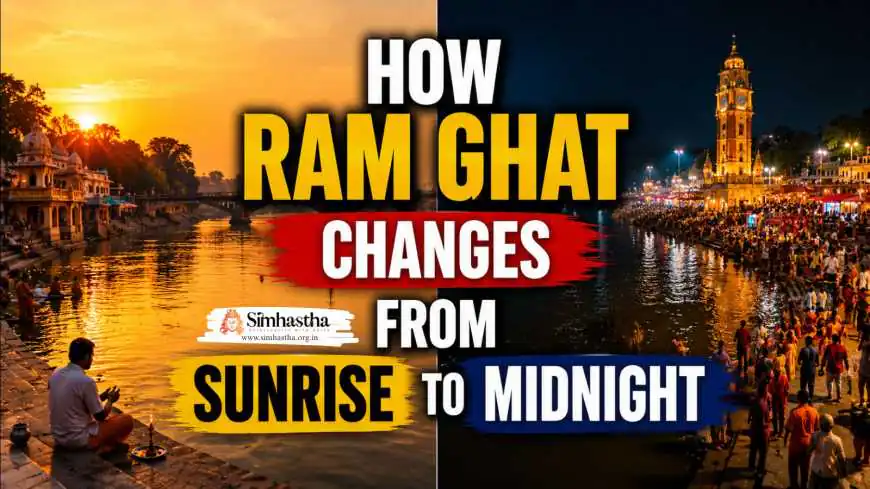
The day at Ram Ghat does not begin with the sun; it begins in the profound, velvety darkness of the brahma muhurta, that sacred, liminal hour roughly ninety minutes before sunrise when the world is still suspended between sleep and waking. The ghat is almost entirely empty. The great, broad stone steps, which will be packed shoulder-to-shoulder with thousands of devotees in just a few hours, are cold and silent, their only occupants a few sleeping figures wrapped in thin cotton blankets, a stray dog curled into a tight, peaceful circle, and the silent, seated form of a sadhu who has been meditating here since the previous evening, his body as still as the stone upon which he sits. The Shipra River, in this pre-dawn hour, is a dark, slow-moving mirror, reflecting the last, faint stars and the soft, golden glow of a few, small oil lamps that have been left to burn on its surface by the night's last pilgrims. The air is cool and carries the clean, mineral scent of the river water mingled with the distant, fragrant smoke of the temple's first incense. The only sound is the gentle, ceaseless lap of the water against the ancient stone, a rhythmic, liquid mantra that has been chanting itself for millennia. This is the hour of the yogis and the sannyasis, the silent, solitary seekers who come to the river not to perform a ritual but to simply sit in the presence of the sacred, to breathe in the untouched peace of the new day, and to feel the first, faint stirrings of divine consciousness that are believed to be most accessible in this quiet, liminal hour before the world awakens. 🧘
The Golden Awakening and the Morning Bathing Rituals
As the first, pale grey light of dawn begins to leach into the eastern sky, a subtle, profound shift occurs. The ghat stirs from its slumber. The first pilgrims of the day, mostly elderly men and women in simple, white dhotis and cotton sarees, begin to descend the stone steps, their bare feet making a soft, shuffling sound on the worn stone. They carry small, brass vessels filled with water from their homes, or simple, woven baskets containing their fresh, dry clothes. The air begins to fill with the quiet murmur of whispered prayers, the sound of the Gayatri Mantra being chanted under the breath, and the gentle, splashing sound of the first ritual baths. The sun, when it finally crests the horizon, does so with a sudden, breathtaking drama. The entire eastern sky ignites in shades of deep orange, rose, and gold, and the dark, reflective surface of the Shipra is instantly transformed into a flowing river of liquid fire. The ghat, bathed in this warm, golden light, becomes a scene of serene, timeless beauty. The pilgrims stand waist-deep in the sacred water, facing the rising sun, their hands raised in the ancient gesture of the Surya Namaskar, offering water to the solar deity and receiving his life-giving blessing. The atmosphere is one of quiet, personal, and deeply intimate devotion, a sacred, morning conversation between the individual soul and the divine that takes place before the loud, communal rituals of the day begin. This is the hour for the pilgrim who seeks not the spectacle of the aarti, but the simple, purifying grace of the sacred river at the moment of its daily rebirth. 🌞
The Mid-Morning Surge and the Arrival of the Temple Crowds
By the time the sun has fully cleared the horizon and the golden light has hardened into the clear, bright day, the character of Ram Ghat has shifted entirely. The solitary, meditative silence of the dawn is now a distant memory. The ghat steps are no longer empty; they are filling rapidly with a continuous, colorful stream of pilgrims who have completed their darshan at the Mahakaleshwar Temple and are now making their way to the river for the ritual bath that is the essential complement to the temple visit. The atmosphere is no longer one of silent, personal prayer but of bustling, communal, and joyous devotion. Families descend the steps together, the women holding the edges of their brightly colored sarees, the men carrying small children on their shoulders. The air is filled with the sound of cheerful conversation, the laughter of children, the occasional, exuberant shout of "Har Har Mahadev," and the insistent, gentle coaxing of the flower sellers and the puja-item vendors who have set up their small stalls along the upper edges of the ghat. The priests who specialize in assisting pilgrims with their ritual baths are now fully occupied, guiding families through the correct sequence of offerings and mantras. The river itself is a churning, colorful mass of humanity, a living, breathing, and deeply joyful mandala of faith. This is the hour for the family pilgrim, for the community, and for the shared, collective expression of a faith that is as much about belonging and togetherness as it is about personal salvation. 👨👩👧👦
Trending Guides Now
Why Ram Ghat Becomes the Spiritual Center of Ujjain
Ram Ghat Complete Visitor Guide for First-Time Pilgrims

Ujjain Railway Station to Mahakaleshwar Temple Distance (2026 Guide)

Ujjain Simhastha 2028 Dates Announced: Full Shahi Snan & Event Timeline

Ujjain Railway Station to Kal Bhairav Temple: Distance, Auto Fare and Best Route

Triveni Ghat Ujjain – Simhastha 2028 Complete Guide

Mahakaleshwar Temple Entry Rules 2026: Dress Code, Mobile & Bag Policy

Bhasma Aarti at Mahakaleshwar Temple – Complete Pilgrim Guide
The Noon Sun and the Quiet Work of Ancestral Rites
As the sun climbs to its zenith and the Malwa heat begins to beat down with an unrelenting intensity, the ghat undergoes another transformation. The large, boisterous family groups retreat to the shade of the surrounding trees and the nearby dharamshalas. The riverbank becomes a quieter, more solemn, and deeply emotionally charged space. This is the hour of pind daan, the ancient, sacred ritual of offering rice balls to the souls of one's departed ancestors. The atmosphere shifts from the joyous, communal bathing of the morning to the tender, intimate, and often tearful work of honouring the dead. Small groups, typically a family led by a hereditary priest, sit cross-legged on the stone steps, facing the southern direction, which is the realm of the ancestors. The priest chants the specific, powerful mantras that invite the souls of the departed fathers, mothers, and forefathers to the riverbank. The devotee then forms the small, round balls of cooked rice mixed with black sesame seeds and ghee, and, with hands that often tremble with emotion, offers them into the flowing Shipra. The air here is heavy not with the cheerful chatter of the morning, but with the quiet sobs of a grieving son, the silent tears of a widow, and the profound, ancient, and unbreakable bond of filial love that reaches across the veil of death. The ghat, in its midday guise, is a sacred, open-air cathedral of mourning and memory, a place where the living can touch the dead, and where the great cycle of life, death, and liberation is made palpable and immediate. 🕯️
The Late Afternoon and the Slow Gathering of the Aarti Pilgrims
The intense, emotional weight of the midday rituals begins to lift as the sun starts its slow, gentle descent towards the western horizon. The priests who perform the pind daan complete their final ceremonies, and the grieving families slowly depart, their faces etched with a mixture of sorrow and a quiet, strange peace. The ghat falls into a brief, peaceful lull. The late afternoon light softens into a warm, golden syrup, casting long, dramatic shadows across the wide stone steps. The river, which was churning with bathers just a few hours ago, is now relatively calm, a few late bathers and children splashing in the shallows. This is the hour of quiet preparation. The temple administration's staff and the dedicated volunteers begin the meticulous work of preparing the ghat for the great, climactic event of the day: the evening Shipra Aarti. They sweep the stone steps, arrange the large brass lamps on their designated platforms, and test the public address system. A new crowd begins to gather, different in its energy from the morning pilgrims. These are the evening devotees, the families and the young people who have come specifically for the aarti, their faces filled with a palpable, excited anticipation. The chai stalls and the snack vendors do a brisk trade, their small, flickering lights adding to the growing sense of a sacred event about to unfold. The entire ghat holds its breath, waiting for the sun to finally surrender to the horizon and for the great, ancient ritual of light and sound to begin. ⏳
The Shipra Aarti and the Blazing Climax of the Day
The moment the last sliver of the sun disappears beneath the horizon and the sky is painted in deep shades of violet and indigo, the transformation is immediate, total, and utterly breathtaking. The great, multi-tiered brass lamps are lit, and the Shipra Aarti erupts into life. A group of young priests, bare-chested and clad in identical saffron dhotis, stand at the water's edge, their bodies already glistening with sweat and the spray of the river. To the thunderous, rhythmic clang of massive cymbals, the deep, resonant blast of conch shells, and the swelling, collective chant of the sacred hymns, they raise and lower the enormous, blazing lamps in synchronized, sweeping arcs. The flames trace huge, glowing circles and figure-eights of fire against the darkening sky, their reflection dancing and shimmering on the black, glassy surface of the Shipra. The entire ghat, now packed solid with thousands of devotees, becomes a single, unified, swaying body. The roar of "Har Har Mahadev" rolls across the water like a wave of sound, and hundreds of small, individual diyas, little leaf and clay boats filled with a tiny, flickering flame, are set afloat on the river by the devotees, each one a silent, personal prayer. This is the moment of absolute, ecstatic, and collective surrender, the great, visible, and audible heart of Ujjain's daily spiritual life. The ghat is not just a place of worship; it is the stage for a magnificent, ancient drama of light, sound, and pure, unadulterated faith. 🔥
The Post-Aarti Exodus and the Gentle Unraveling of the Crowd
As the final, powerful notes of the aarti fade into the night, the great, ecstatic, unified energy of the crowd begins to dissolve, gently and organically, into a thousand smaller, quieter streams. The mass of devotees, their faces still glowing with the reflected light of the flames and the peace of the blessing, begins the slow, shuffling exodus up the stone steps and back into the narrow, winding lanes of the old city. The vendors begin to pack up their stalls, the large brass lamps are carefully extinguished and cleaned, and the volunteer crews begin their first, swift sweep of the ghat steps. A profound, palpable, and deeply peaceful silence begins to descend, punctuated only by the soft, distant ringing of a temple bell and the gentle murmur of the receding crowd. The river, which moments ago was a stage for a divine spectacle, returns to its natural state, the thousands of floating diyas now drifting slowly downstream, a silent, luminous, and slowly dissolving constellation on the dark water. The ghat is caught in a beautiful, liminal moment, suspended between the roaring climax of the aarti and the deep, meditative silence of the coming night. It is a time for the pilgrim who wants to sit, undisturbed, and allow the powerful, transformative energy of the aarti to settle deeply into their soul, without the pressure of the crowd. 🌙
The Late Evening Silence and the Return to Personal Devotion
An hour after the aarti, the transformation is nearly complete. The vast, sweeping ghat, which had just held thousands, is now populated by only a handful of solitary figures. The loudspeakers are silent. The air is cool and carries the lingering, beautiful scent of the aarti's incense, the burnt ghee from the lamps, and the clean, earthy smell of the river. A single, elderly woman, her white saree glowing faintly in the darkness, sits at the very edge of the water, placing a single, small diya into the river with a whispered prayer that is known only to her and the Shipra. A young couple sits on a higher step, their bodies close, their voices hushed, sharing a moment of quiet, intimate connection in the presence of the sacred. A sadhu, who has been meditating under the ancient banyan tree at the edge of the ghat, remains motionless, a silent, ash-smeared statue. This is the hour when the ghat returns to the individual, to the solitary seeker, to the person who is not there for the spectacle but for the silent, personal conversation with the divine. The Shipra, in her gentle, maternal wisdom, receives all these quiet, unspoken prayers with the same infinite grace with which she received the thunderous, collective roar of the aarti. The ghat, in its late-night incarnation, is a sanctuary for the introvert, the contemplative, and the quietly broken-hearted, a place of profound, healing silence that is the true, hidden treasure of the Ujjain pilgrimage. 🌿
The Midnight Ghat and the Realm of the Unseen
The clock strikes midnight, and Ram Ghat enters its final, most mysterious, and most profoundly sacred transformation. The last of the solitary pilgrims have drifted away. The chai stalls are shuttered and dark. The river is now a vast, silent, and seemingly infinite expanse of black water, its surface broken only by the occasional, gentle ripple of a fish and the shimmering, silver reflection of the moon and the stars. The ancient stone steps are completely empty, their cold, worn surface a testament to the millions of bare feet that have walked upon them. The silence is no longer just an absence of noise; it is a living, breathing, and deeply palpable presence. This is the hour that belongs not to the human world of ritual and prayer, but to the realm of the unseen, the divine, and the eternal. The local belief whispers that this is the hour when the gods themselves descend to bathe in the sacred Shipra, when the great sages of the past come to meditate on its banks, and when the thin, permeable veil between the material and the spiritual worlds is at its most diaphanous. A stray dog wanders silently across the steps, its own, ancient presence a quiet, watchful guardian of the sacred ground. The ghat, in its midnight form, is not empty; it is, in the deepest spiritual sense, utterly full. It is full of the accumulated, absorbed devotion of the day, full of the silent, benevolent presence of the divine, and full of the quiet, eternal peace that is the true source and the ultimate destination of all pilgrimage. 🌌

The Eternal Cycle and the Ghat That Never Sleeps
As the deepest part of the night begins its slow, inexorable turn back towards the first, faint grey light of the pre-dawn, the great, eternal cycle of Ram Ghat prepares to begin again. The transformation is not a series of separate, disconnected events, but a single, continuous, and beautifully seamless flow, a river of time and devotion that mirrors the river of water that flows past its steps. From the silent, solitary meditation of the brahma muhurta to the golden, purifying baths of the sunrise, from the joyful, communal splashing of the mid-morning families to the tearful, sacred grief of the noon pind daan, from the thunderous, ecstatic fire of the evening aarti to the intimate, whispered prayer of the late-night solitary pilgrim, and finally, to the profound, full, and mysterious silence of the midnight hour, the ghat is a living, breathing, and ever-changing mandala of the entire human spiritual experience. To sit on the steps of Ram Ghat for a full day and night is to witness the entire, magnificent drama of life, death, faith, and liberation played out in a single, sacred space. The ghat does not merely change from sunrise to midnight; it breathes, it weeps, it sings, it dances, and it meditates, a timeless, compassionate, and eternal witness to the endless, beautiful, and profoundly human quest for the divine. 🔱
Frequently Asked Questions