










Raja Yoga Meditation by Swami Vivekananda: The Path of Mind Mastery and Self-Realization

Explore Swami Vivekananda’s Raja Yoga Meditation system — grounding the mind in discipline, concentration and self-realization through the Eight-Limbed Yogic Path.

02 Dec 2025 at 04:55 PM
 0
🚩 Plan Your Ujjain & Simhastha 2028 Visit → 🏨 View Today’s Hotel Deals →
Raja Yoga Meditation by Swami Vivekananda: The Path of Mind Mastery and Self-Realization

Raja Yoga Meditation by Swami Vivekananda

Swami Vivekananda is one of the greatest spiritual teachers of modern India. Among his many contributions, his teaching of Raja Yoga Meditation stands as a practical and powerful path for mental purity, inner strength and self-realization. Vivekananda took the ancient yogic knowledge of Patanjali and communicated it in a clear, scientific, universal and non-ritualistic way. His message emphasized that meditation is not escape from life — it is mastery of life.

He described Raja Yoga as the royal road to the highest knowledge, because it trains the mind to become silent, disciplined and transparent — revealing the true Self beyond thoughts.


Core Principle of Raja Yoga

Raja Yoga rests on one fundamental idea:

The mind, when disciplined and concentrated, becomes the doorway to infinite knowledge and peace.

Trending Guides Now

Every disturbance — fear, anger, confusion, stress, ego — comes from an uncontrolled mind.
Every success — clarity, compassion, intelligence, intuition — comes from a trained mind.

Raja Yoga transforms the mind from a master that controls us into a servant that supports us.


The Eight Limbs of Raja Yoga (Ashtanga)

Swami Vivekananda explained the Eight-Limbed Path not as steps to learn mentally, but as a sequence of inner evolution.

Limb Meaning Purpose
Yama Moral discipline Reduce inner disturbance
Niyama Personal discipline Build inner strength
Asana Physical posture Prepare for meditation
Pranayama Breath control Regulate energy
Pratyahara Sense withdrawal Reduce distractions
Dharana Concentration One-pointed attention
Dhyana Meditation Continuous flow of awareness
Samadhi Absorption Realization of true Self

Swami Vivekananda emphasized that meditation begins only after concentration becomes steady.


The Unique Vision of Swami Vivekananda

Unlike many teachers, Vivekananda taught:

  • Meditation is scientific and universal

  • No blind belief is required

  • Anyone can practice regardless of religion

  • Meditation must reflect in real life — character, confidence, compassion

He also insisted that purity of thought, service to others and self-discipline are not optional but foundational.


What Happens in Raja Yoga Meditation

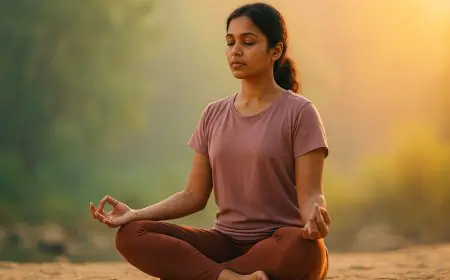
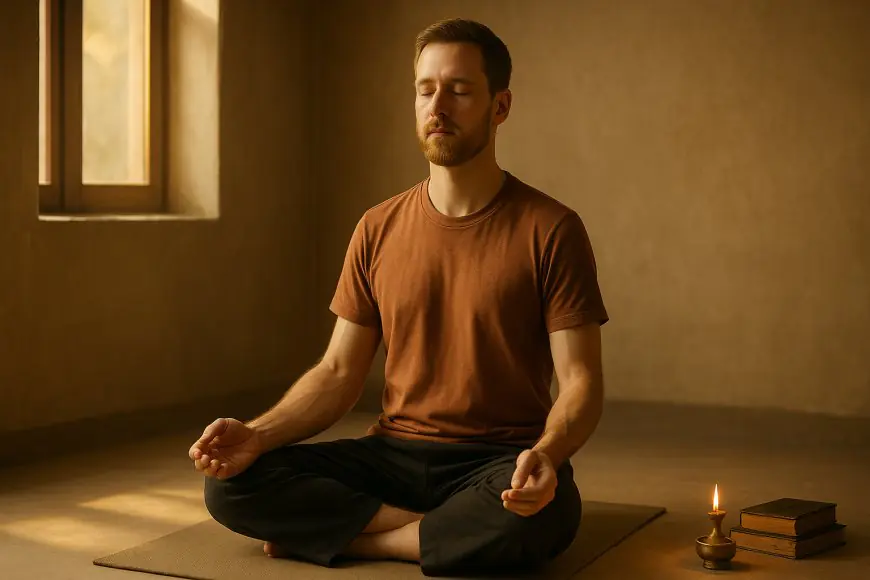
The meditator trains the mind to hold attention on a single point — breath, sound, sensation or inner silence — without distraction. As concentration deepens:

  • Mental chatter fades

  • Emotions become balanced

  • The sense of ego softens

  • Inner peace becomes natural

When thoughts stop dominating, the awareness of pure existence appears — called Self or Atman.


Raja Yoga vs Other Meditation Systems

Style Primary Path Outcome
Raja Yoga Mental concentration & discipline Self-realization
Bhakti Yoga Devotion Divine love
Jnana Yoga Knowledge & inquiry Wisdom
Karma Yoga Selfless action Purification

Vivekananda encouraged combining the paths, but said Raja Yoga is necessary for true inner control.


Psychological and Practical Benefits

Consistent Raja Yoga practice may result in:

  • Emotional balance and resilience

  • Reduced overthinking and fear

  • Increased concentration and memory

  • Improved confidence and decision-making

  • Deep calmness independent of circumstances

  • A stable and grounded personality

It strengthens both inner stillness and outer success.


Swami Vivekananda’s Famous Meditation Teaching

“The mind is not your enemy; you have simply never trained it.”

Meditation does not remove life problems — it makes the mind powerful enough to face them without fear.


Final Thought

Raja Yoga invites humanity to rise from limitation to unlimited potential.
Not through ritual, not through belief, but through inner mastery.

When the mind becomes silent and steady, the true Self shines without effort.
That state is not escape — it is freedom.


Frequently Asked Questions

It is the path of meditation and mind mastery based on the Eight Limbs of Yoga.

No, it is universal and can be practiced by anyone.

A steady and comfortable sitting posture is enough.

10–20 minutes is ideal for beginners.

To realize the true Self beyond the mind and ego.

Basic pranayama helps concentration but is optional initially.

Yes, by reducing mental restlessness and emotional reactivity.

No, concentration can be done with breath, silence or a symbol.

Yes, it strongly improves focus and confidence.

Not recommended because it induces sleep.

Calmness is felt early; deep transformation is gradual.

Helpful but not compulsory; self-practice is possible.

Raja Yoga uses disciplined concentration; mindfulness uses broad awareness.

Only basic postures to prepare for long sitting.

Yes, especially with Bhakti, Karma and Jnana Yoga.
Shiv Anand Shiv Anand is a Simhastha researcher and meditation writer who turns India’s sacred traditions into simple, practical guidance for modern seekers. He writes on meditation, Simhastha, temples, and spiritual lifestyle rooted in Sanatan Dharma.
WhatsApp Live Updates Instagram Photos
Home Live Hotels Notifications