


















Observing Thoughts Meditation: The Ultimate Method to Detach From the Mind
Discover how observing thoughts meditation helps you detach from the mind, stop overthinking, and enter a peaceful state of awareness through step-by-step practice.


Observing Thoughts Meditation: Detaching From the Mind
In modern life, the human mind is constantly flooded with information, responsibilities, and emotional triggers. Even when the body is resting, the mind continues to run. Thoughts about the past, worries about the future, judgments about people, self criticism, and endless planning keep circulating without pause. Slowly this turns into overthinking, mental exhaustion, and emotional stress.
Observing thoughts meditation offers a deeply spiritual but very practical solution. Instead of asking you to fight your thoughts or force silence, it teaches you to simply watch the mind. By becoming a witness to your thinking, you discover that you are not the mind itself. This quiet realization is the beginning of detachment and inner freedom.
Understanding the Nature of Thoughts
Thoughts are like clouds moving across the open sky of awareness. They arise for a moment and disappear. Some are useful, some are neutral, and some are intensely emotional. The problem is not the existence of thoughts but the habit of identifying with them. The mind says a sentence and we immediately feel it is true and personal.
When a thought appears such as "I am not good enough" or "Nothing is working in my life," the body reacts with tension, fear, or sadness. In reality it is only a movement of energy in the mind. Observing thoughts meditation helps you create space between awareness and thinking. In that space you start to see thoughts as passing events, not as your identity.
Trending Guides Now

Color Meditation: A Simple Technique to Heal the Mind Through Visual Imagery
Transcendental Meditation: Simple Step-by-Step Process for Beginners

Indian Meditation Traditions: Journey from the Vedas to Modern Day Practices

Sitting Positions for Meditation: Padmasana to Chair Pose — The Ultimate Guide

Ujjain Railway Station to Mahakaleshwar Temple Distance (2026 Guide)

Ujjain Simhastha 2028 Dates Announced: Full Shahi Snan & Event Timeline

Ujjain Simhastha Update: CM Mohan Yadav Reviews 2028 Works

Ujjain Railway Station to Kal Bhairav Temple: Distance, Auto Fare and Best Route
Indian spiritual wisdom has always emphasized this distinction. Scriptures and saints consistently point to the idea of sakshi bhav, the state of being a witness. When you are the witness, you see clearly that thoughts come and go in your presence, but you remain unchanged. This understanding brings profound stability.
Why Detaching From the Mind Is Necessary
Continuous identification with thoughts gives them enormous power. A single worry can disturb sleep, affect appetite, and spoil relationships when it is repeated again and again. Over time this leads to chronic stress, anxiety, and burnout. Detaching from the mind does not mean becoming cold or irresponsible. It simply means you are no longer controlled by automatic thinking.
When you detach from thoughts, three important changes occur:
-
Emotional reactions become softer and shorter.
-
Situations are seen more clearly, without exaggeration.
-
You gain the freedom to respond wisely instead of reacting impulsively.


In spiritual terms, detachment from the mind is a step toward realizing your deeper self. In practical life, it brings better decision making, healthier relationships, and a calmer nervous system.
How Observing Thoughts Meditation Works
This meditation uses simple awareness as the main tool. You do not need any props, mantras, or complicated visualizations. You only need willingness to watch whatever arises within the mind without trying to control it.
When you sit quietly and begin observing, you notice that thoughts are not under your conscious command. They appear from memory, habit, or imagination. By watching them like an impartial witness, you slowly withdraw the energy of belief and attachment. Thoughts may still come, but they no longer feel heavy or threatening.
Over time, the brain also responds to this new way of relating to mental activity. Regions responsible for self awareness and emotional regulation become stronger. Stress responses grow weaker. This is why people who practice observing thoughts regularly report that they feel lighter and more centered even in busy situations.
Step by Step Guide to Observing Thoughts Meditation
Preparation
-
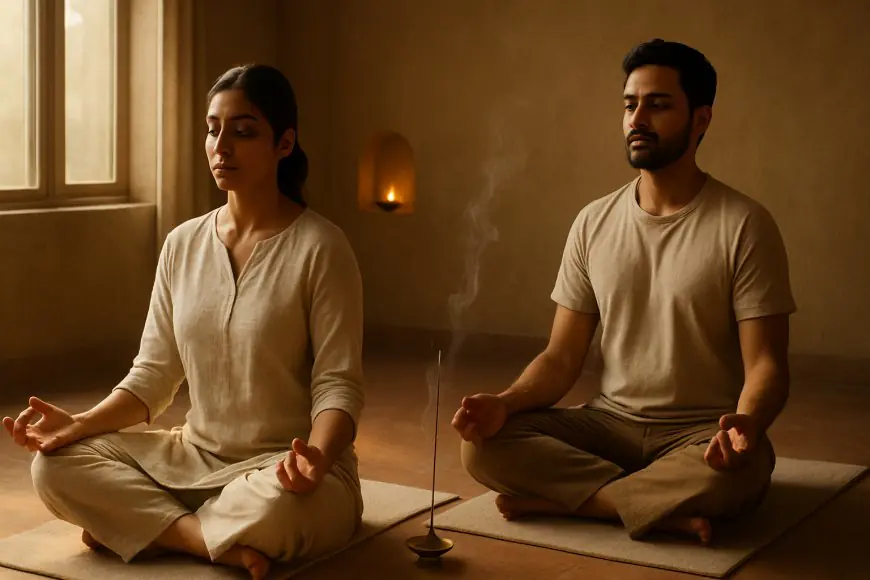
Choose a time when you are less likely to be disturbed. Early morning or late evening is ideal.
-
Sit on a mat or chair with the spine comfortably straight and the body relaxed.
-
Keep your hands resting on your knees or in Gyan mudra. Close your eyes gently.
Stage One: Settling With the Breath
Begin by noticing your natural breath. Do not change it. Simply feel the air moving in and out of the nostrils or the gentle rise and fall of the chest. Stay with this for two to three minutes. This step collects your scattered attention and brings it into the present moment.
Stage Two: Watching Thoughts Arise
Soon you will notice thoughts appearing. They might be about work, family, past events, or plans for the rest of the day. Instead of following the story of the thought, label it softly in your mind. You can mentally say "planning," "memory," "worry," or just "thinking."
The key is to notice that a thought has appeared without getting lost in its content. Imagine you are sitting on the river bank and thoughts are leaves floating past on the water. You can see each one clearly, but you do not jump into the river to chase it.
Stage Three: Practicing Non Reaction
Thoughts often carry emotional charge. When a painful memory appears, the body may tighten. When an exciting fantasy comes, the mind wants to cling to it. In this stage, practice non reaction. Let the thought be there. Let the emotions move through the body without acting on them. You are only observing.
If the mind says "This is too much, I cannot handle these thoughts," observe that statement as well. Everything that appears in the mind, including resistance, becomes part of the meditation.
Stage Four: Returning to Awareness Again and Again
It is natural to get involved in thoughts and forget you are meditating. The moment you notice that you are lost in a story, gently come back to the role of the witness. There is no need to feel guilty or frustrated. Every return strengthens your awareness. Over weeks of practice, these returns become easier and the gaps between thoughts grow longer.
Stage Five: Recognizing the Space Behind Thoughts
As your observation deepens, you may begin to sense a silent background behind thoughts. This background does not come and go. It is always present, whether the mind is noisy or quiet. You can call it pure awareness, presence, or simply the sense of "I am."
Recognizing this inner space is the heart of detachment from the mind. Thoughts continue to appear, but they are like ripples on the surface of a vast lake. Your true identity is not the ripple, but the lake itself.
Common Experiences and How to Handle Them
Many people experience restlessness in the beginning. The mind may feel even louder than usual. This does not mean meditation is failing. It means you are finally seeing what was already happening unconsciously. With patience, the intensity gradually reduces.
Sleepiness is another common experience. If you feel drowsy, straighten your posture slightly, open your eyes for a few breaths, or meditate in a brighter room. Strong emotions may sometimes arise. When that happens, focus on feeling the sensations in the body instead of replaying the story in the mind. This allows energy to release safely.
You may also encounter moments of blankness where there are few or no thoughts. Enjoy them, but do not cling to them. Observing thoughts meditation is not about chasing a special state. It is about remaining awake in whatever is happening, whether it is silence or noise.
Integrating Thought Observation Into Daily Life
Formal sitting practice is essential, but the true power of this method is felt when you bring it into ordinary activities. While working, notice how many thoughts are unnecessary. While talking with someone, observe the inner commentary that tries to judge or compare. While walking, simply watch the stream of thoughts passing through.
You can silently repeat a reminder such as "Just observing" during the day. This simple cue brings you back to the witness position. Over time, you discover that you do not have to believe every thought in order to function. You can act from clarity while still seeing thoughts as temporary.
For example, when anger arises, instead of immediately speaking harshly, you may notice "Anger is rising in the mind." That one moment of observation can prevent many regrets. Similarly, when fear appears, you may see "A fearful story is being created." From this understanding, you can choose a wise response.
Long Term Benefits of Detaching From the Mind
With regular practice, observing thoughts meditation brings a broad range of benefits:
-
Overthinking is gradually replaced by calm clarity.
-
Emotional reactions soften, and you recover faster from stress.
-
Sleep improves because the mind is not endlessly replaying worries.
-
Focus and creativity grow, as mental energy is no longer wasted.
-
Relationships become more harmonious because you listen with more presence and react less blindly.
-
Spiritually, you feel closer to your true self, which is quiet, spacious, and compassionate.
These benefits do not appear overnight, but they build steadily. The most important factor is consistency. Even 15 to 20 minutes each day can create a major shift if practiced sincerely.
Simple Daily Routine for Observing Thoughts
Morning:
Sit for 15 minutes after waking. Spend a few minutes on the breath, then observe thoughts as they arise. Set the intention to remain as the witness during the day.
Daytime:
Use small pauses between tasks to notice what the mind is doing. Take three conscious breaths and watch the current thought without judgment.
Night:
Before sleep, sit for another 10 to 15 minutes. Observe the whole day as a series of passing events. Watch any regrets, worries, or plans as thoughts, then let them dissolve into awareness.
Over weeks and months, this rhythm turns thought observation into a natural habit. Detachment from the mind becomes less of a technique and more of a lifestyle.
The Essence of Observing Thoughts Meditation
At its heart, this practice reveals a simple truth: thoughts are visitors, you are the host. The host does not need to chase every visitor or throw them out. The host only needs to remain present. When you rest as awareness, thoughts lose their power to disturb you. The mind becomes a helpful servant rather than a restless master.
Detaching from the mind is not running away from life. It is the beginning of living fully, with clarity, sensitivity, and peace.
Frequently Asked Questions