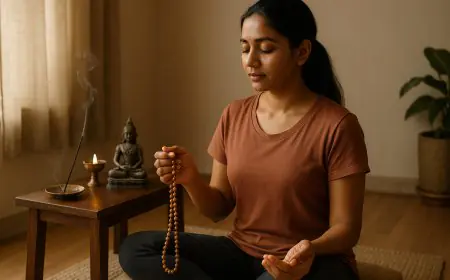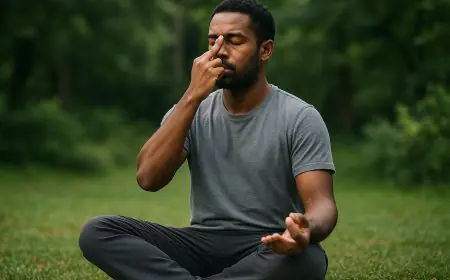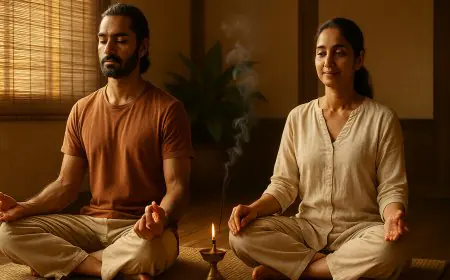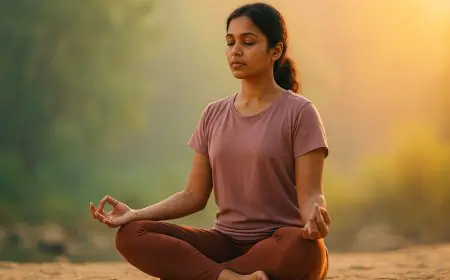














Mindful Breathing Exercises to Calm Your Mind Naturally
Learn simple mindful breathing exercises to calm your mind, reduce stress, and restore inner balance. A beginner-friendly guide to peaceful breathing.



Introduction — When Breath Becomes a Path to Peace
Your breath is the most powerful tool for calming the mind, yet it is the most overlooked.
Mindful breathing is not about controlling your breath — it is about observing, softening, and connecting with it.
In a world full of noise, deadlines, notifications, and internal chaos, the breath pauses everything. It brings you back to the present moment, grounding you gently but deeply.
This blog explores the best mindful breathing exercises that instantly calm your mind, relax your body, and restore emotional clarity.
What Is Mindful Breathing?
Mindful breathing means paying conscious attention to the natural flow of your breath.
You observe:
Trending Guides Now
Candle Gazing Meditation (Trataka): A Complete Beginner’s Guide to Method and Benefits
Third Eye Meditation: How to Awaken Intuition and Deep Inner Awareness
Gaze Meditation: Improving Concentration Naturally with Candle Flame Trataka
Bhramari (Bee Humming) Meditation Technique

Ujjain Railway Station to Mahakaleshwar Temple Distance (2026 Guide)

Ujjain Simhastha 2028 Dates Announced: Full Shahi Snan & Event Timeline

Ujjain Simhastha Update: CM Mohan Yadav Reviews 2028 Works

Karkateshwar Mahadev: 22/84 Mahadev of Ujjain
-
the coolness of the inhale
-
the warmth of the exhale
-
the movement of the chest
-
the rise and fall of the abdomen
You breathe normally, without forcing.
You simply watch.
This awareness anchors your mind into the present — where peace naturally exists.

Why Mindful Breathing Works
1. Activates the Parasympathetic Nervous System
This lowers stress hormones and relaxes muscles.
2. Reduces Overthinking
Breath brings awareness from the mind into the body.
3. Improves Emotional Stability
It slows reactive patterns and restores clarity.
4. Relaxes the Mind Instantly
Just a few mindful breaths shift your state.
5. Enhances Focus
The breath is stable, rhythmic, and perfect for concentration training.
The 7 Best Mindful Breathing Exercises to Calm Your Mind
Below are the most effective and beginner-friendly breathing techniques rooted in mindfulness and proven to calm the mind naturally.
1. Natural Breath Awareness (Anapanasati)
This is the simplest and purest form of mindful breathing.
How to Practice:
-
Sit comfortably with a straight spine.
-
Close your eyes gently.
-
Observe the breath at the nostrils — cool air in, warm air out.
-
Notice its length, speed, and rhythm.
-
Don’t change it — just watch.
Why it works:
Observing without controlling creates deep mental calm.
2. Box Breathing (4–4–4–4 Method)
A powerful technique used by athletes, yogis, and even the military.
How to Practice:
-
Inhale for 4 seconds
-
Hold for 4 seconds
-
Exhale for 4 seconds
-
Hold for 4 seconds
Repeat for 8–10 rounds.
Benefits:
-
Reduces anxiety quickly
-
Improves concentration
-
Balances nervous system
3. 4–7–8 Breathing (Relaxation Breath)
A deeply soothing pattern ideal for nighttime relaxation.
How to Practice:
-
Inhale for 4 seconds
-
Hold for 7 seconds
-
Exhale for 8 seconds
Repeat 4–6 cycles.
Effect:
Slows the heart rate, calms the mind, induces peacefulness.
4. Belly Breathing (Diaphragmatic Breathing)
A grounding, calming approach to reduce stress physically.
How to Practice:
-
Place one hand on chest, one on belly.
-
Inhale deeply into the belly.
-
Exhale slowly through the nose.
-
Let the chest remain relatively still.
Benefits:
-
Removes tension
-
Improves oxygen flow
-
Calms emotional agitation
5. 1-Minute Mindful Pause
Works perfectly during stress, panic, or work overload.
How to Practice:
-
Sit or stand still.
-
Take one long inhale.
-
One slow exhale.
-
Focus fully on your breath for 60 seconds.
Effect:
Instant grounding — mental reset within one minute.
6. Counting the Breath
A widely used mindfulness technique.
How to Practice:
Inhale → count “1”
Exhale → count “2”
Continue up to 10, then restart.
Why it's effective:
Counting interrupts overthinking and stabilizes awareness.
7. Mindful Exhalation Practice
Exhalation is linked to the relaxation response.
How to Practice:
-
Inhale naturally
-
Exhale slowly and mindfully
-
Feel the release in your body
-
Repeat for 5–10 minutes
Benefits:
-
Deep relaxation
-
Emotional release
-
Calms nervous system quickly
How to Get the Most Out of Mindful Breathing
1. Practice at the Same Time Daily
Morning or night — both work well.
2. Sit Comfortably
Comfort supports focus.
3. Use Natural Light or Dim Light
Soft lighting helps the mind unwind.
4. Begin with Just 5 Minutes
Gradually increase as comfort grows.
5. Don’t Force the Breath
Mindfulness comes from observation, not control.
6. Keep a Relaxed Face and Jaw
A relaxed face → relaxed mind.
Common Mistakes to Avoid
Trying to control the breath
Breathing too deeply at the start
Expecting instant results
Judging your progress
Practicing in a noisy area
Mindful breathing is gentle, not forceful.
The Science Behind Mindful Breathing
Scientific studies show mindful breathing:
-
decreases cortisol (stress hormone)
-
increases prefrontal cortex activity
-
improves emotional resilience
-
enhances attention span
-
supports better sleep and digestion
Your breath physically changes your brain.
Conclusion — Calmness Begins with a Breath
Mindful breathing is the easiest and most transformative meditation technique. It needs no special posture, no tools, and no teacher — only your awareness.
Every breath becomes an invitation:
To pause.
To return.
To relax.
To be present.
Practice daily, even for a few minutes, and you will feel your mind becoming lighter, clearer, and deeply peaceful.
Frequently Asked Questions