













Indore–Ujjain Vande Bharat Metro for Simhastha 2028: Key Travel Upgrade
Indore–Ujjain Vande Bharat Metro planned for Simhastha 2028 will reduce travel time to 45 minutes, operate as a high-frequency shuttle service, and manage massive pilgrim movement using existing railway infrastructure.
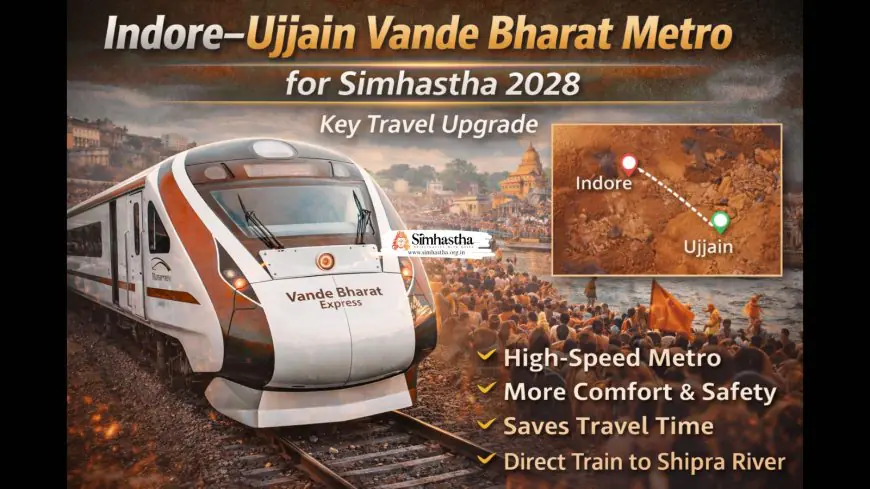


Indore–Ujjain Vande Bharat Metro for Simhastha 2028: A Key Travel Upgrade



Also Read | What Is Simhastha? Complete Explanation of Ujjain’s Sacred Kumbh
Why Indore–Ujjain Connectivity Is Critical During Simhastha
Indore serves as the primary entry point for a large section of Simhastha pilgrims. The city hosts the nearest international airport, major railway junctions, large accommodation capacity, and extensive road networks. Historically, a substantial share of pilgrims reach Indore first before proceeding to Ujjain.
During peak snan days, road corridors between Indore and Ujjain become heavily congested, leading to long delays and operational strain. A rail-based, high-capacity solution becomes essential under these conditions. The Indore–Ujjain Vande Bharat Metro has been planned specifically to absorb this pressure and ensure smoother pilgrim movement.
Running on Existing Railway Infrastructure
One of the defining features of this project is that the Vande Bharat Metro will operate entirely on the existing Indore–Ujjain railway line. No new track construction is required.

This approach allows for:
-
Faster rollout of services
-
Lower capital expenditure
-
Minimal land acquisition
-
Reduced environmental impact
Railway authorities have already conducted high-speed trials on this corridor, with successful testing at speeds up to 180 kmph, confirming that the route is technically suitable for semi-high-speed operations.
For readers seeking complete and authoritative coverage of Ujjain Simhastha, including its history, mythological significance, Shahi Snan rituals, dates, temples, Akharas, travel planning, and first-time pilgrim guidance, refer to our ultimate Simhastha guide for Ujjain. This detailed resource consolidates every essential aspect in one place and serves as the primary reference for understanding Simhastha holistically.
Shuttle-Style Operations Designed for Crowd Peaks
Unlike long-distance express trains, the Indore–Ujjain Vande Bharat Metro will function as a shuttle service, similar to an urban metro system.
Operational characteristics include:
-
Continuous round trips throughout the day
-
Short halt durations at stations
-
Increased frequency during peak pilgrimage hours
This model is particularly effective for Simhastha, where crowd density fluctuates sharply based on auspicious bathing schedules rather than uniform daily demand.
Travel Time Reduced to 40–45 Minutes
One of the most impactful benefits of this service is the significant reduction in travel time. The Vande Bharat Metro is expected to complete the Indore–Ujjain journey in approximately 40 to 45 minutes.
This time reduction will:
-
Ease congestion on highways
-
Improve scheduling for snan participation
-
Reduce physical strain for elderly and family pilgrims
-
Enable faster turnaround of passenger volumes
Metro-Style Coaches with AC and Non-AC Options
The train is being designed specifically for short-distance, high-density travel. Plans indicate the availability of both AC and Non-AC coaches, ensuring affordability and inclusivity.
Key design features include:
-
Wide automatic doors for rapid boarding
-
Standing-friendly layouts
-
Modern ventilation systems
-
Fast acceleration and braking
There is also the possibility that the service may be branded under the “Namo Bharat” identity, aligning it with India’s new-generation regional rapid transit initiatives.
High Passenger Capacity Suited for Simhastha Scale
To meet the exceptional demand during Simhastha, the Indore–Ujjain Vande Bharat Metro is expected to operate with 12-coach train sets.
Estimated capacity per train includes:
-
Around 1,150 seated passengers
-
Nearly 2,000 standing passengers
This configuration allows the railway system to move large crowds efficiently within limited time windows, especially during major bathing days.
Part of a Larger Railway Plan for Simhastha 2028
The Vande Bharat Metro is one component of a broader railway strategy planned for Simhastha 2028. This larger plan includes:
-
Operation of more than 300 special and regular trains
-
Improved connectivity with surrounding regions
-
Distribution of passenger loads across multiple stations
Such integrated planning is essential to avoid bottlenecks and ensure smooth operations during the event.
Laxmibai Nagar Station Redevelopment
To support increased rail traffic, Laxmibai Nagar railway station in Indore is undergoing major redevelopment.
Key highlights include:
-
Estimated investment of ₹55 crore
-
Construction of a new foot overbridge
-
Improved passenger circulation and amenities
Current timelines suggest the redevelopment could be completed by January 2026, with full operational readiness expected by February 2026, well ahead of Simhastha 2028.
Why the Indore–Ujjain Vande Bharat Metro Matters for Simhastha 2028
The Indore–Ujjain Vande Bharat Metro represents a shift in how large-scale spiritual gatherings are supported through modern transport planning. By combining high speed, shuttle-style frequency, and massive passenger capacity on existing railway infrastructure, the project directly addresses one of the most complex challenges of Simhastha 2028: managing the movement of lakhs of pilgrims without disruption.
For pilgrims, it promises faster, safer, and more predictable travel. For administrators, it offers a scalable and controllable crowd management solution. For the region, it delivers a long-term mobility upgrade that will continue to serve daily commuters even after Simhastha concludes.
As preparations for Simhastha 2028 gather pace, transport initiatives like the Indore–Ujjain Vande Bharat Metro underline how infrastructure and pilgrimage planning can move forward together in a structured and sustainable way.
Frequently Asked Questions