

















Ayodhya - Birthplace of Lord Rama and One of Hinduism’s Most Sacred Sapta Puri Cities
Discover Ayodhya, the sacred birthplace of Lord Rama and one of Hinduism’s seven holiest cities. Experience its spiritual essence, temples, ghats, and timeless devotion.


There are places you visit. And then there are places that visit you — settling somewhere deep in your chest, long after you have left.
Ayodhya is the second kind.
Nestled on the banks of the sacred Sarayu River in Uttar Pradesh, this ancient city carries a vibration that no photograph can capture and no description can fully contain. It is not just a geographical location. It is a heartbeat. A memory etched into the soul of India. A name that, when whispered, makes millions close their eyes and bow their heads.
For the devout Hindu, Ayodhya is not simply a city. It is the city — the birthplace of Lord Rama, the seventh avatar of Vishnu, the embodiment of dharma, the prince whose life story has shaped the moral and spiritual compass of a civilization for over five thousand years.
Trending Guides Now

Mathura – Shri Krishna Janmabhoomi: The Birthplace of Lord Krishna and One of Hinduism’s Most Sacred Cities
Haridwar – Gateway to Spirituality and One of the Seven Holiest Cities in Hinduism
Varanasi / Kashi: The Eternal Spiritual Heart of India – A Pilgrim’s Journey

Which Sapta Puri Is the Most Visited by Pilgrims Today

Ujjain Railway Station to Mahakaleshwar Temple Distance (2026 Guide)

Ujjain Simhastha 2028 Dates Announced: Full Shahi Snan & Event Timeline

Ujjain Simhastha Update: CM Mohan Yadav Reviews 2028 Works
Ujjain Railway Station to Kal Bhairav Temple: Distance, Auto Fare and Best Route
As one of the Sapta Puri — the seven most sacred cities of Hinduism that grant liberation — Ayodhya stands alongside Varanasi, Mathura, Haridwar, Kanchipuram, Ujjain, and Dwarka. But make no mistake. Its place in the Hindu heart is singular. Unrepeatable. Holy in a way that defies comparison.
Whether you come as a pilgrim seeking blessings, a seeker tracing the footsteps of Rama, or simply a traveler hungry for authentic India, Ayodhya will meet you exactly where you are. And it will leave you different.
Let us walk these ancient lanes together. Not as tourists. But as visitors to the womb of a civilization.
Why Ayodhya Is Called the Birthplace of Lord Rama
Let us start with the question that sits at the very foundation of this city’s identity.
Why Ayodhya? Why not somewhere else?
The Ramayana, Valmiki’s immortal epic, describes Ayodhya as a city so magnificent that it rivaled the heavens themselves. Built by the divine architect Vishwakarma, Ayodhya was the capital of the Ikshvaku dynasty — the solar dynasty of kings from which Lord Rama descended. It was here that King Dasharatha ruled. It was here that Queen Kaushalya, after years of longing, gave birth to Rama on the ninth day of the bright half of the lunar month of Chaitra. That day is celebrated across the world as Ram Navami.

But the evidence is not merely mythological. Ancient texts, including the Vishnu Purana and the Skanda Purana, unequivocally state that Ayodhya on the banks of Sarayu was the venue of Rama’s incarnation. The Atharva Veda mentions Ayodhya as “a city built by the gods themselves and as prosperous as paradise itself.”
For the faithful, no archaeological proof is needed. The city itself is proof. Every stone. Every breath. Every chant of “Jai Shri Ram” that echoes through its alleyways.
And yet, modern scholarship and the Archaeological Survey of India have uncovered temple remains, pillars, and structures dating back centuries beneath the Ram Janmabhoomi site — evidence that devotion here has been continuous, unbroken, and fierce.
Ayodhya is not a city that claims Rama. Rama is the soul that makes Ayodhya a city.
Ayodhya as One of the Sapta Puri Cities of Hinduism
The concept of Sapta Puri is deeply embedded in Hindu pilgrimage tradition. The seven cities are believed to be kṣetra — sacred fields where the divine has directly touched earth. To live in them, visit them, or die within their boundaries is to receive moksha — liberation from the cycle of birth and death.
The seven are:
-
Ayodhya – Birthplace of Lord Rama
-
Mathura – Birthplace of Lord Krishna
-
Haridwar – Gateway to the gods
-
Varanasi – City of Lord Shiva
-
Kanchipuram – City of golden temples
-
Ujjain – City of Mahakaleshwar
-
Dwarka – Kingdom of Lord Krishna
Among these, Ayodhya holds a unique fragrance. Mathura and Dwarka celebrate Krishna’s playful, heroic, and kingly leelas. Varanasi and Haridwar focus on liberation through Ganga and Shiva. Kanchipuram and Ujjain dazzle with temple architecture and cosmic energies.
But Ayodhya? Ayodhya is about maryada — righteous conduct, duty, honor, and the quiet strength of a king who chose exile so that his father’s word would not break.
When you walk Ayodhya, you are not walking toward spectacle. You are walking toward character.
That is what makes the Sapta Puri so powerful. Each city offers a different doorway to the divine. Ayodhya’s doorway is marked by the footprints of a prince who taught the world how to live.
The Sacred Geography of Ayodhya – Sarayu River, Ram Janmabhoomi, and Spiritual Landmarks
📍 Ram Janmabhoomi – The holiest of holies. This is the exact spot where Lord Rama is believed to have taken birth. For centuries, devotees have flocked here. The newly constructed Ram Mandir, a magnificent sandstone structure in the Nagara style of temple architecture, now rises on this site. The sanctum houses the Ram Lalla idol — the infant form of Rama. Standing before it, you feel something shift inside you. Time collapses. The epic becomes personal.
🌊 Sarayu River – Unlike the Ganga’s thunderous energy or the Yamuna’s melancholy, Sarayu flows with a gentle, almost maternal calm. The Gupta Ghat is the most famous bathing ghat. Pilgrims take a holy dip here before temple visits, believing it washes away sins and prepares the soul for darshan. Evening aarti at Sarayu is not to be missed — diyas float on the water, carrying prayers directly to Rama’s feet.
🛕 Hanuman Garhi – Before you enter the Ram Janmabhoomi complex, you must visit this fortress-like temple dedicated to Hanuman. It is believed that Hanuman resides here as the eternal gatekeeper of Rama’s birthplace. The climb up the steep stairs is itself a small act of penance. At the top, the idol of Mata Anjani with young Hanuman in her lap stops you cold — fierce and tender all at once.
🕊️ Nageshwarnath Temple – Built by Kush, Rama’s son, this Shiva temple is one of Ayodhya’s oldest. Legend says Kush lost his armlet in Sarayu, and a nag kanya (serpent princess) returned it after he promised to build a temple to Shiva here. The temple holds a quiet, almost secret energy — less crowded, deeply meditative.
🏛️ Kanak Bhawan – A stunning temple gifted to the city by the queen of Orchha. It is said that when Rama and Sita arrived here, the gods themselves showered gold (kanak). The idols of Rama and Sita adorned in gold jewelry make this one of Ayodhya’s most photogenic and emotionally charged spots.
📜 Treta Ke Thakur – An ancient temple marking the spot where Rama performed the Ashwamedha Yagna after returning from Lanka. The black stone idols here are remarkably old, worn smooth by centuries of touch and tears.
Ayodhya is not a city you see. It is a city you feel. And these landmarks are not stops on a checklist. They are verses in a living poem.
The Spiritual Significance of Visiting Ayodhya in Hinduism
Why do millions walk miles to this city every year? What pulls them?
The answer is not theological. It is experiential.
Hinduism teaches that sacred geography is not arbitrary. The Puranas explain that divine energy descends upon certain places during specific cosmic events. Rama’s birth was one such event. The Vishnu’s footprint — his avataric descent — left an indelible spiritual imprint on Ayodhya’s soil.
To visit Ayodhya is to touch that imprint.
Pilgrims believe:
-
A single darshan of Ram Lalla can remove the accumulated karma of seven lifetimes.
-
A dip in Sarayu on Amavasya (new moon) or during Kartik Purnima cleanses ancestral debts.
-
Dying in Ayodhya grants direct passage to Vaikuntha — Vishnu’s supreme abode.
-
Chanting the Ram Raksha Stotra or Hanuman Chalisa within the city’s limits multiplies their spiritual potency a hundredfold.
But beyond belief, there is something more tangible. Ayodhya quietens the mind. The chaos of modern life — the notifications, the deadlines, the endless wanting — simply falls away here. In its place rises a stillness that feels ancient. Unshaken. As if the city remembers something we have collectively forgotten.
That is the real gift of Ayodhya. Not wish fulfillment. But remembrance.
Ram Mandir – The Heart of Modern Ayodhya
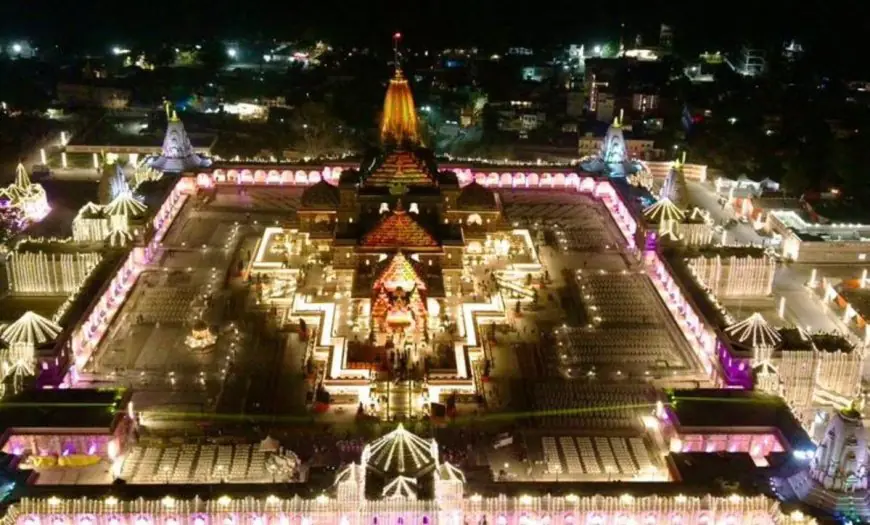
You cannot speak of Ayodhya today without speaking of the Ram Mandir.
After centuries of longing, legal battles, and unwavering faith, the temple at Shri Ram Janmabhoomi is now open. And it is breathtaking.
Built in the Nagara architectural style, the temple rises 161 feet high, supported by 392 pillars and decorated with 44 doors. No iron or steel has been used in its core structure — only stone, copper, and the devotion of millions. The sanctum houses the idol of Ram Lalla (Rama as a five-year-old child), carved from black stone by the renowned sculptor Arun Yogiraj.
But the temple is more than architecture. It is a national emotion given form.
Walking through its corridors, you see pilgrims from every corner of India — from snow-clad Himachal to humid Kerala, from the deserts of Rajasthan to the tea gardens of Assam. They speak different languages. Wear different clothes. Eat different foods. But their eyes hold the same light. Their lips shape the same name: Rama.
The temple complex also includes:
-
A museum narrating the history of Ayodhya and the Ramayana
-
A yajnashala for Vedic rituals
-
A meditation center
-
A statue of Jatayu (the noble eagle who fought Ravana)
-
The restored Sita Koop — a well where Sita is said to have bathed
If you visit Ayodhya and miss the Ram Mandir, you have missed the city’s lungs. But if you visit only the Ram Mandir and leave, you have missed its heart. Because Ayodhya breathes across its ghats, its small unknown temples, its crumbling walls, and its ever-flowing Sarayu.
Festivals in Ayodhya That Amplify Its Divine Energy
Ayodhya does not celebrate festivals. Ayodhya becomes festivals.
🎉 Ram Navami – The birthday of Lord Rama. The entire city transforms into a sea of saffron, green, and white. The Ram Janmabhoomi witnesses over a million pilgrims. The Ramayana is recited continuously for nine days. On the final day, a spectacular Shobha Yatra (procession) carries idols of Rama, Sita, Lakshmana, and Hanuman through the streets. The air is thick with chants, flowers, and a joy so pure it borders on ecstasy.
🪔 Deepotsav – If you see only one festival in Ayodhya, let it be this. On Diwali, Ayodhya lights over 25 lakh (2.5 million) diyas along the Sarayu ghats — a Guinness World Record. The sight is beyond words. The river reflects a million flames. Fireworks crackle above ancient temples. And somewhere in the chaos, you feel Rama, Sita, and Lakshmana returning from 14 years of exile. The city recreates their homecoming every year. And every year, grown men weep.
📖 Ram Leela – Unlike the polished stage productions of Delhi or Varanasi, Ayodhya’s Ram Leela is raw, local, and breathtakingly sincere. Performed across multiple neighborhoods during Dussehra, the play culminates in the burning of Ravana’s effigy — but not before you have watched the city breathe the epic for ten straight nights.
🌕 Kartik Purnima – The full moon night of the Hindu month of Kartik. Pilgrims flock to Sarayu for a holy dip before sunrise. Thousands of diyas float on the water. The Satya Narayan Katha is recited on every street corner. It is Diwali’s quieter, more meditative cousin — equally sacred, far less crowded.
If you want to feel Ayodhya’s pulse, come during a festival. But be warned. You may never want to leave.
How to Reach Ayodhya for a Soulful Pilgrimage
By Air – The Maryada Purushottam Shri Ram International Airport is now operational, with flights connecting Ayodhya to Delhi, Mumbai, Bangalore, and Chennai. From the airport, taxis and auto-rickshaws reach the temple area in 20 minutes.
By Train – Ayodhya Cantt (AYC) and Ayodhya Junction are well-connected. Trains like the Ramayana Express (a special tourist train covering the entire Ramayana circuit) stop here. The station itself feels like a temple — announcements begin with “Jai Shri Ram.”
By Road – Ayodhya is 130 km from Lucknow and 200 km from Varanasi. Buses (state-run and private) ply regularly from both cities. Alternatively, hire a cab for a more comfortable journey. The roads are good, and the highway views — flat green fields dotted with village temples — prepare your mind for what is coming.
Local Transport – E-rickshaws, cycle-rickshaws, and electric buses. The core temple area is pedestrian-friendly. Wear comfortable shoes. You will walk. And that walking is its own meditation.
Where to Stay – From Simple Ashrams to Comfortable Hotels
Ayodhya now balances devotion with convenience.
Budget stays – Shri Ram Ashram, Gayatri Dharmashala, and Tulsi Sadan offer clean rooms at nominal rates (₹300–₹800). Do not expect luxury. Do expect warmth, simple meals, and the sound of bhajans at dawn.
Mid-range hotels – Hotel Ramprastha, Rameshwaram Palace, and Dev Darshan offer air-conditioned rooms, attached baths, and reliable service (₹1500–₹3500).
Premium stays – The Ramayana Hotel, Ayodhya Haat, and the newly built Shri Ram Residency cater to families and international travelers (₹4000–₹8000). Some have rooftop restaurants overlooking Sarayu — magical during sunset.
A word of advice: book well in advance during festival seasons. Ayodhya swells beyond capacity. And the best stays vanish weeks ahead.
What to Eat in Ayodhya – A Vegetarian Pilgrim’s Paradise
Ayodhya is strictly vegetarian. And gloriously so.
🥞 Kachori Sabzi – The breakfast of champions. Fluffy kachoris served with spicy potato curry and tangy tamarind chutney. Try it at the stalls near Naya Ghat.
🍛 Thali – Unlimited roti, rice, dal, sabzi, paneer curry, raita, and halwa. The temple-run bhojanalayas (especially near Hanuman Garhi) serve this for ₹100–₹150. It is simple. It is satiating. It is made with devotion.
🥛 Pedas and Rabri – Ayodhya’s milk-based sweets are legendary. Braj Sweets and Shri Ram Misthan Bhandar are local institutions. Do not leave without trying their Kesar Peda.
🍌 Chhappan Bhog – Offered first to Ram Lalla and then sold to devotees. A mix of fruits, sweets, and dry fruits. Eating it feels less like snacking and more like receiving prasad.
🫓 Litti Chokha – Bihar’s gift to Ayodhya. Roasted gram flour balls mashed with spiced vegetables. Hearty, rustic, unforgettable.
Food in Ayodhya is not fuel. It is bhakti served on a plate. Eat slowly. Eat gratefully.
Best Time to Visit Ayodhya for an Unforgettable Experience
October to March – The sweet spot. Temperatures range from 15°C to 28°C. Pleasant days, cool nights, and a sky so clear you can almost see the stars Ram must have gazed at. This is also festival season — Navratri, Diwali, Kartik Purnima, Ram Navami (which falls in March or April).
April to June – Hot. Very hot. 42°C is common. If you come, come early morning or late evening. Midday darshan can be punishing. But the crowds are thinner, and the temple priests have more time for blessings.
July to September – Monsoon. Sarayu swells. The city turns lush green, almost Kerala-like in its tropical beauty. But heavy rains can flood streets. Pack accordingly — and expect leeches if you venture into forested areas near the ghats.
Best months overall – November (for Deepotsav), January (pleasant weather), March (Ram Navami).
Ethical and Spiritual Travel Tips for Ayodhya
🙏 Dress modestly – Shoulders and knees covered. Ayodhya is not a beach resort. It is a living temple. Dress like you are entering someone’s sacred home — because you are.
🧼 Remove footwear before temple entry – This is non-negotiable. Carry a cloth bag to hold your shoes.
📸 Ask before photographing – Inner sanctums often prohibit photography. Respect the rules. The gods are watching, and so are the priests.
💧 Drink only packaged or filtered water – Street water can upset unaccustomed stomachs. Carry a reusable bottle and refill at temple purification stations.
👂 Listen more than you speak – Ayodhya is full of stories. The elderly man selling flowers may have walked here barefoot from a village 400 kilometers away. The priest may have a grandfather who guarded a secret well for sixty years. Listen.
💸 Donate thoughtfully – Many temples have official donation boxes. Use them. Avoid giving cash to random “priests” who approach you on the street claiming special rituals.
🚮 Carry your trash out – Sarayu is sacred. Let us keep her that way. Pack wet wipes, a small bag for litter, and leave no trace behind.
Why Ayodhya Should Be on Every Seeker’s Sacred Cities List
You have visited Varanasi. You have bathed in Haridwar. You have seen Krishna’s Mathura. But have you stood where Rama first opened his eyes?
That is the question Ayodhya silently asks.
In an age of distraction, disconnection, and digital overwhelm, Ayodhya offers something radical — presence. The presence of a god who chose to be human. The presence of a king who cried when his father sent him away, not because he was weak, but because his love was real. The presence of a city that has been destroyed and rebuilt more times than history can count, yet never lost its name, never lost its faith.
Ayodhya is not for the cynical. It is not for the hurried. It is for the open-hearted. For the ones who still believe that devotion matters, that dharma is possible, that a prince born thousands of years ago can still touch a stranger’s life today.
So come. Not to check a box. But to open a door.
The door to Rama’s birthplace. The door to your own forgotten goodness. The door to Ayodhya — the city that refuses to let divinity die.
Frequently Asked Questions