

















Bulldozer Action on Ashrams Ahead of Simhastha 2028
Ujjain administration intensifies anti-encroachment drive before Simhastha 2028. Sadhus meet Collector over facilities, surveys, and demolition concerns in the Simhastha zone.


Bulldozer Action Intensifies in Ujjain Ahead of Simhastha 2028
Preparations for Simhastha 2028 in Ujjain have entered an aggressive infrastructure phase. Road widening, diversion planning, sanitation upgrades, and encroachment removal are progressing simultaneously. However, recent anti-encroachment action has created visible tension within the saint community.
As the administration tightens compliance norms inside the notified Simhastha zone, several ashrams are reportedly under scrutiny for unauthorized constructions built after the 2016 Simhastha.
Also Read | Ujjain Simhastha Mega Development Plan
Why the Administration Is Acting Now
The district administration has clarified that early enforcement is essential to prevent last-minute chaos. With crores of pilgrims expected in Ujjain Simhastha 2028, authorities are prioritizing:
Trending Guides Now

Simhastha 2028 Latest Update: Disaster Mitra Training Begins in Ujjain
Government Doubles Powers of Ujjain Mayor and Commissioner Ahead of Simhastha 2028
Ujjain Simhastha 2028: ₹700 Crore Bypass Road Plan to Manage 30 Crore Pilgrims
Simhastha 2028 Ujjain Development Plan: What’s Changing Before the Kumbh

Ujjain Railway Station to Mahakaleshwar Temple Distance (2026 Guide)

Ujjain Simhastha 2028 Dates Announced: Full Shahi Snan & Event Timeline

Ujjain Simhastha Update: CM Mohan Yadav Reviews 2028 Works

Ujjain Railway Station to Kal Bhairav Temple: Distance, Auto Fare and Best Route
-
Road expansion and traffic corridors
-
Crowd flow management
-
Drainage and sanitation systems
-
Open access zones near the Shipra river
-
Structural safety compliance
According to officials, constructions raised after 2016 inside restricted areas are being reviewed. Notices have been issued to those found violating zoning rules.

Municipal Commissioner Abhilash Mishra stated that preparations must begin years in advance due to the scale of the event. Any permanent construction within designated Simhastha land parcels is restricted.
For pilgrims seeking certainty and planning clarity, refer to the officially confirmed Simhastha 2028 dates and Shahi Snan schedule released for Ujjain.
For readers seeking complete and authoritative coverage of Ujjain Simhastha, including its history, mythological significance, Shahi Snan rituals, dates, temples, Akharas, travel planning, and first-time pilgrim guidance, refer to our ultimate Simhastha guide for Ujjain. This detailed resource consolidates every essential aspect in one place and serves as the primary reference for understanding Simhastha holistically.
Demolition Near Shipra River
Three days before the saint delegation met the Collector, the administration carried out demolition drives along the banks of the Shipra River.
Reports indicate that:
-
A three-storey structure linked to Shankaracharya Math was demolished.
-
A total of five properties faced action.
-
Structures were categorized as encroachments under civic norms.
This action triggered concern among sections of the saint community. While no official statement connected the meeting directly to the demolitions, the timing intensified discussions.
As part of the permanent riverfront redevelopment, the Kshipra has been divided into structured sectors to ensure safety and ritual flow, which pilgrims should understand through the Kshipra Riverfront Zones and pilgrim movement planning for Simhastha.
Saints Meet Collector Over Concerns
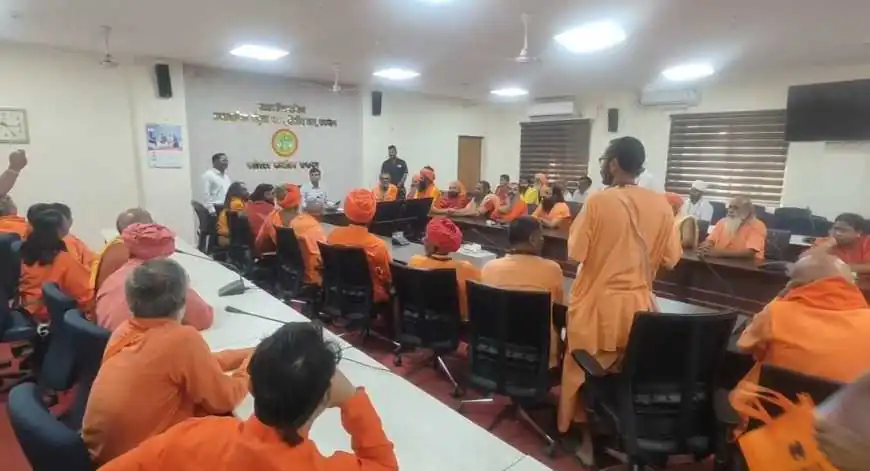
On Friday evening, a large group of saints met District Collector Roshan Kumar Singh. The delegation included members from Shev Shambhu Sanyasi Mandal and other akharas.
The saints emphasized two major points:
-
Future disorder in the Simhastha area must be prevented through early survey planning.
-
Basic infrastructure should be guaranteed before any structural removal.
They suggested that clear mapping, zoning surveys, and communication mechanisms be established to avoid misunderstandings.
The Collector reportedly listened to all suggestions and assured cooperation.
Demand for Basic Facilities
While demolition concerns exist, the saint community also raised practical demands for Simhastha arrangements, including:
-
Borewell water facilities
-
Proper drainage
-
Road access improvement
-
Public toilets
-
Diversion maps and route clarity
Sant Mahavir Nath stated that clarity regarding layout maps and service facilities is essential. Mahant Rameshwar Giri urged acceleration in construction of roads and sanitation systems.
These demands align with broader Simhastha infrastructure development objectives.
Restriction on Permanent Construction in Simhastha Zone
Authorities have reiterated that permanent construction within the notified Simhastha region is restricted.
Key policy positions include:
-
Structures built after 2016 without approval may face removal.
-
Temporary religious setups during Simhastha will be permitted as per guidelines.
-
Large-scale encroachments along the Shipra are under strict monitoring.
This reflects a balance attempt between spiritual establishments and civic compliance.
Administrative Perspective
From the administrative side, early enforcement avoids:
-
Congested access routes
-
Emergency service blockage
-
Structural collapse risks
-
Riverbank erosion
-
Unregulated land occupation
Officials argue that structured urban planning is necessary for an event of global scale.
The upcoming Simhastha is expected to test urban capacity across transportation, water management, waste disposal, and security logistics.
Police and 4S Model Preparedness
Parallel to civic action, law enforcement agencies are reportedly working on advanced crowd management strategies. The 4S model, described as a structured operational framework, is being aligned to manage large congregations efficiently.
The objective remains clear: prevent chaos before it emerges.
A Sensitive Balance Between Faith and Regulation
Simhastha is not merely an event; it is a civilizational congregation. However, governance mechanisms must operate within statutory limits.
The tension unfolding is less about conflict and more about synchronization.
Faith institutions seek dignity and facility support.
Administration seeks order and safety compliance.
The coming months will determine how effectively both sides collaborate.
Related Simhastha 2028 Updates :
Frequently Asked Questions