













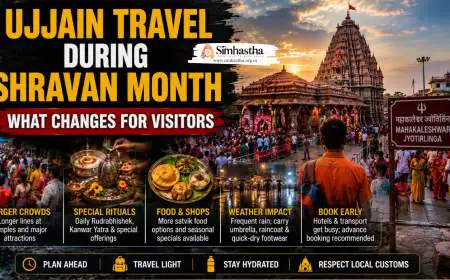

Narsingh Ghat – Simhastha 2028 Complete Guide
Complete Narsingh Ghat guide for Simhastha 2028. Location, Lord Narasimha legend, Bharat Sevak temple, bathing significance, and ghat development project details.
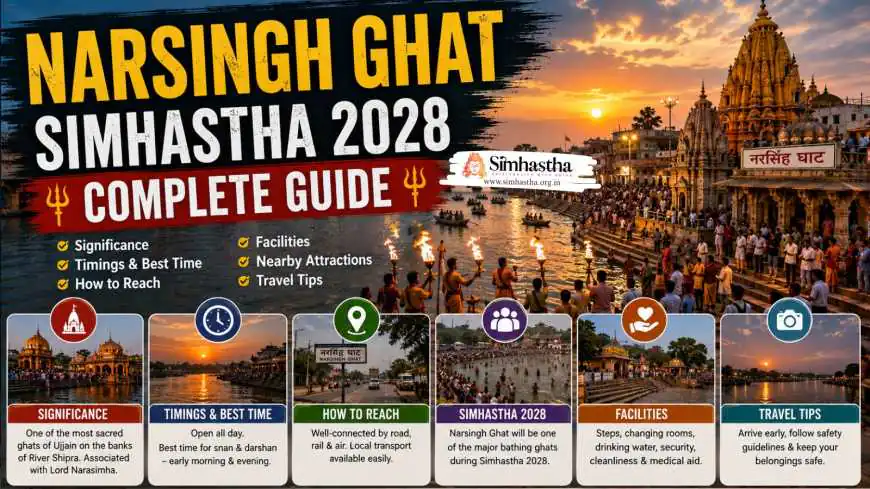


The Ghat That Hides in Plain Sight 🌊
Let me tell you about a place that most pilgrims completely miss.
Every 12 years, when Ujjain transforms into the epicentre of the Simhastha Kumbh Mela, millions of devotees flock to the grand Ram Ghat and the towering Mahakaleshwar Temple. They queue for hours, take their holy dip, offer their prayers, and leave—never knowing that just a short distance away, a ghat of fierce spiritual power sits in near-complete silence. 🤫
Narsingh Ghat is one of Ujjain's most powerful and spiritually intense ghats, named after Lord Narasimha – the fourth avatar of Lord Vishnu, who appeared as a fierce half-man, half-lion to vanquish the demon Hiranyakashipu and protect his devoted son Prahlada. Unlike the more peaceful and serene ghats like Prashanti Ghat or the ancestral-focused Triveni Ghat, Narsingh Ghat carries an energy of fierce protection, courage, and the destruction of evil forces.
And yet, it remains largely unknown to most pilgrims.
Trending Guides Now

Forgotten Stories and Legends Connected to Narsingh Ghat
Why Narsingh Ghat Remains Unknown to Most Pilgrims

Ujjain Railway Station to Mahakaleshwar Temple Distance (2026 Guide)

Ujjain Simhastha 2028 Dates Announced: Full Shahi Snan & Event Timeline
Ujjain Railway Station to Kal Bhairav Temple: Distance, Auto Fare and Best Route

Ujjain Simhastha Update: CM Mohan Yadav Reviews 2028 Works

Mahakaleshwar Temple Entry Rules 2026: Dress Code, Mobile & Bag Policy

Bhasma Aarti at Mahakaleshwar Temple – Complete Pilgrim Guide
So, why should you visit Narsingh Ghat during Simhastha 2028? Because this is where you come when you need protection from fear, relief from enemies and obstacles, and the powerful, transformative blessings of the man-lion god. This is your complete guide to this hidden gem of Ujjain's spiritual geography. 🙏
The Legend: When the Man-Lion Emerged from a Pillar 🦁
To understand Narsingh Ghat, you must first understand the legend of Narasimha—one of the most dramatic and terrifying stories in Hindu mythology.
The Boon That Shook the Universe
According to the Bhagavata Purana, the demon king Hiranyakashipu had obtained a boon that made him nearly indestructible. He could not be killed:
-
🚫 By man or animal
-
🚫 Indoors or outdoors
-
🚫 During day or night

-
🚫 On land or in air
-
🚫 By any weapon

Armed with this invincibility, Hiranyakashipu terrorized the three worlds. He forbade the worship of Lord Vishnu and demanded that everyone worship him instead.
The Devotee Who Would Not Bow
But Hiranyakashipu had a problem: his own son, Prahlada. Despite being born to a demon king, Prahlada was a devoted worshipper of Lord Vishnu. No amount of torture, threats, or cajoling could shake his faith. He endured brutal punishments. He refused to bow. And he kept chanting the name of Vishnu.
The Moment of Divine Fury
Finally, Hiranyakashipu's patience ran out. In a fit of rage, he pointed to a pillar in his courtyard and demanded: "If your Vishnu is everywhere, is he in this pillar?" Prahlada calmly replied: "Yes, my Lord is everywhere" .
Enraged, Hiranyakashipu smashed the pillar with his mace. And then—it happened. From the shattered pillar emerged Lord Narasimha—neither fully man nor fully animal, with the body of a man and the head of a lion. His eyes were blazing. His fangs were sharp. His roar shook the universe.
Narasimha killed the demon at twilight on the threshold of a courtyard, using his sharp lion claws instead of any weapon. The fierce energy of that divine protection is believed to reside at Narsingh Ghat, making it a sacred spot for devotees facing persecution, legal troubles, enemies, or any form of oppression.
The Location: A Ghat Without a Landmark 📍
Why Most Pilgrims Miss It
The primary reason for Narsingh Ghat's anonymity is its location. Ujjain's sacred geography is heavily clustered around the grand arc from Ram Ghat to the Mahakaleshwar Temple, which captures the overwhelming majority of pilgrim footfall.
Narsingh Ghat lies outside this magnetic centre, tucked away in a quieter part of the city where the lanes narrow and the commercial buzz of pilgrimage fades into the rhythms of ordinary Ujjain life. It is not on the way to any major temple, nor is it a required stop in the standard one-day darshan circuit.
Distance and Accessibility
| From | Distance | Travel Time |
|---|---|---|
| Ujjain Junction Railway Station | ~2.5 km | 10-15 min by auto |
| Ram Ghat | ~1.5 km | 5 min by auto |
| Mahakaleshwar Temple | ~2-3 km | 10-15 min by auto |
The ghat is accessible via the Narsingh Ghat Bridge, which serves as a key landmark. The area also houses the Mahakal Dharamshala within the Narsingh Ghat Complex.
The Modest Temple
The ghat lacks a monumental visual anchor. Ram Ghat has its sweeping steps and evening lamps. Harsiddhi has its twin pillars of fire. Narsingh Ghat has a modest, ancient-feeling temple dedicated to Lord Narsingh (Narasimha). The temple, while deeply sacred, is architecturally humble.
In an age of visual culture, where pilgrim destinations are often chosen based on their Instagrammability, Narsingh Ghat's modest beauty is its first and most effective screen. It filters out those who seek spectacle, admitting only those who seek stillness.
The Spiritual Significance: Fierce Protection and Healing 💪
What Devotees Seek Here
Narsingh Ghat holds fierce energy, dedicated to Lord Narasimha — the half-lion, half-man avatar of Vishnu. Pilgrims seeking:
-
🛡️ Protection from obstacles and enemies
The waters here are believed to carry potent healing properties, especially during early morning hours when the sun's first rays touch the river surface.
The Holy Dip: Washing Away Fears
The holy dip at Narsingh Ghat is believed to wash away:
-
💨 Fears and phobias
-
🧿 The karmic seeds of past wrongdoings
Devotees first bathe in the Shipra River at Narsingh Ghat, then climb the steps to the temple to offer red flowers, turmeric powder, kumkum, and coconuts to the deity.
The Most Auspicious Days 📅
During Narasimha Chaturdashi, which falls on the fourteenth day of the bright fortnight in Vaishakha (April-May), thousands of devotees gather at the ghat for special pujas, abhishekams, and night-long prayers.
The Quiet Sanctuary: Why Silence Matters 🤫
The Antithesis of Mass Pilgrimage
There is a profound irony in the obscurity of a ghat dedicated to Narasimha, one of the most dramatic and terrifying forms of the divine. And yet, the ghat that bears his name is a sanctuary of peace.
The small Narsingh Temple that overlooks the river is often empty, its sanctum holding a powerful image of the deity with his consort, Lakshmi. The priest, when present, is unhurried, and a devotee can sit undisturbed for long stretches, listening to the river and the distant sound of the city's bells.
A Place for Intimate Encounter
The ghat's lack of a large, regular congregation contributes to its unknown status. There are no daily aartis that draw a crowd, no prasad distribution lines, no queues. The ghat's spiritual rhythm is defined by individual, private worship rather than communal spectacle.
Narasimha's fierce grace is not a public performance; it is a personal, inner cataclysm, the destruction of the demons of ego. The ghat's silence is a perfect setting for this kind of intimate encounter.
The Pardeshwar Mahadev Temple: Home to the World's Largest Shivling 🏛️
Within the Narsingh Ghat complex lies the Pardeshwar Mahadev Temple, located on the banks of the Shipra River. This temple is dedicated to Lord Shiva and is famous for housing the largest shivling in the world.
This makes Narsingh Ghat a unique spiritual destination—a place where the fierce energy of Lord Narasimha and the meditative presence of Lord Shiva coexist on the same sacred riverbank.
The Bharat Sevak Temple: Honoring India's Martyrs 🇮🇳
One of the most remarkable and lesser-known features of Narsingh Ghat is the Bharat Sevak temple, a temple dedicated to the soldiers and martyrs who laid down their lives for securing the frontiers of the country.
Located at the Narsingh Ghat of the city, this temple has idols of around 50 martyrs, and beneath these idols are written their tales of courage. This unique fusion of spirituality and patriotism makes Narsingh Ghat a profoundly moving place to visit.
Narsingh Ghat During Simhastha 2028: What to Expect 🌊🏗️
The 29-Km Ghat Transformation
Simhastha 2028 is driving one of the most ambitious infrastructure transformations Ujjain has ever seen. The government is undertaking a 29.15-km-long ghat construction project at a cost of ₹778 crore.
What this means for Narsingh Ghat:
-
🏛️ Newly developed ghats with modern facilities
-
🚶 Wider access points and improved approach roads
-
🛡️ Safe and convenient bathing facilities for millions of devotees
-
🌊 Cleaner Shipra River through the Kanh Diversion Project
The Kanh Diversion Project
The Kanh Closed Duct Diversion Project, costing ₹919.94 crore, prevents polluted water from the Kanh River from entering the major ghats and pilgrimage sites along the Shipra River.
Project Status:
| Component | Progress |
|---|---|
| Barrage Construction | Underway |
| Head Regulator | Completed |
| Cut-and-Cover Section (18.15 km) | Precast segments laid over 4.50 km; segments prepared for 10.30 km |
| Tunnel Section (12 km) | Four shafts completed; excavation over 8.15 km completed |
The project ensures that the Shipra remains clean and sacred.
The Vaishnava Gathering Point
During Simhastha 2028, Narsingh Ghat becomes a special gathering point for Vaishnava sadhus and pilgrims who prefer Vishnu-aligned bathing spots over the more Shaiva-dominated ghats of Ujjain. The ghat remains relatively quieter than the bustling Ram Ghat, allowing for more focused and uninterrupted prayer.
What's New for 2028
-
🚻 Bathing facilities for more than four crore devotees in a 24-hour period
-
🚗 22 new bridges and improved connectivity
-
🅿️ 3,000 hectares of parking across 30 sectors
-
💧 Clean water for the holy dip, as emphasized by Chief Minister Mohan Yadav
Practical Guide for Pilgrims 🗺️🙏
Best Time to Visit
What to Carry
-
🌺 Red flowers, turmeric powder, kumkum, coconuts for offering to Lord Narasimha
-
🧣 Modest traditional attire
-
💧 Water bottle (stay hydrated)
-
👟 Comfortable footwear
What to Expect
-
🧘 Silence and solitude—a stark contrast to the crowded ghats
-
🏛️ The Narsingh Temple with a powerful Ugra (fierce) idol of Lord Narasimha
-
🕉️ The Pardeshwar Mahadev Temple housing the world's largest shivling
-
🇮🇳 The Bharat Sevak temple with idols of 50 martyrs
How to Reach
-
🚆 By Train: Ujjain Junction (UJN) is well-connected. From the station, take an auto-rickshaw (approximately 2.5 km, 10-15 minutes).
-
🚗 By Road: The Narsingh Ghat Bridge is a key landmark.
-
🛺 By Auto: From Ram Ghat, it's about 1.5 km.
The Bottom Line: Discover Ujjain's Hidden Power 🎯
Narsingh Ghat is not for the pilgrim who wants to check off a list. It is for the seeker who needs something deeper—fierce protection, healing from chronic struggles, release from fear, and the quiet assurance that the divine is watching over them.
What makes Narsingh Ghat special:
-
The Fierce Energy: Named after Lord Narasimha, the protector who destroys evil and fear
-
The Sacred Legend: The divine protection that emerged from a pillar to save Prahlada
-
The Healing Waters: Believed to carry potent healing properties
-
The Quiet Sanctuary: A place for intimate, personal worship away from the crowds
-
The Unique Blend: Home to both the Ugra Narasimha and the world's largest shivling
-
The Tribute to Martyrs: A temple honoring 50 soldiers who gave their lives for the nation
-
The Simhastha 2028 Connection: A special gathering point for Vaishnava pilgrims
For the Pilgrim: When you visit Narsingh Ghat during Simhastha 2028, you are not just visiting another ghat. You are stepping into a space where fierce protection meets quiet devotion, where the man-lion's energy still pulses through the waters, and where you can finally find the courage to face your demons.
Har Har Mahadev! Jai Narasimha! 🙏🦁
Frequently Asked Questions