


















The Magic of Mantras: What You’ll Hear at Every Ghat During Ardh Kumbh 2027
Discover the divine soundscape of Ardh Kumbh 2027 — explore the sacred mantras, chants, and hymns that echo through Haridwar’s ghats, invoking peace, purity, and spiritual awakening.



The Magic of Mantras: What You’ll Hear at Every Ghat During Ardh Kumbh 2027
At the heart of the Ardh Kumbh Mela 2027 in Haridwar, where millions gather in devotion, one thing binds every soul together — sound.
The sound of the Ganga flowing, of bells ringing, and most profoundly, of mantras being chanted in perfect rhythm.
From dawn till midnight, the ghats of Haridwar hum with sacred vibrations. Each mantra, each syllable, carries a cosmic resonance that connects the human spirit to the divine.
The Sound of Faith That Never Sleeps
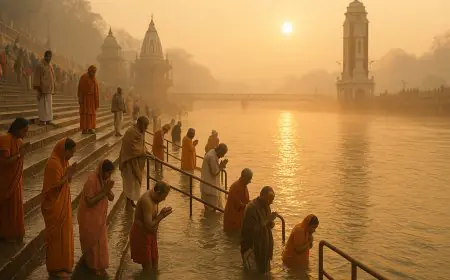
Long before sunrise, when mist still hugs the Ganga, the first notes of “Om Namah Shivaya” ripple through the air.
It begins with one priest, then spreads — pilgrims join in, sadhus echo back, and soon the entire ghat becomes a choir of faith.
At Har Ki Pauri, the focal point of the Kumbh, these chants are believed to purify not just water but the very vibration of the Earth.
During Ardh Kumbh 2027, this soundscape will be magnified beyond imagination — thousands of Akharas, ashrams, and mandalis (chanting groups) creating a living ocean of mantra energy.
Trending Guides Now
The Astrology Behind Ardh Kumbh 2027: Why These Dates Are Considered Highly Auspicious

Astrology of Faith: How Ardh Kumbh Mela 2027 Aligns with the Stars

The Secret Astronomical Timing Behind Ardh Kumbh Mela 2027

Where Faith Meets Festivity: The Cultural Side of Ardh Kumbh 2027

Ujjain Railway Station to Mahakaleshwar Temple Distance (2026 Guide)

Ujjain Simhastha 2028 Dates Announced: Full Shahi Snan & Event Timeline

Ujjain Simhastha Update: CM Mohan Yadav Reviews 2028 Works

Karkateshwar Mahadev: 22/84 Mahadev of Ujjain
The Ancient Science Behind the Mantras
Every mantra in Hinduism is not merely a prayer — it is a vibration, a formula for tuning consciousness.
In the Vedas, it is said that the universe itself was born from sound — the primordial “Om”.
When devotees chant mantras like “Om Namo Bhagavate Vasudevaya” or “Gayatri Mantra”, they are aligning their inner frequency with the cosmic rhythm of creation.
Modern researchers studying sound therapy often draw parallels between Vedic chanting and neural synchronization — the way rhythmic sound can calm the mind and balance emotions.
At the ghats of Haridwar, this becomes not science but living experience.
Mantras You’ll Hear at Every Ghat
-
“Om Namah Shivaya” – The eternal salutation to Lord Shiva, representing transformation and liberation.
-
“Har Har Gange” – The chant of devotion to Mother Ganga, invoking her cleansing power.
-
“Gayatri Mantra” – A universal prayer for enlightenment and purity.
-
“Om Namo Narayanaya” – A hymn for peace and surrender to the divine.

-
“Jai Ganga Mata Ki Jai” – A spontaneous chant of joy celebrating the river goddess.

Each ghat has its own rhythm — some echo with Aghori chants, others with bhajans, and some with tantric mantras chanted softly at midnight by yogis deep in meditation.
The Role of Akharas and Ashrams in Preserving Sacred Sound
During Ardh Kumbh 2027, Haridwar’s 13 Akharas will hold special mantra recitations led by their gurus.
From Juna Akhara’s deep Vedic chants to Niranjani Akhara’s musical bhajans, the diversity of sound becomes a living library of India’s spiritual heritage.
Each sound serves a purpose:
-
To purify the space.
-
To awaken inner awareness.
-
To connect the devotee to divine consciousness.
This is why saints say, “At Kumbh, even silence sings.”
Vibration and the Human Spirit
Standing beside the Ganga during the chanting of thousands, one feels the body vibrate — not metaphorically, but literally.
The sound of mantras synchronizes the heartbeats of pilgrims, uniting millions in one collective pulse.
When the Maha Aarti begins at dusk, the chants, bells, and conches merge into a single wave of energy.
It’s in this resonance that many experience what sages call ananda — divine bliss.
Mantras and the Five Elements
According to the Rigveda, every element of nature — earth, water, fire, air, and space — responds to mantra vibrations.
The Ganga, being the water element, absorbs and reflects this energy most strongly.
That’s why chanting at her banks is said to be a thousand times more powerful than elsewhere.
During Ardh Kumbh 2027, the mantras echo across ghats, temples, and tents — merging with the natural elements to create what yogis call “Shabda Brahman” — the Divine Sound of the Universe.
The Evolution of Chanting at Kumbh
From the Naga Sadhus who chant while smeared in ash to modern devotees carrying small speakers broadcasting bhajans, chanting has evolved — but its essence remains unchanged.
Even as loudspeakers and recordings assist the priests, the core of the ritual is the human voice — unamplified, raw, and sacred.
The 2027 festival will also witness international chanting collaborations, where monks from across the world participate in Ganga Gayatri Yajnas, bridging global faiths through sound.
Healing Through Sound — The Unseen Gift of Kumbh
Many visitors to previous Kumbhs have reported profound peace after spending time near the chanting ghats.
Psychologists attribute this to collective entrainment, while saints call it grace.
In truth, it is both — the ancient realization that the universe heals through sound and silence working together.
During Ardh Kumbh 2027, Haridwar will become not just a spiritual city but a giant healing frequency, vibrating with compassion, unity, and divine rhythm.
Conclusion: When Words Become Worship
The magic of mantras lies not just in their sound but in the intention behind them.
Every “Om” uttered at Haridwar carries the echo of ages — of rishis, yogis, and pilgrims who walked before us.
At Ardh Kumbh 2027, as you stand by the river and close your eyes, you’ll feel it — the soundless sound within you, the heartbeat of creation itself.
In that moment, you won’t just be hearing mantras —
you’ll be becoming one.
Frequently Asked Questions